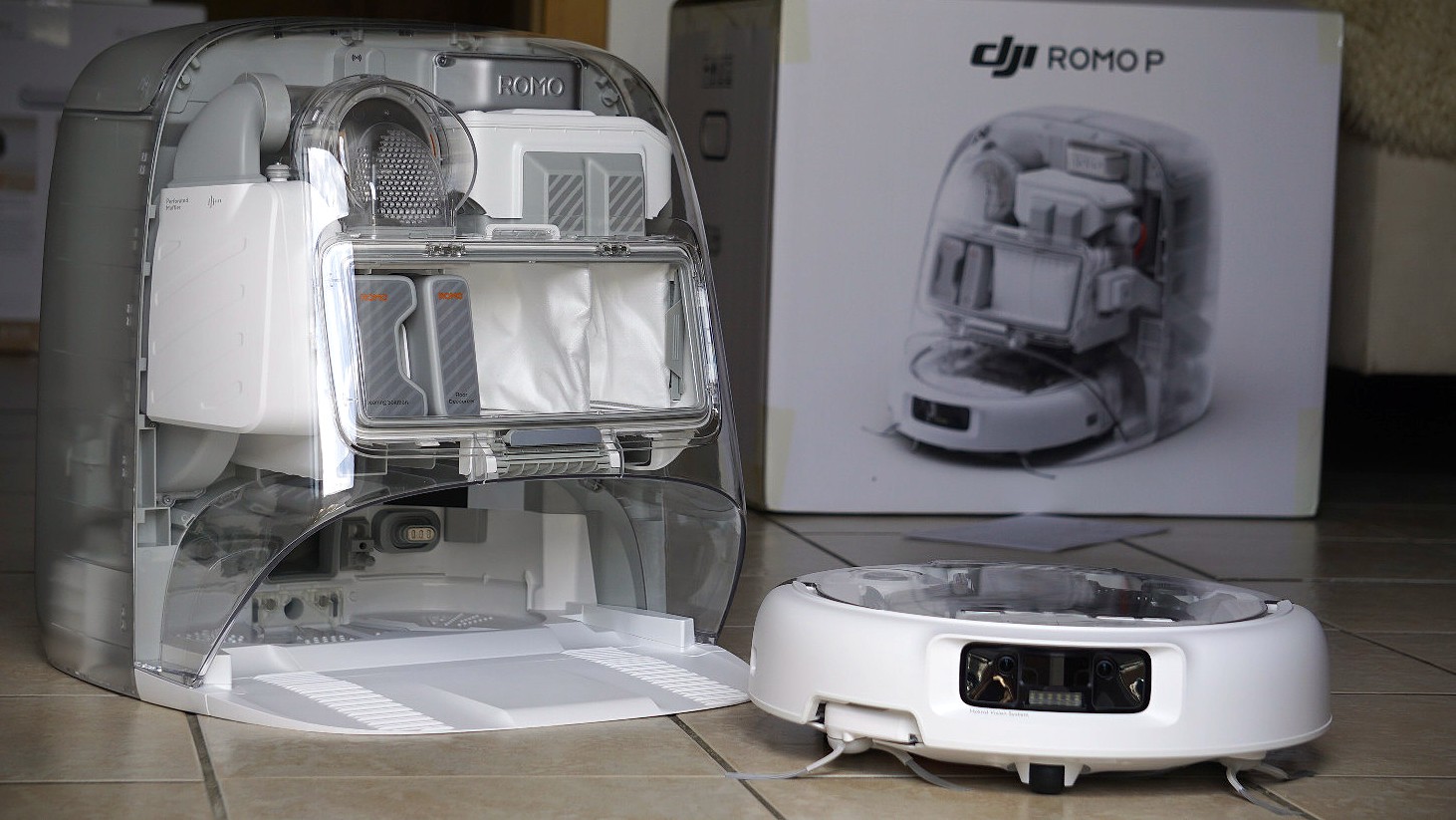
With its transparent design, the DJI ROMO P already stands out at first glance as a robot vacuum. In our review, we checked how well vacuuming, mopping, and obstacle detection work in practice and where there is still room for improvement. Stay tuned.
From the SKY to the GROUND – DJI is on a roll
With the DJI ROMO P, one thing has clearly succeeded – attracting attention in the market. Thanks to its unprecedented design, one thing is now clear – DJI is ready to take on the robot vacuum market. We were able to find out how well that already works in a multi-week test. The obvious question was: "Can the drone specialist design a top-tier robot vacuum on its very first attempt?"
On paper, the answer looks promising. The ROMO P combines 25,000 Pa suction power with precise obstacle detection, rotating mop pads, and a highly automated cleaning station. Of course, the transparent design is what stands out most, deliberately making its technology visible instead of hiding it. But impressive specs do not automatically mean spotless floors. We checked how well the ROMO P handles real living spaces, how effectively it removes dirt and hair on different surfaces, and whether its high price is actually justified.
[toc]
Design and build quality
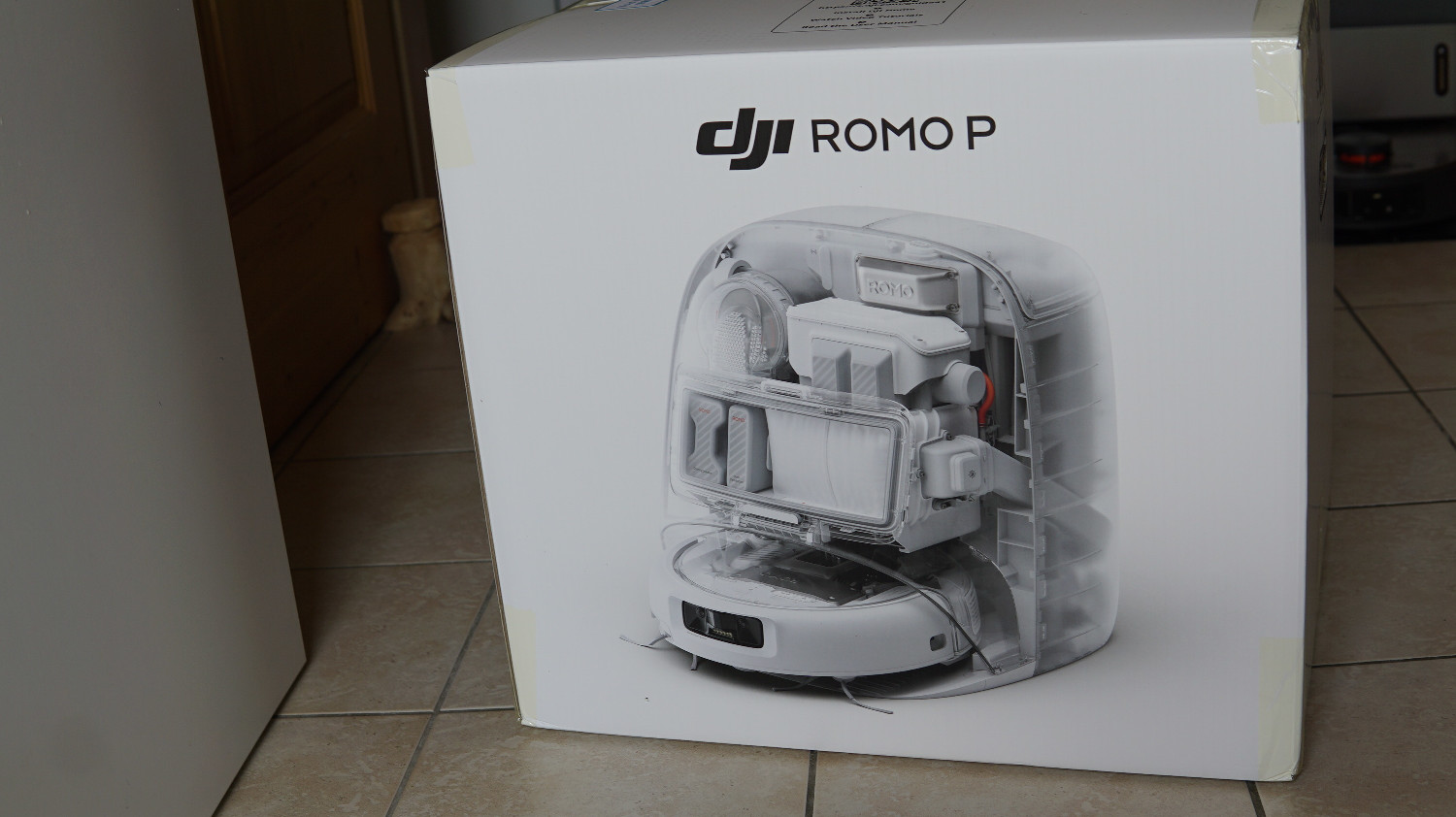
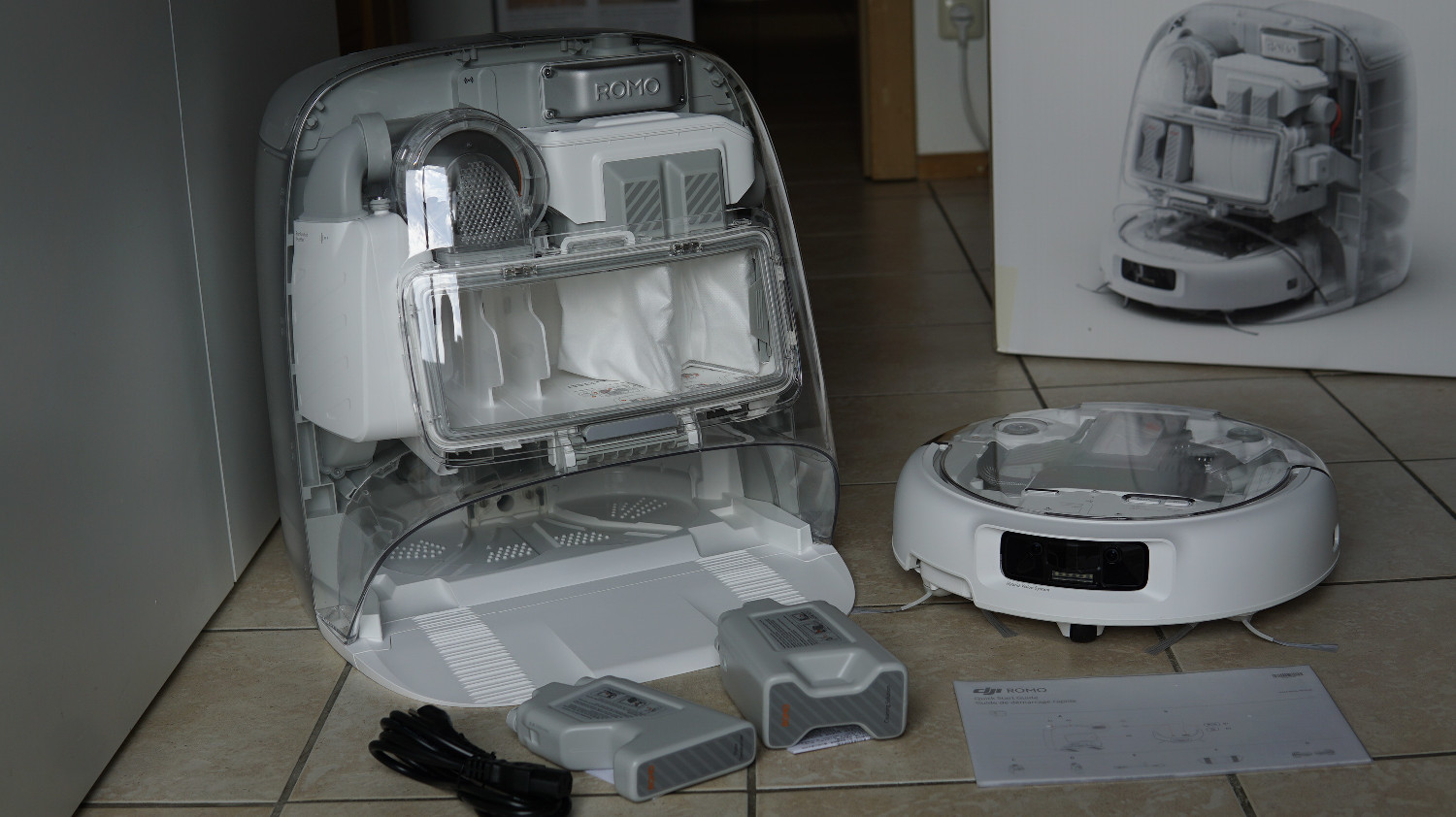
As soon as you unbox it, one thing becomes immediately clear: the DJI ROMO P does not even try to pretend to be an inconspicuous household helper. The robot and station feature a fully transparent housing.
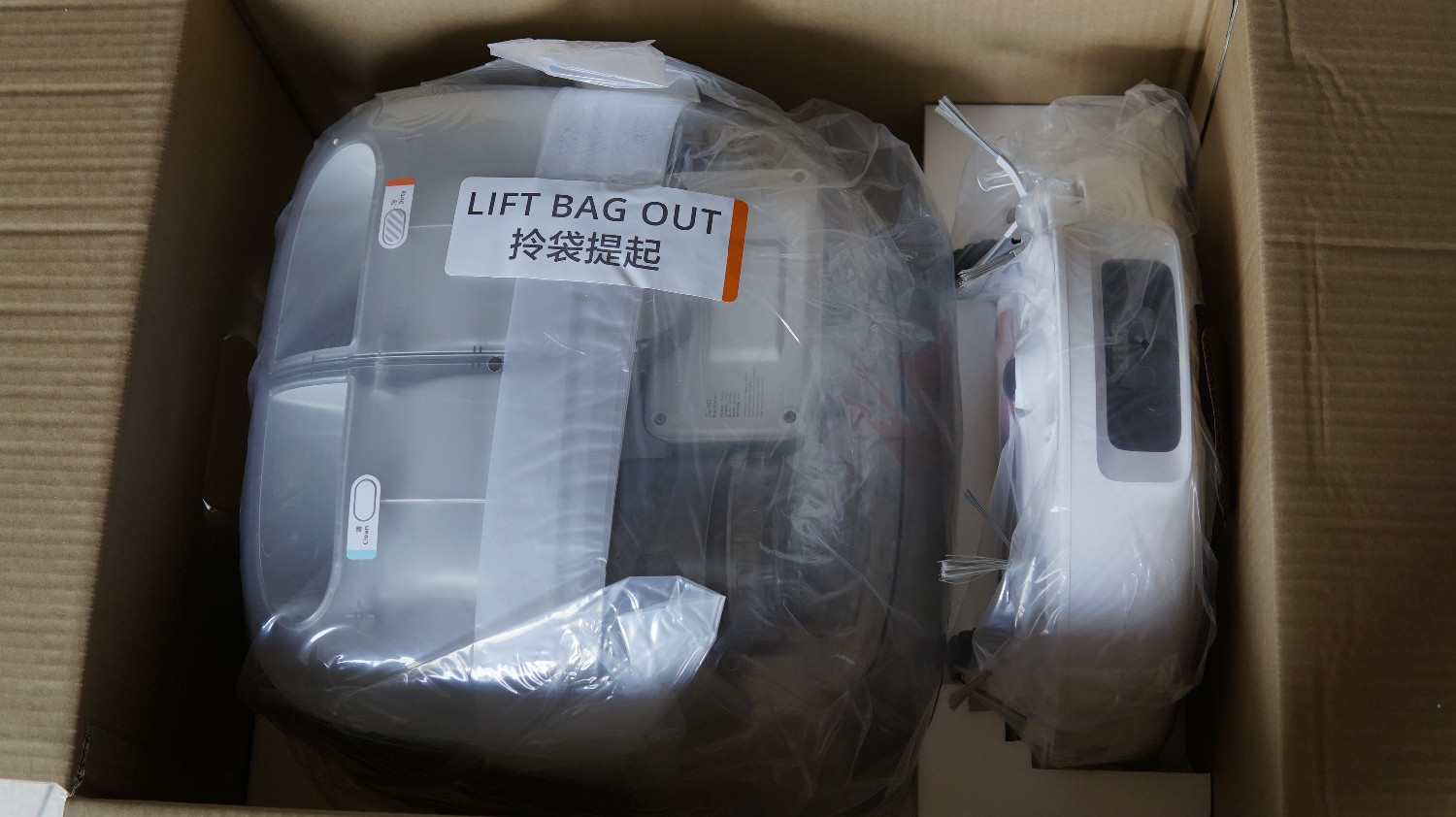
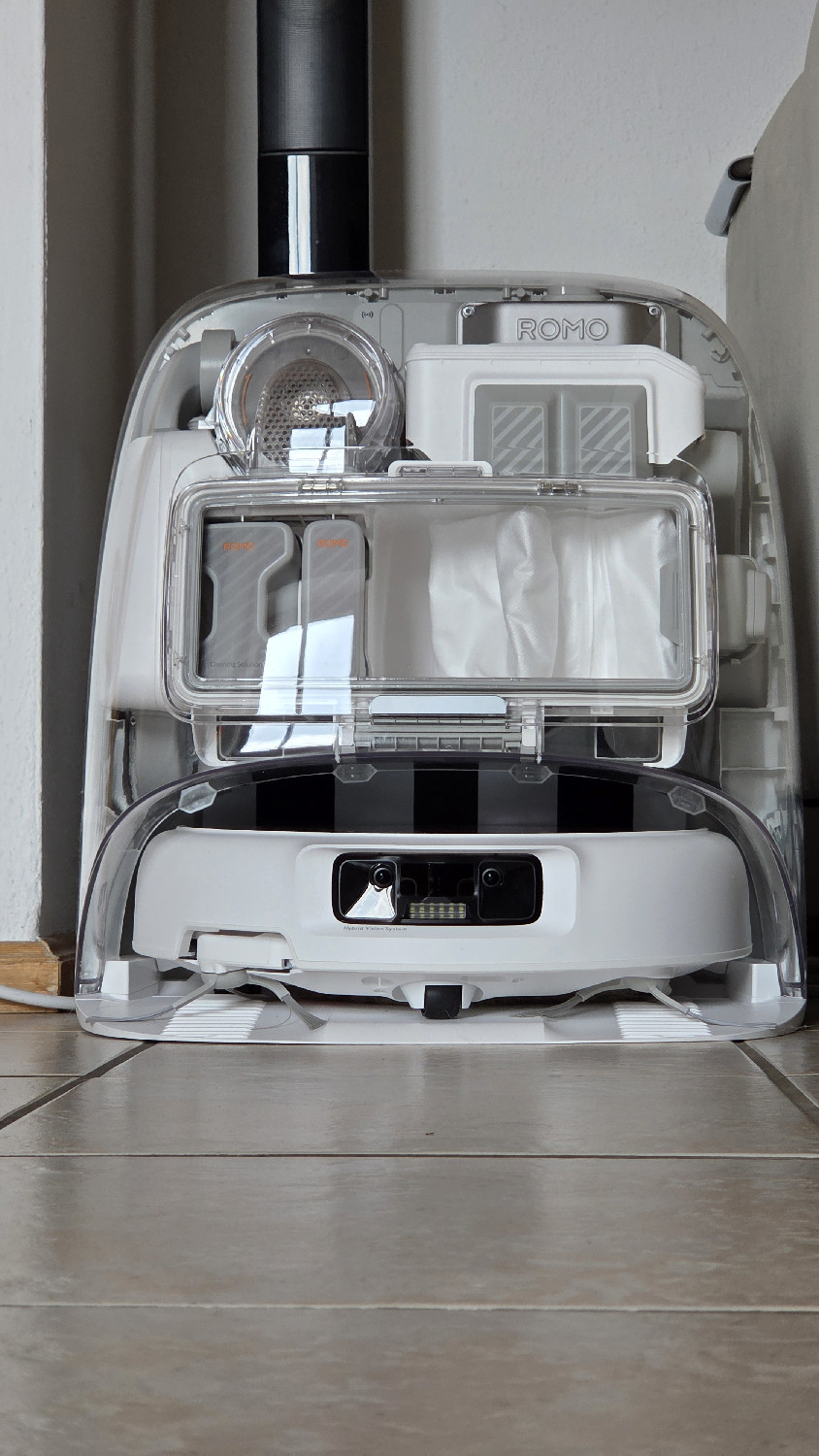
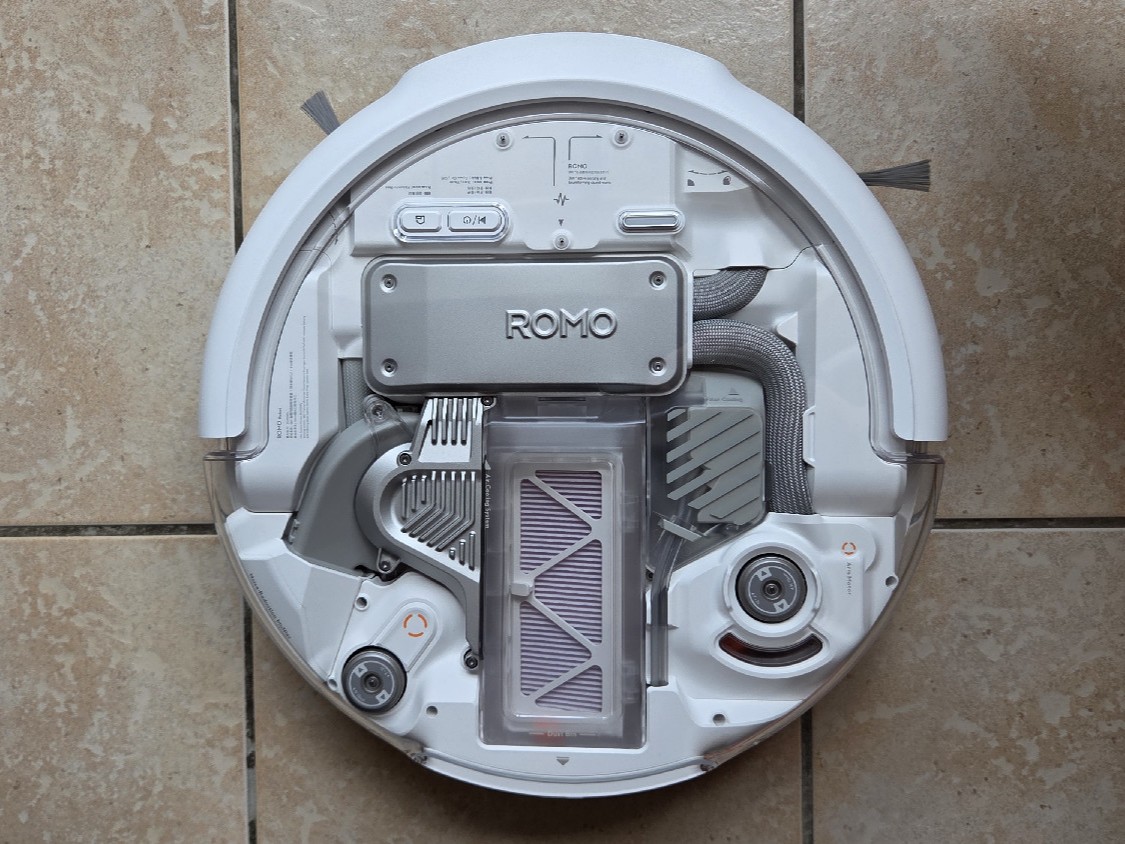
In everyday use, this design has a very practical side effect. You can more quickly see where dirt is collecting and whether a container or filter needs attention. Especially with a vacuum and mop robot with an auto-empty station, that is not just a gimmick. It helps you keep maintenance better in view. Another advantage is the direct labeling in the housing, which reveals the functions of the buttons, as can be seen in the following images.
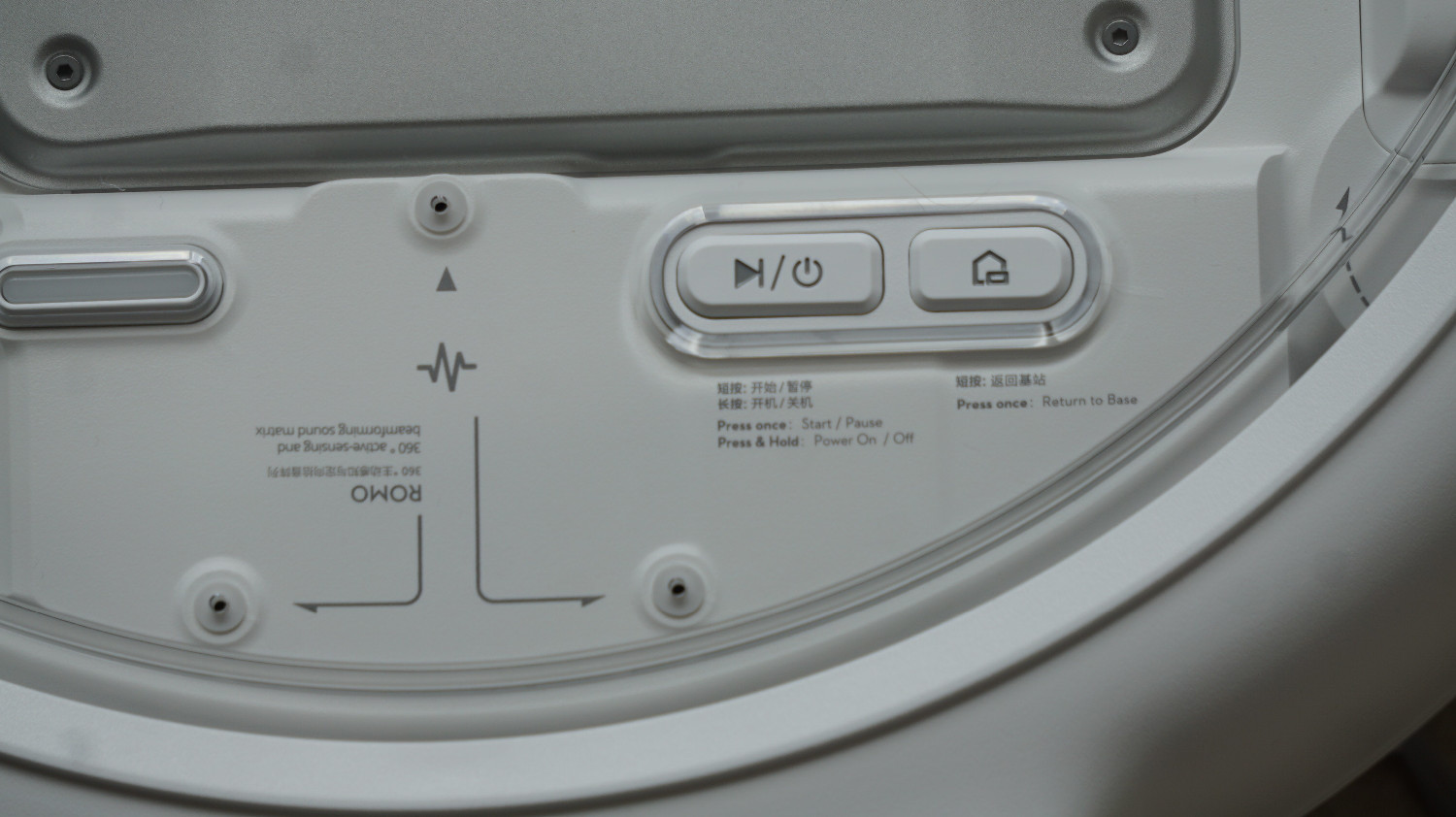

At the same time, the look is naturally a matter of taste. In a modern apartment, the unit can come across like a design object. Between rustic wood and country-house decor, however, it stands out more than a classic white or black robot. My wife initially found it very weird in the pictures and rather unsuitable for our apartment, but in person it looked so fancy that she ended up liking it, and we have kept using it.
The overall build quality leaves a convincing impression. Nothing rattles, nothing feels cheap, and the entire package matches the device’s technical ambitions. The fact that DJI also relies on navigation with binocular fisheye sensors and wide-angle solid-state LiDAR underlines the high-tech character not just on the spec sheet, but visibly as well. Fittingly, navigation in the test environments of other bloggers was rated very good, which matches our own observations. While that is not a direct build-quality metric, it does show that behind the striking shell there is also a seriously well-thought-out system.
There are still a few small blemishes, though. The station’s black power cable looks too dominant next to the transparent setup. That is no drama, but visually it does not feel completely thought through. It also remains to be seen how the transparent housing will look after months or years. I cannot yet seriously assess scratches, dust marks, or yellowing based on the current period of use. After three weeks of operation, however, it still looks absolutely great.
At 351 × 351 × 98 mm, the robot is somewhat flatter than many models with a classic LiDAR tower. But you should not expect miracles. The height of 9.8 cm helps under some furniture, but it does not automatically make the ROMO P a specialist for especially low sofas or sideboards. All in all, for me it remains a strongly built device with a distinctive look that deliberately polarizes instead of trying to blend in.
Navigation and obstacle detection
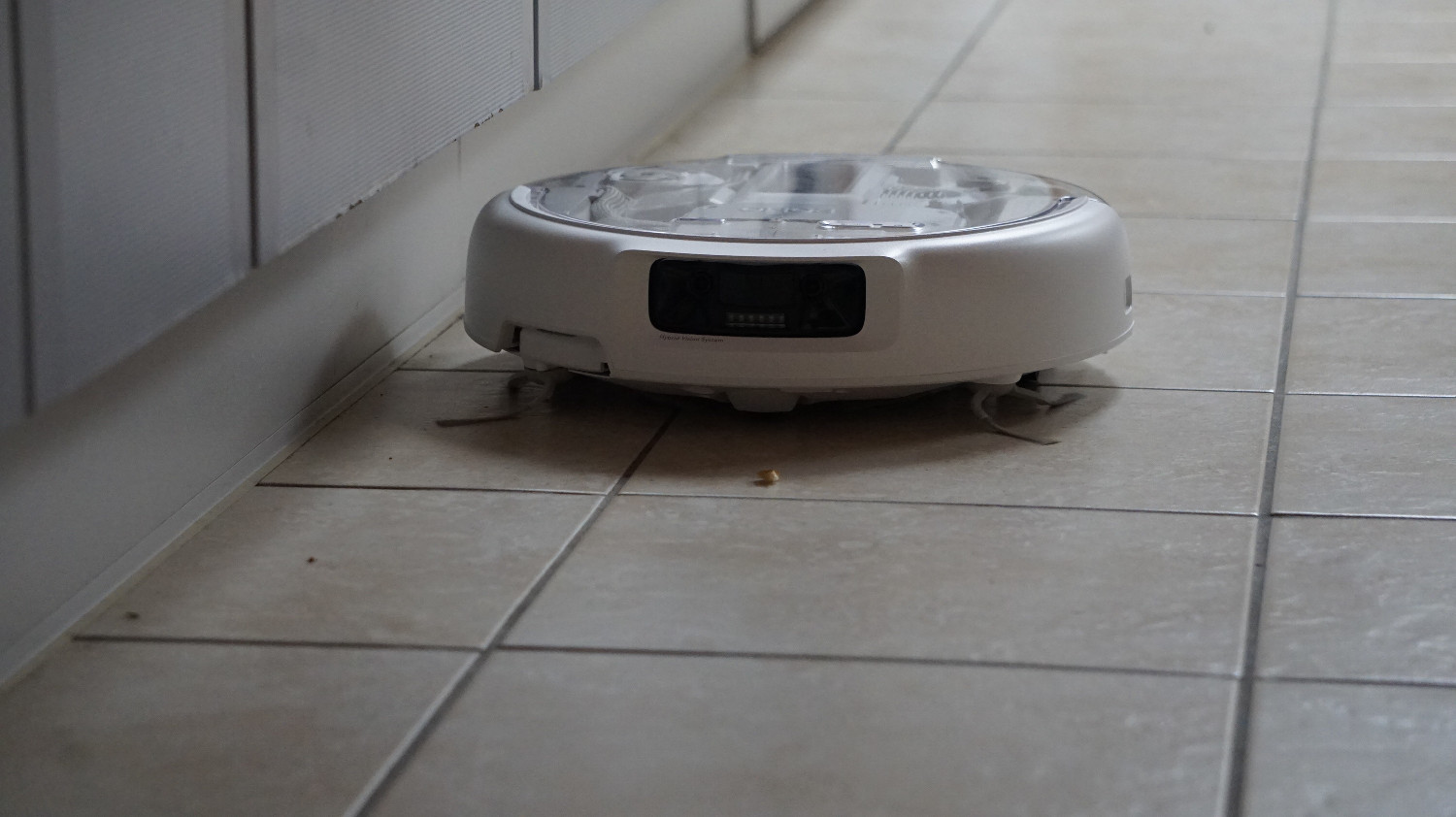
As mentioned earlier, the DJI ROMO P unquestionably shows its best side when it comes to navigation. In everyday use, the robot feels surprisingly composed. It does not drive nervous random circles through the living room, but moves in calm, logically structured paths and does so relatively quickly. The cleaning feels deliberate, not like a little technical chaos on wheels.
In practice, the fisheye sensors and the wide-angle LiDAR mainly achieve one thing: the ROMO P creates very accurate maps and moves safely through the home. Above all, it drives very close to furniture and walls without constantly bumping into them. That not only looks confident, but also improves edge cleaning.

The obstacle detection is particularly strong. In the test course, 100 percent of the objects were avoided. That is a figure that really matters in everyday life, because it means less prep work. Closely spaced chair legs, cantilever chairs, shoes, socks, Lego bricks, cables, and even simulated pet poop were detected very reliably. Cables in particular are something like the classic banana peel for many robots. Here, the ROMO P stays pleasingly cool. According to the technical data, it detects cables from 2 mm in diameter and obstacles from 15 mm in height under suitable conditions, which I was able to confirm in the test.
The LED lighting in darker areas is also practical. The camera-based detection gets extra support when things become tricky under furniture or in less well-lit corners. That helps ensure orientation does not already fail because of the shadow cast by a cabinet.

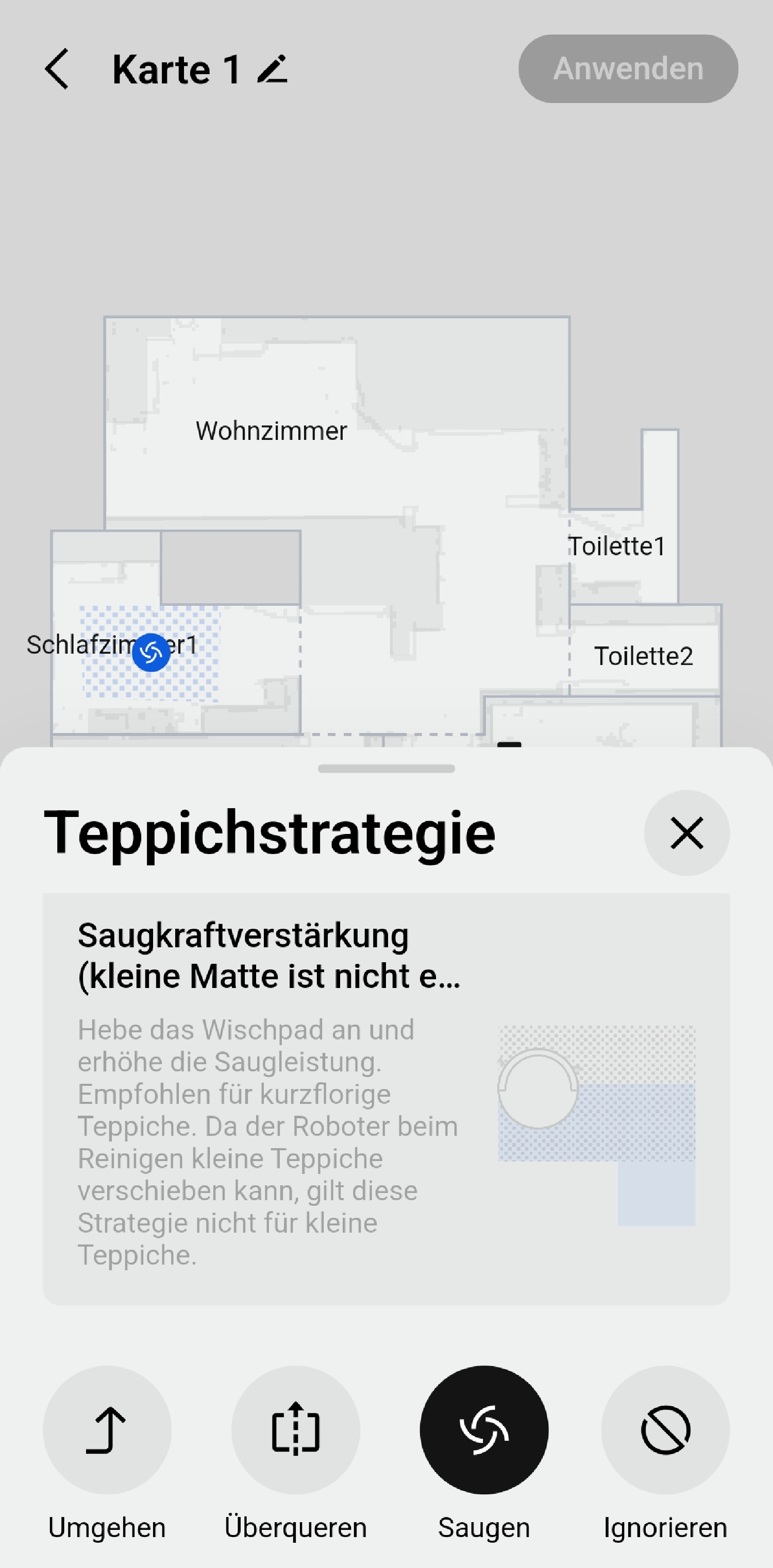
The system is not completely perfect, though. One known limitation showed up with carpet detection. One carpet was initially not fully recognized and was therefore partially skipped. After a renewed scan, cleaning then worked correctly. On top of that, there is a general issue with visual navigation: highly glossy or reflective surfaces can confuse such systems. That is not a problem exclusive to the ROMO P, but it belongs in an honest evaluation.
All in all, navigation is for me the greatest strength of the new DJI robot. Perhaps DJI was able to make good use of mapping data from its drones for the training.
Suction performance in the test
When it comes to the suction performance of the DJI ROMO P, you have to accept two truths at the same time. In everyday use, the robot does a mostly good job. It reliably picks up crumbs, dust, pet hair, rabbit litter, and even coarser dirt. Especially on hard floors, the result feels convincing. Its calm navigation also plays into its hands there, because it works through areas cleanly and systematically instead of frantically scraping past them somewhere.
It gets interesting when you look at the big number DJI advertises. 25,000 Pa sounds like brutal suction power. But that figure alone still does not say how well a robot actually picks up fine dust under standardized conditions. That is where the picture becomes a bit more sober. In CHIP’s reproducible lab test, the dust pickup on the lowest setting was 31.1 percent and 61.2 percent on the highest setting. Maximum suction performance was rated 3.1. That is not bad, but it is also not the kind of dominance you might expect after such an impressive Pascal figure. In everyday use in our apartment with 80% hard flooring and two carpets, however, I had nothing to complain about. No crumbs were left on the floor, and the carpets were well vacuumed after every run. In the torture test, the scattered crumbs were picked up almost completely. That fits with the fact that the robot also handles hair-like debris well. In the test, it even collected 10 out of 10 clumps of dog hair on high-pile carpet. So my conclusion is clear – complete satisfaction in everyday use.
Carpets are reliably detected automatically and the mop pads are lifted, which is sufficient for short- and medium-pile carpets, but does not quite work for high-pile carpets. Compared with the robot vacuum elite, the ROMO lacks one feature here – leaving the mop pads in the station in order to avoid dampening carpets altogether. If you have a lot of carpets of this kind, you may want to look at top models from Dreame or Mova. And one more note: the mopping discs (not the mop cloths) are permanently installed and cannot be removed.
In practical terms, that means this: the ROMO P is neither a poser nor the ultimate dust monster. It works very well with everyday dirt. Especially coarser particles and typical household debris are handled reliably. When it comes to pure, strictly standardized fine-dust pickup, however, it lands more in the average range. That is an important distinction, because lab values and everyday life at home are simply not the same. And the latter is what really matters… After comparing the data, my impression is therefore quite clear: in everyday use, the ROMO P vacuums better than the cautious lab values suggest.
Hair and pet hair
When it comes to hair, the DJI ROMO P shows one of those qualities that are truly worth gold in everyday life: DJI relies on two counter-rotating main brushes that reduce hair tangles. Anyone who has ever had to regularly pull long hair out of a tightly wrapped brush roll knows that every avoided tangle is a small everyday victory.
What is interesting is that DJI includes two different brushes. There is a pure rubber brush, aimed primarily at hair pickup and low-maintenance operation. On top of that, there is a hybrid brush made of rubber and bristles, which is supposed to work a little deeper on carpet. That is a sensible solution because it allows cleaning to be better adapted to your own living setup. In an apartment with lots of fur, hair, and smooth floors, I would see the rubber brush as particularly suitable. Anyone with more carpet benefits from the second attachment.
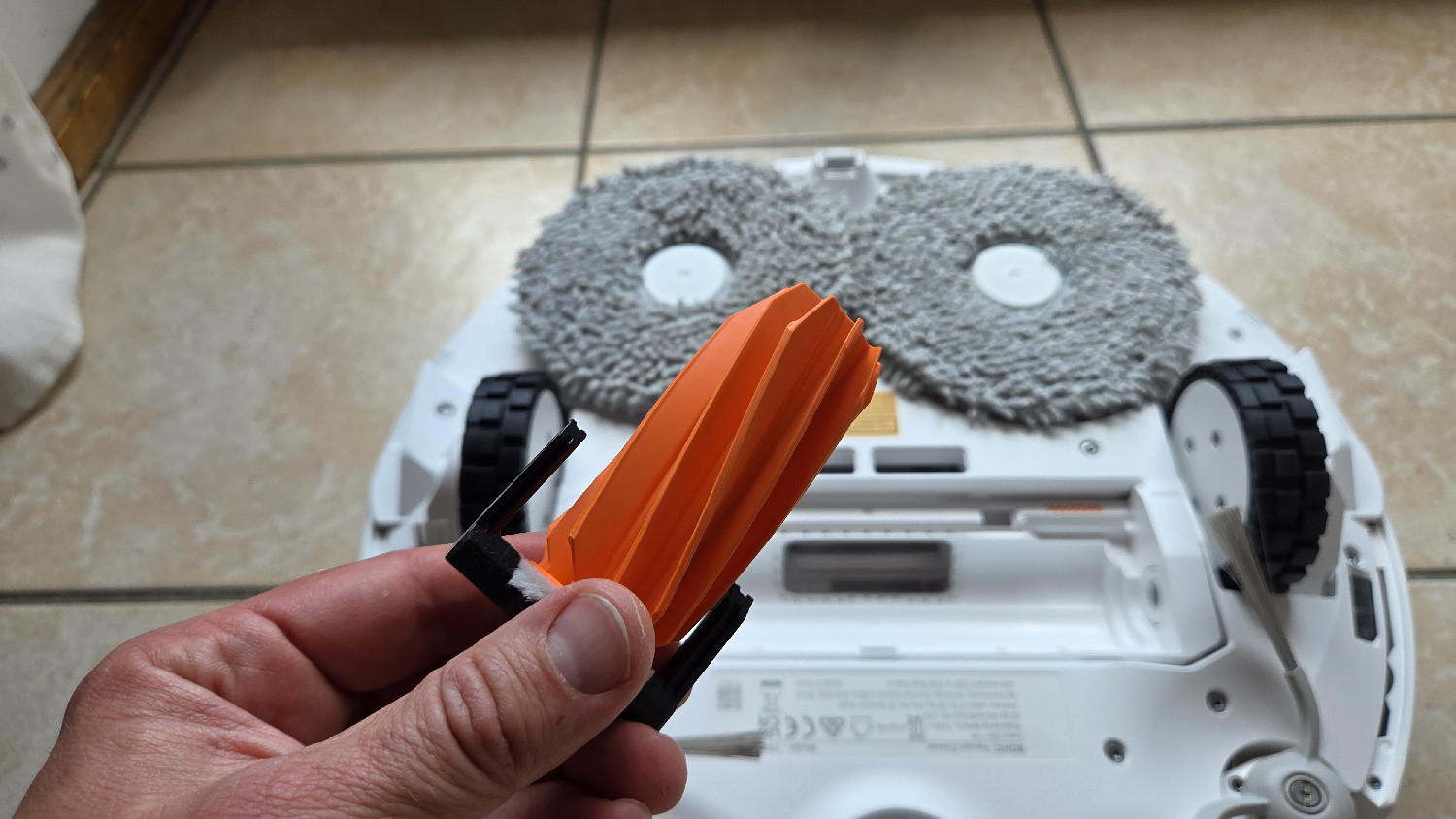
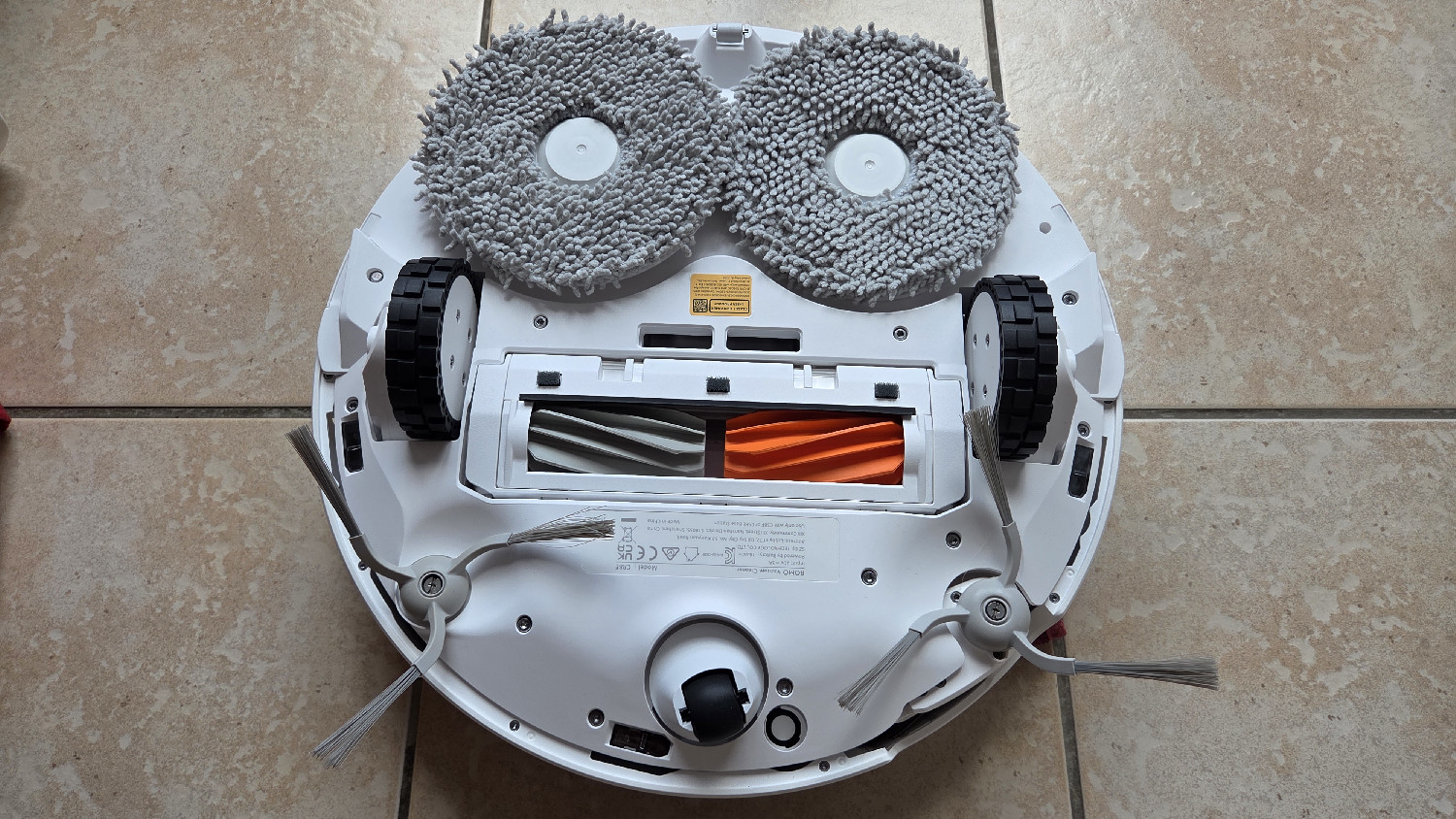
I already mentioned the good pickup of hair clumps above. Even more telling is the hard test with long hair: in a test with hair up to 25 cm long, only two hairs remained stuck on the roller in the end. That is remarkably little for this discipline.
In practical terms, that means the ROMO P is especially well suited for households with long hair or pets, because the brush concept and cleaning performance work together sensibly here. Hair is picked up reliably, and the brushes remain comparatively free. That saves maintenance time. All in all, the ROMO P is therefore one of the pleasantly uncomplicated models for me.
Corner and edge cleaning
When cleaning along walls, the DJI ROMO P demonstrates quite impressively what its extendable components can do. The side brush extends outward when needed and pulls crumbs out even from areas that many round robot vacuums like to ignore. The right mop pad also extends to the side and therefore wipes strikingly close along baseboards and furniture.
In the test, there was sometimes only a gap of about one millimeter between the robot and the wall. That is not just impressive on paper. Especially in the kitchen or dining area, dirt tends to collect right where the floor and wall meet. The ROMO P works through these areas very consistently and leaves hardly any visible residue along straight edges.
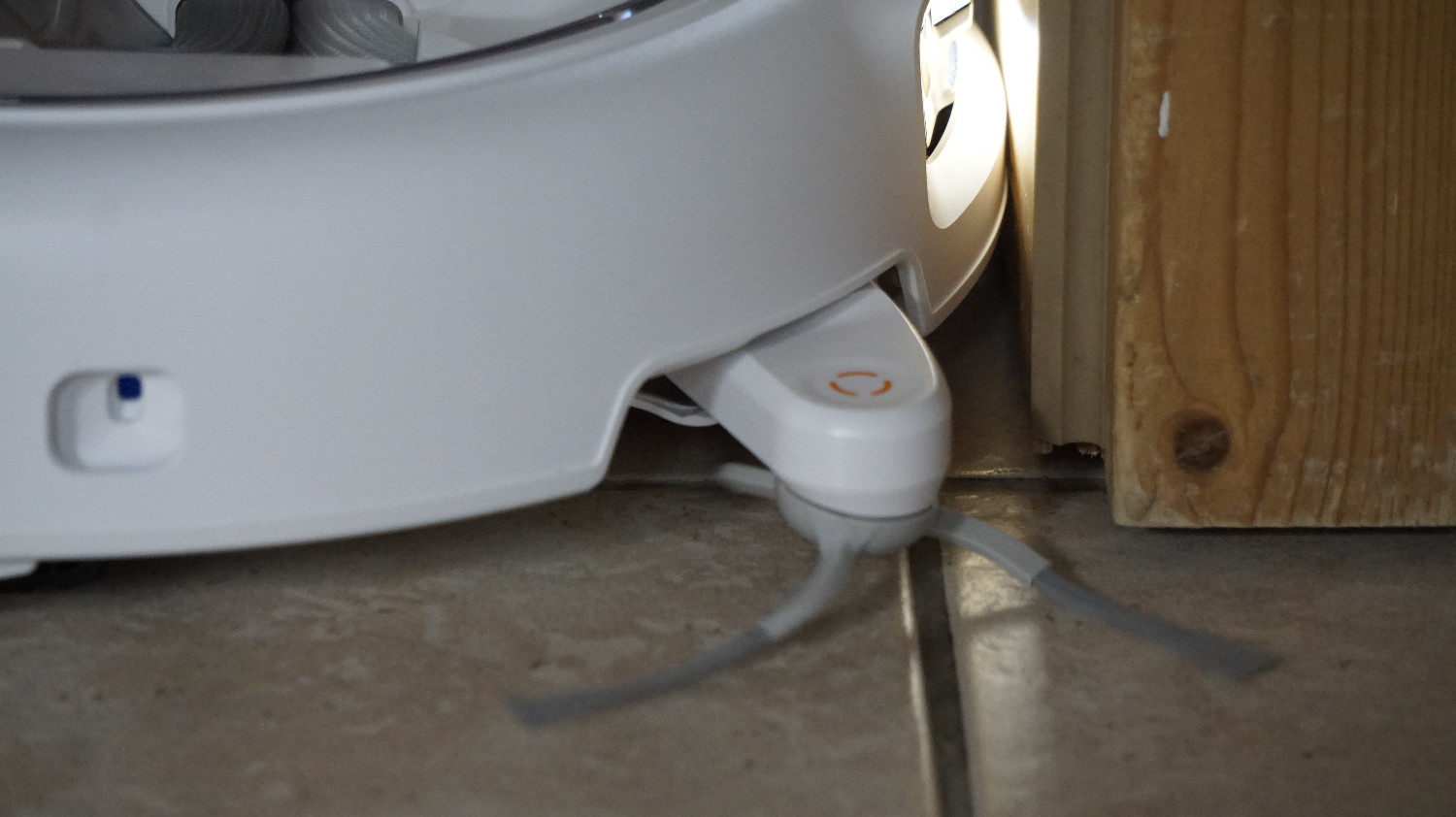
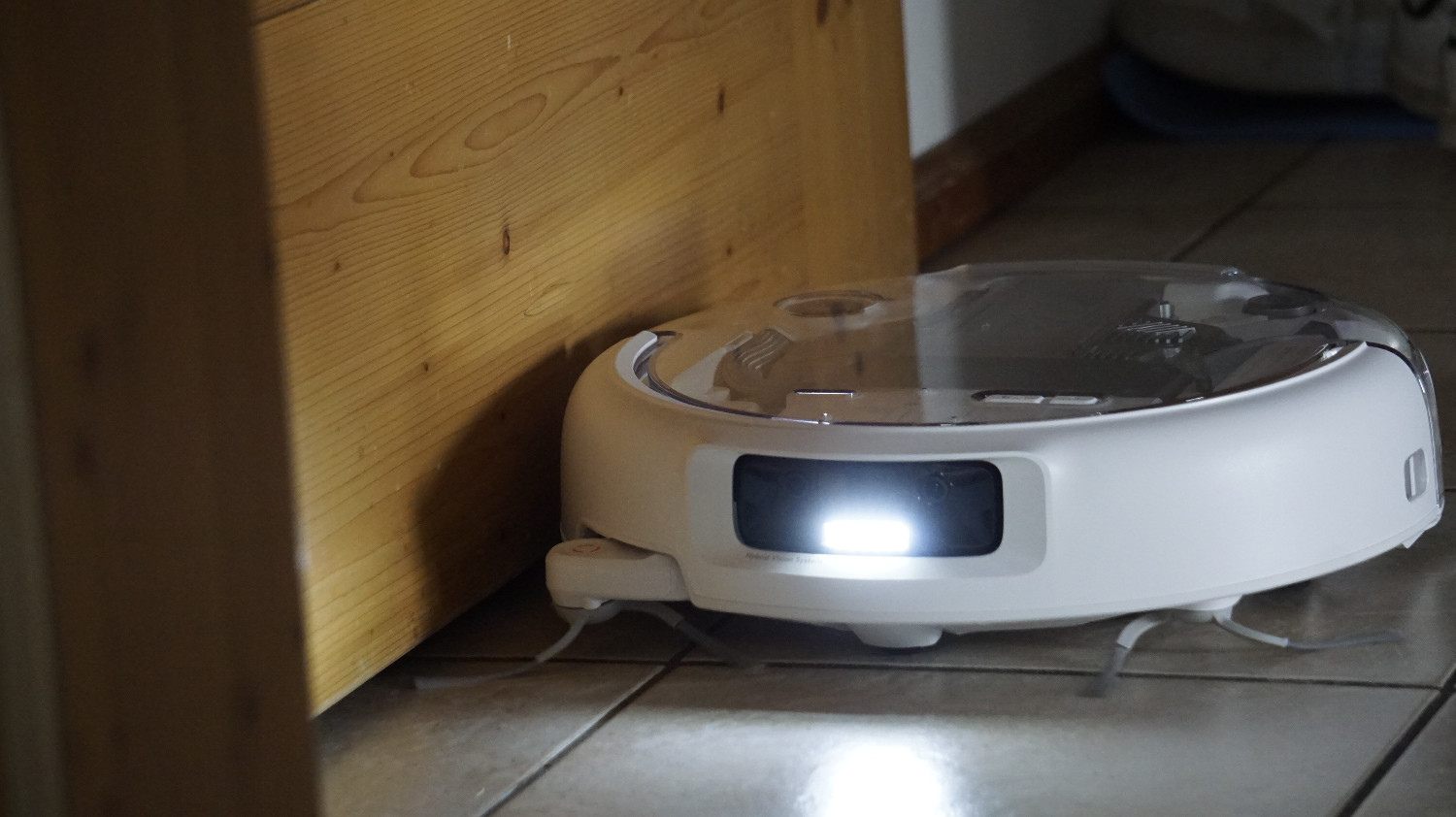
Our corner test was also very convincing. All ten scattered test particles were picked up. At first, that sounds like a perfect performance. But the result in corners is not entirely flawless. The round brushes and mop pads cannot completely compensate for the round shape. However, this problem affects almost all robot vacuums on the market.
In practice, that means this: along straight walls, the ROMO P is one of the strongest devices we have experienced so far. Open corners are cleaned thoroughly. But if a crumb has made itself comfortable in the deepest angle between two walls, it has nothing to fear – hopefully future generations will sort that out (strangely enough, I suddenly felt a brief moment of sympathy for the crumb 😅).
All in all, corner and edge cleaning is a clear strength of the DJI ROMO P. It is not perfect for design-related reasons, but in everyday use that matters noticeably less than it does with many other round robot vacuums.
Mopping performance
For mopping, the DJI ROMO P relies on the proven two rotating pads that glide across the floor with light pressure. The system has advantages and disadvantages compared with robot vacuums with a roller. Personally, I prefer it over a mop roller on slightly uneven tiles with somewhat wider grout lines, especially because of the deeper cleaning thanks to the longer fibers.
As you can see on the floor, the water distribution is even and can be adjusted to suit the floor type. That means it leaves neither a dry trail nor turns the living room floor into a puddle.
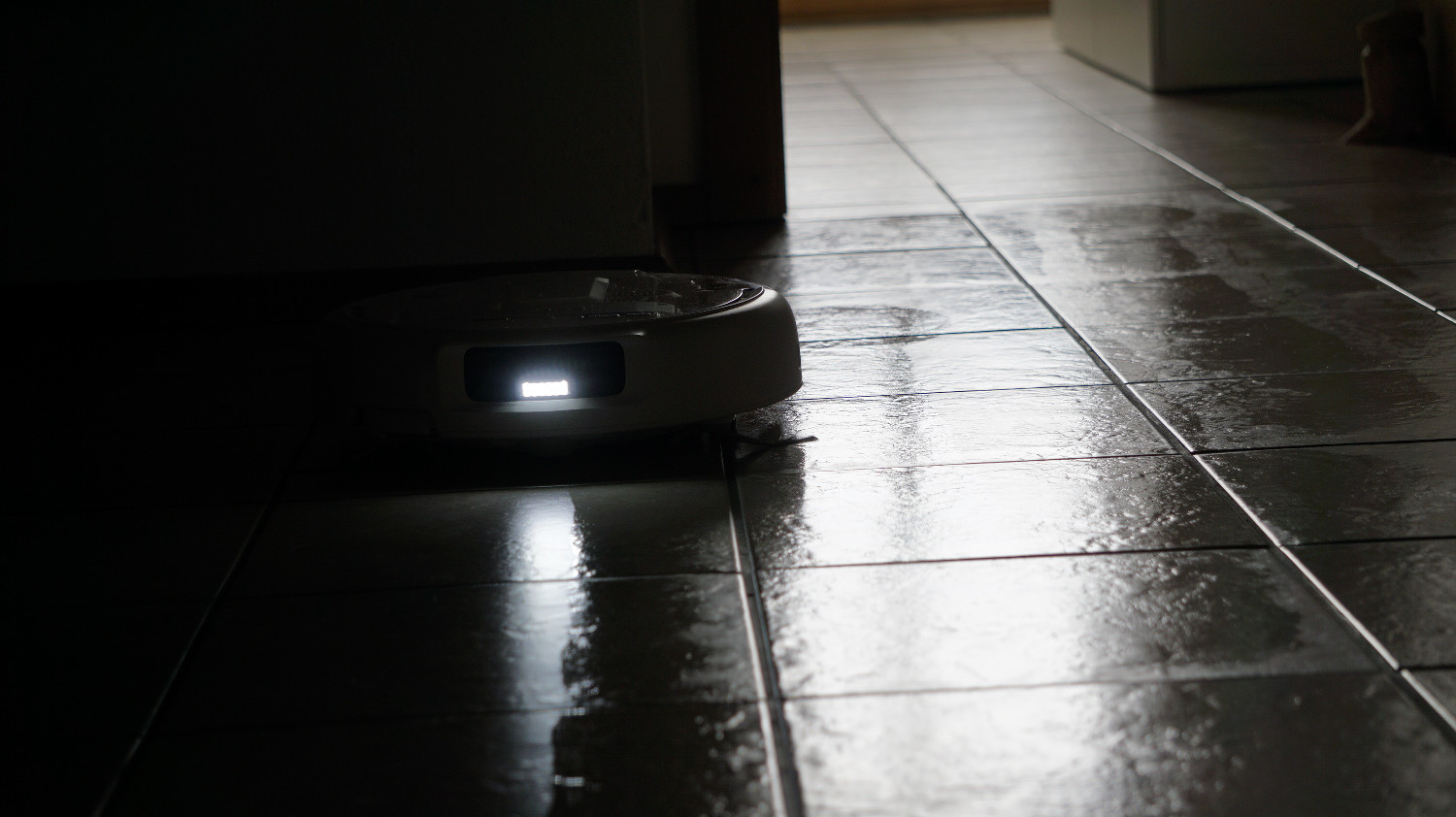
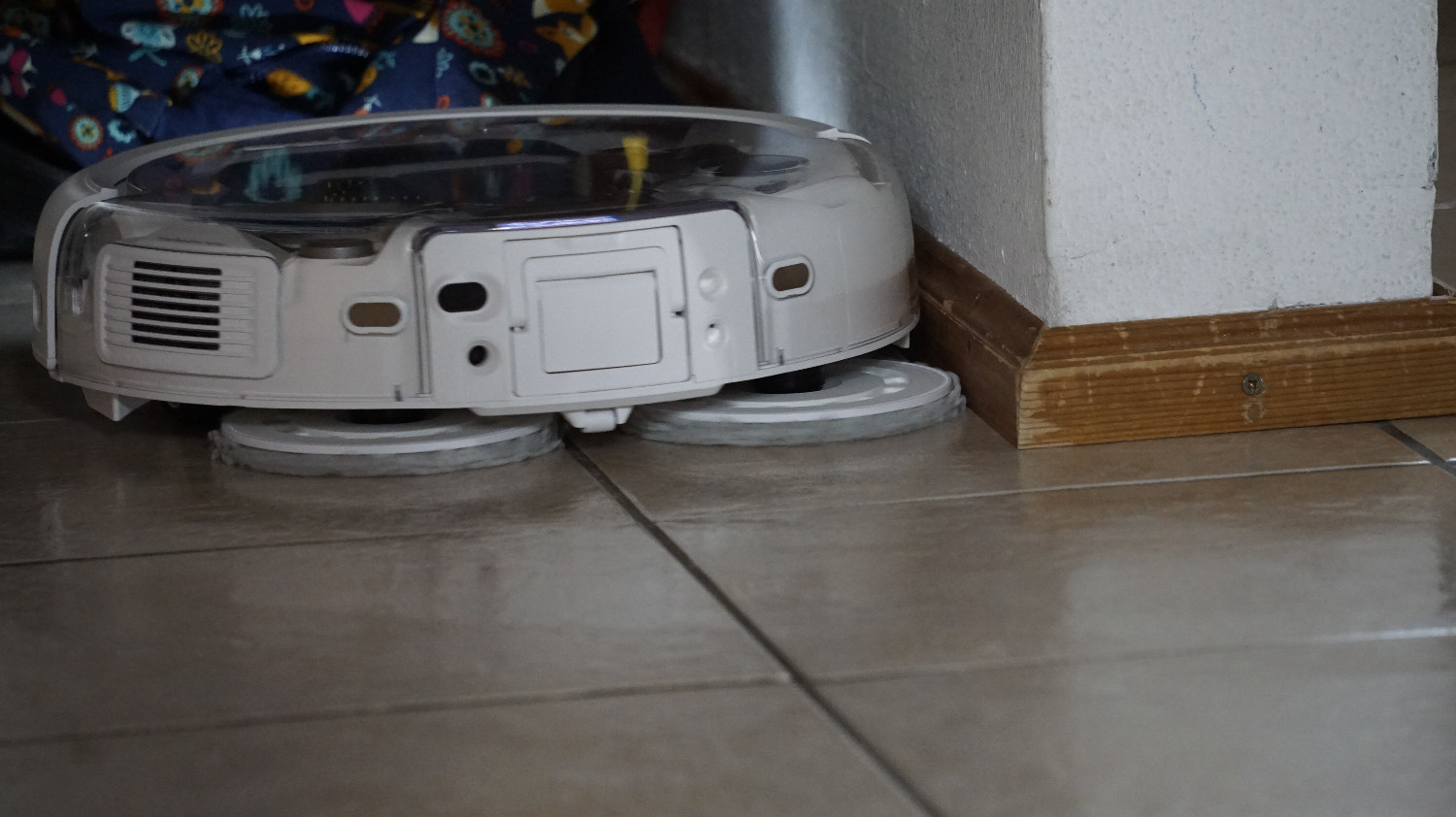
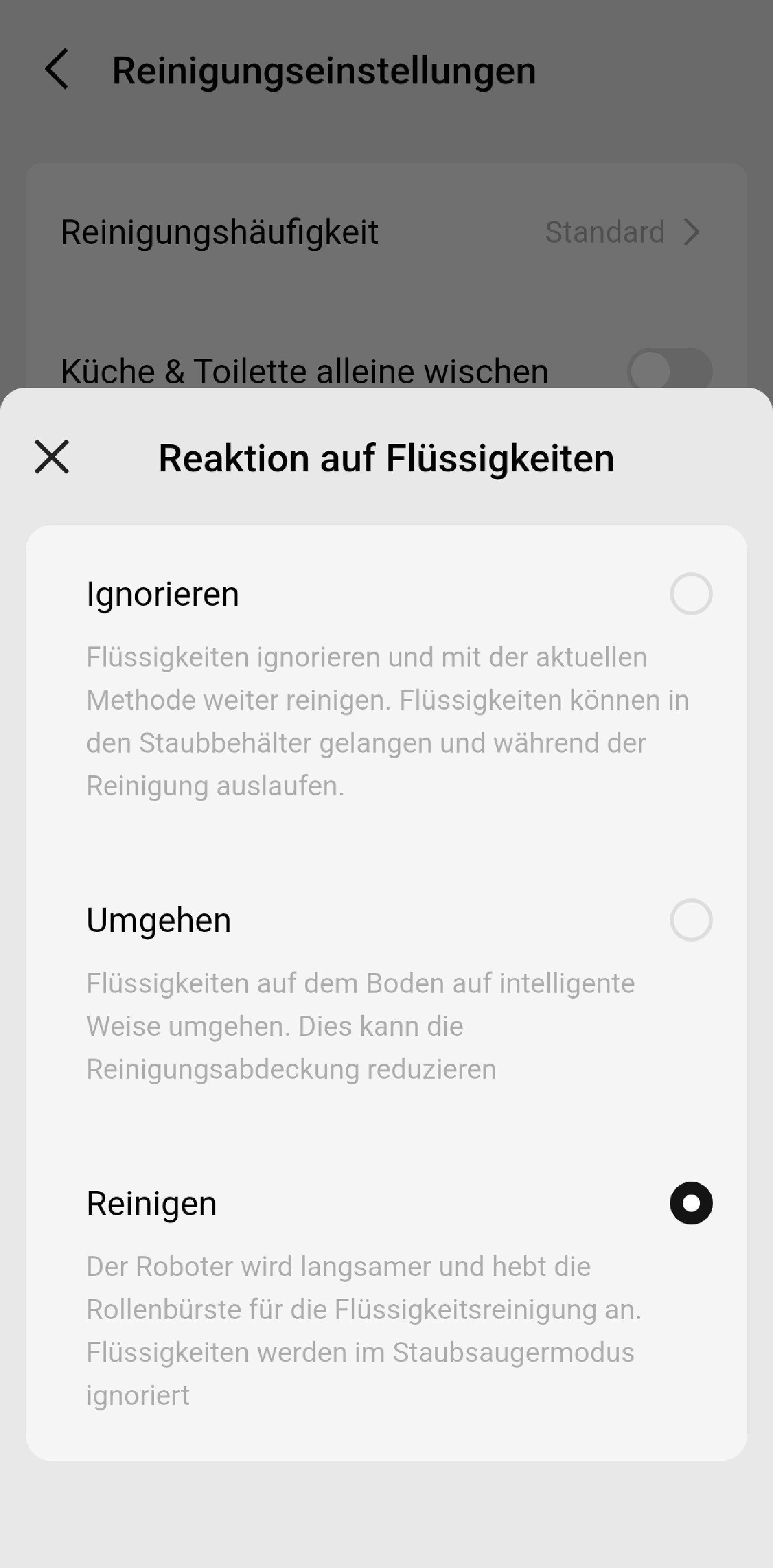
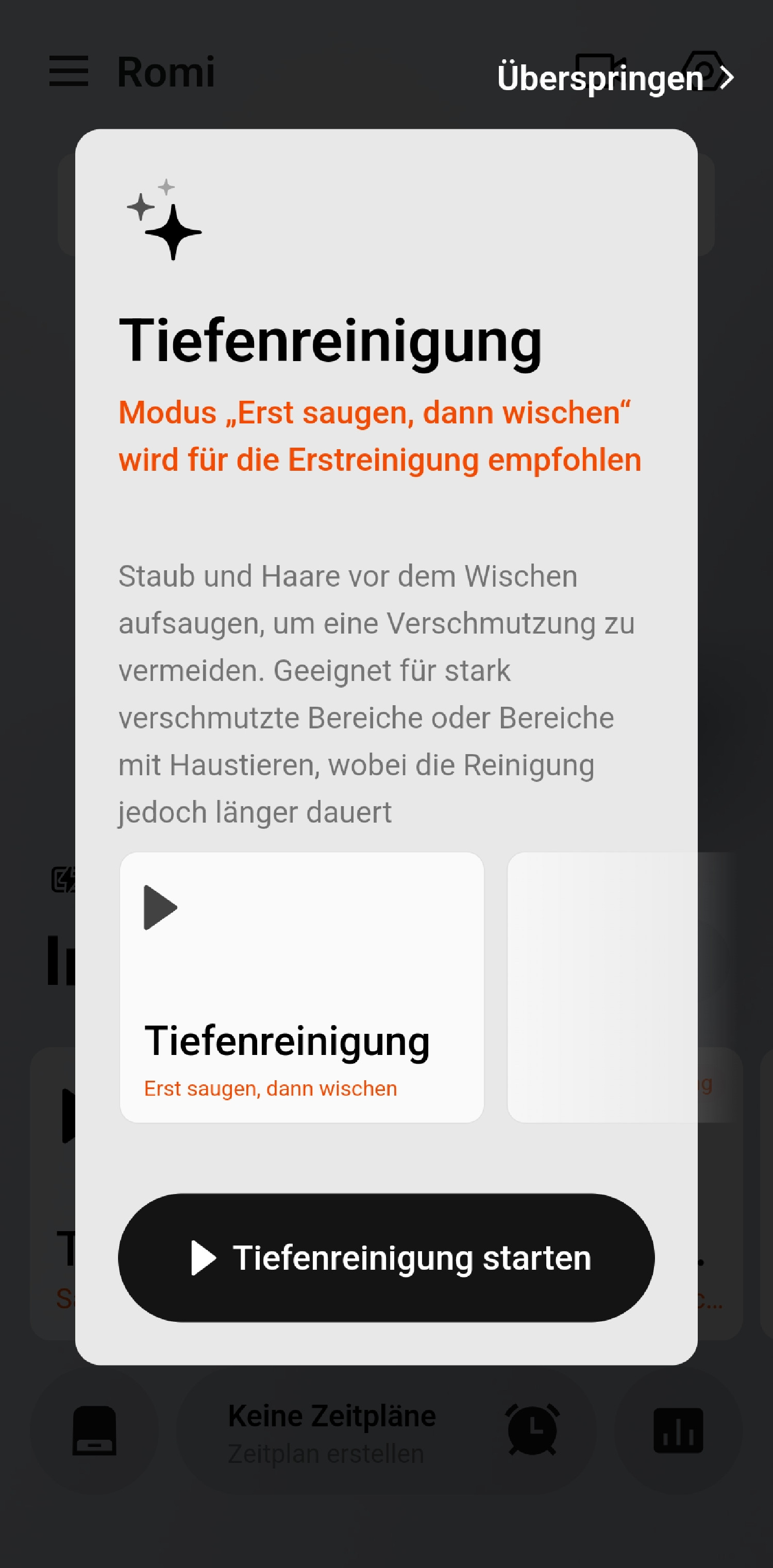
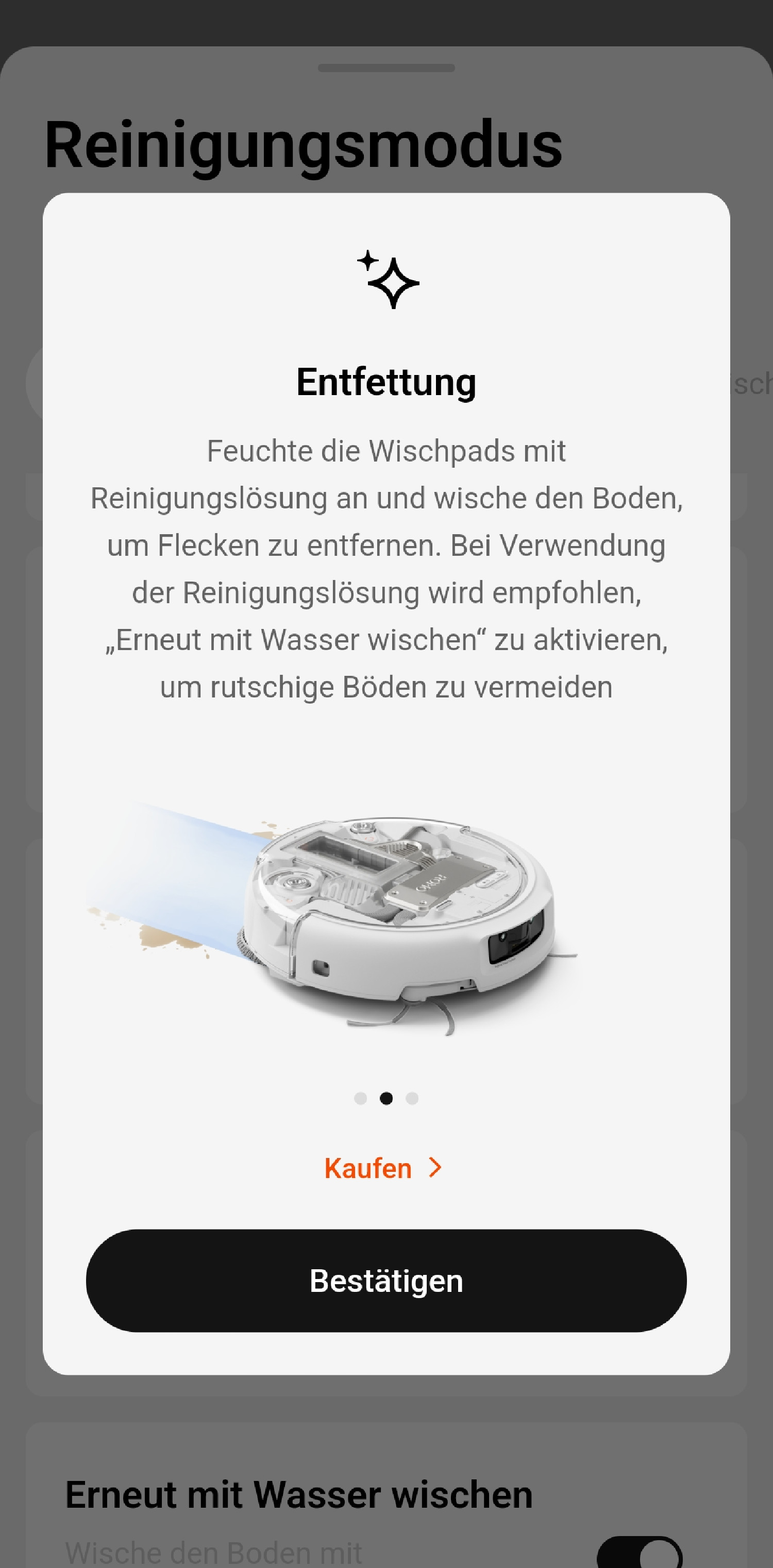
With normal everyday dirt, the ROMO P does a good job. Light stains and fresh splashes mostly disappear without much argument. In the test, I can give the mopping performance a good rating. Dried coffee and espresso stains were largely removed. However, slight residues sometimes remained visible. It helps to choose the app mode in which it first mops with cleaning agent and then goes over the floor again afterward with water. The result was convincing even after several days without mopping.
With stubborn stains, like those that can be found in abundance under our daughter’s baby chair, the robot needs several attempts. In the hard test, dried coffee and ketchup were only fully removed after four passes. On the first pass, heavier dirt was initially spread around in some cases. Unfortunately, that is typical behavior for rotating mop pads, but as mentioned, it does resolve itself with repeated mopping…
Modern mop rollers often have the advantage here. They generate more mechanical pressure and continuously pick up some of the loosened dirt, sometimes with suction support. The ROMO P, on the other hand, needs two or three runs.
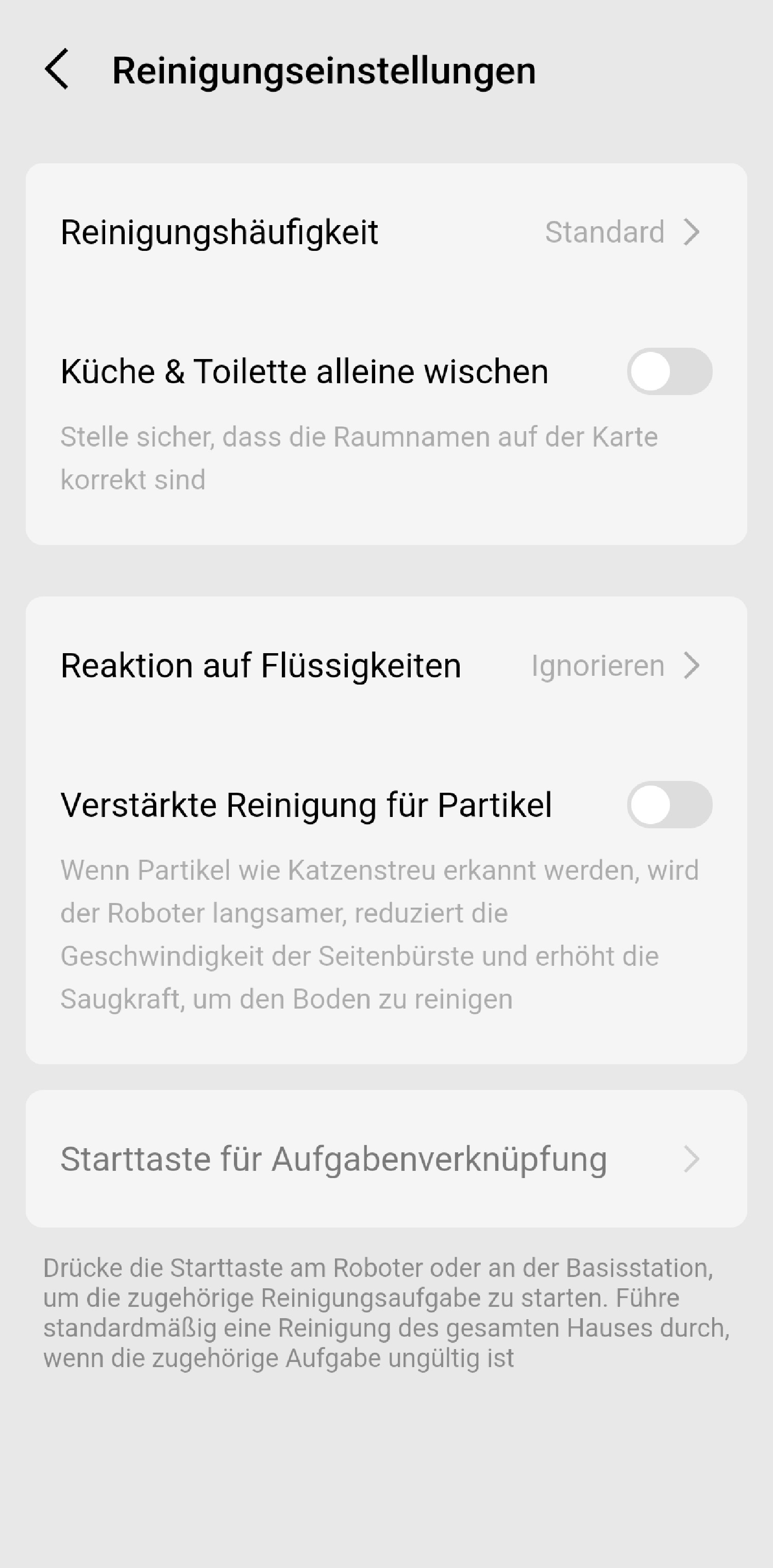
Its reaction to heavy or liquid dirt is clever. The robot can lift the main brush so that liquid is not picked up by the roller and then spread through the room. If the mop pads become too dirty, it returns to the station automatically. There, the pads are cleaned before it resumes work at the point where it was interrupted.
All in all, the mopping function is very well suited for daily floor care. Dust films, light stains, and fresh dirt disappear reliably. However, when it comes to heavily dried residues, the ROMO P is not among the absolute top performers. Here, several passes are needed or, in the end, perhaps a wet vacuum cleaner or the good old mop is required.
Cleaning and auto-empty station
The base station of the DJI ROMO P handles almost everything that comes after the actual floor cleaning. It empties the robot’s 260-milliliter dustbin and refills its water tank. It also washes the two mop pads and then dries them with warm air. In everyday use, this usually reduces the work to refilling fresh water and emptying the dirty water tank.
With four liters of fresh water and 3.2 liters of capacity for dirty water, the containers are generously sized. Dust ends up in a 2.4-liter bag. But even this premium station does not work entirely without manual effort. Water tanks and dust bags still need to be checked regularly. Wear parts do not replace themselves either. The app provides helpful reminders for this.
The self-cleaning is particularly thorough. High-pressure water jets rinse the station tray and loosen hair and dirt. The residues are then sucked through a large opening into the dirty water tank. In our test, the washing area therefore remained pleasingly clean. That is a real advantage over stations where, after a few weeks, a small biological research station develops in the base area.

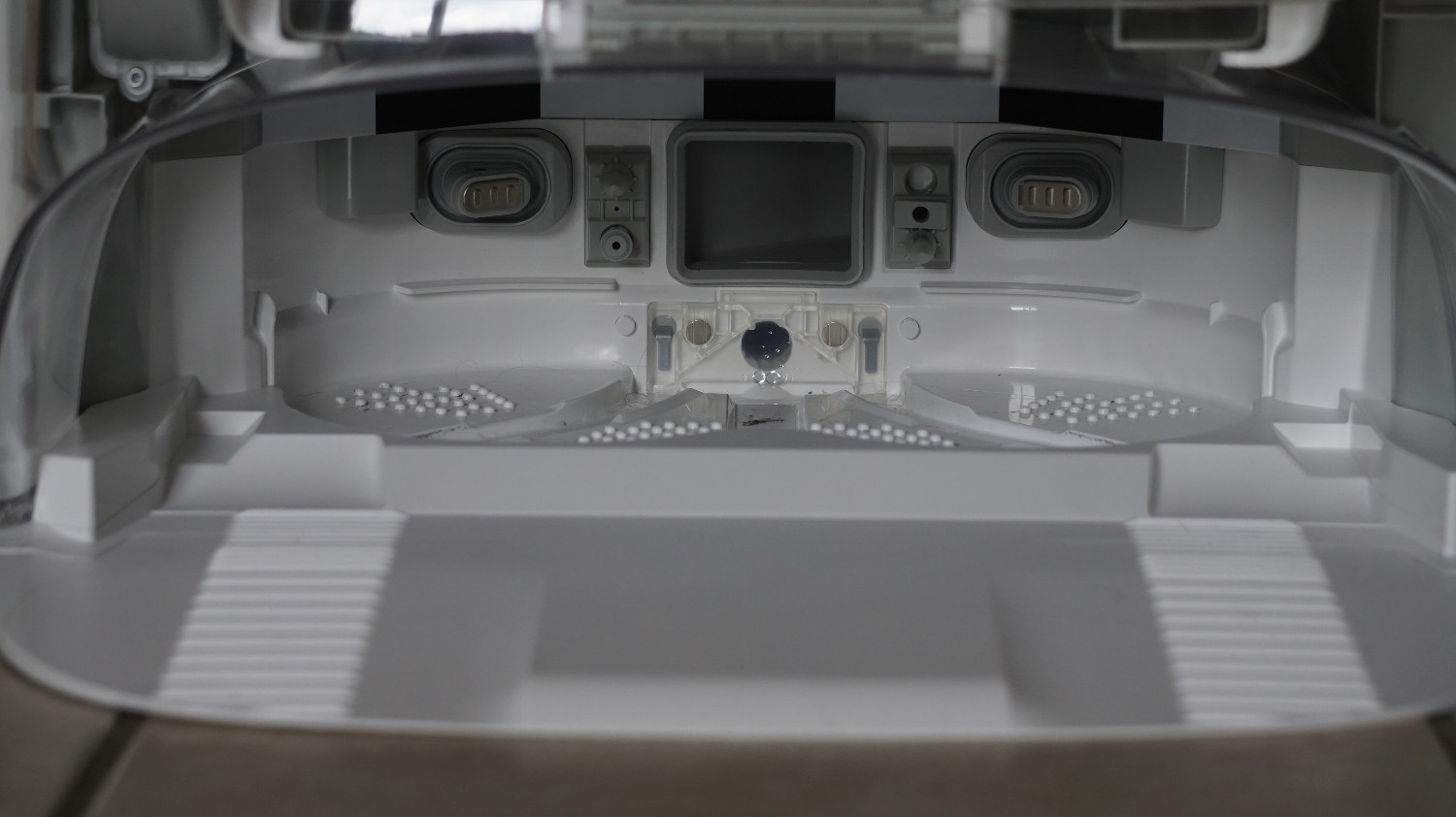
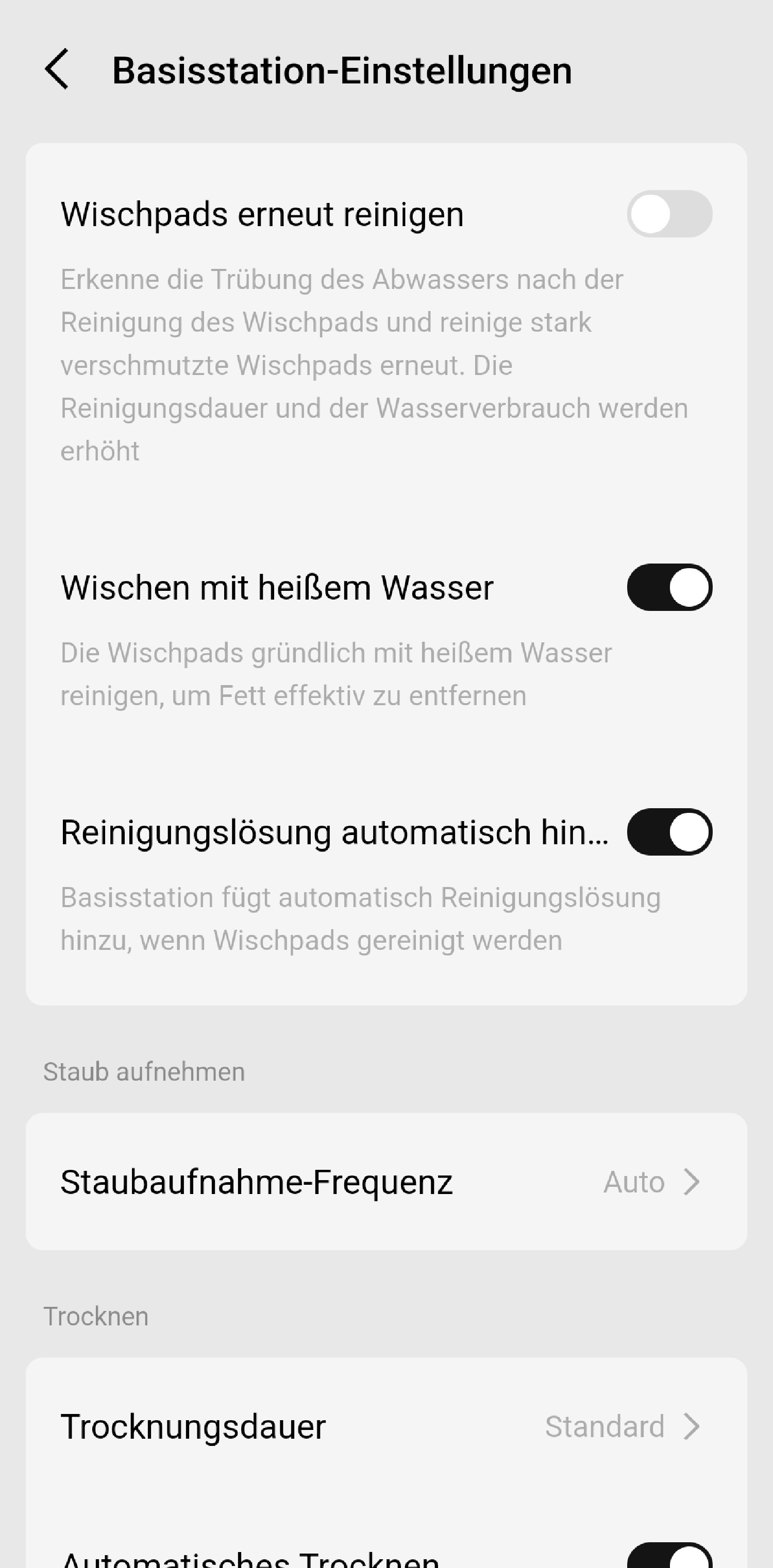
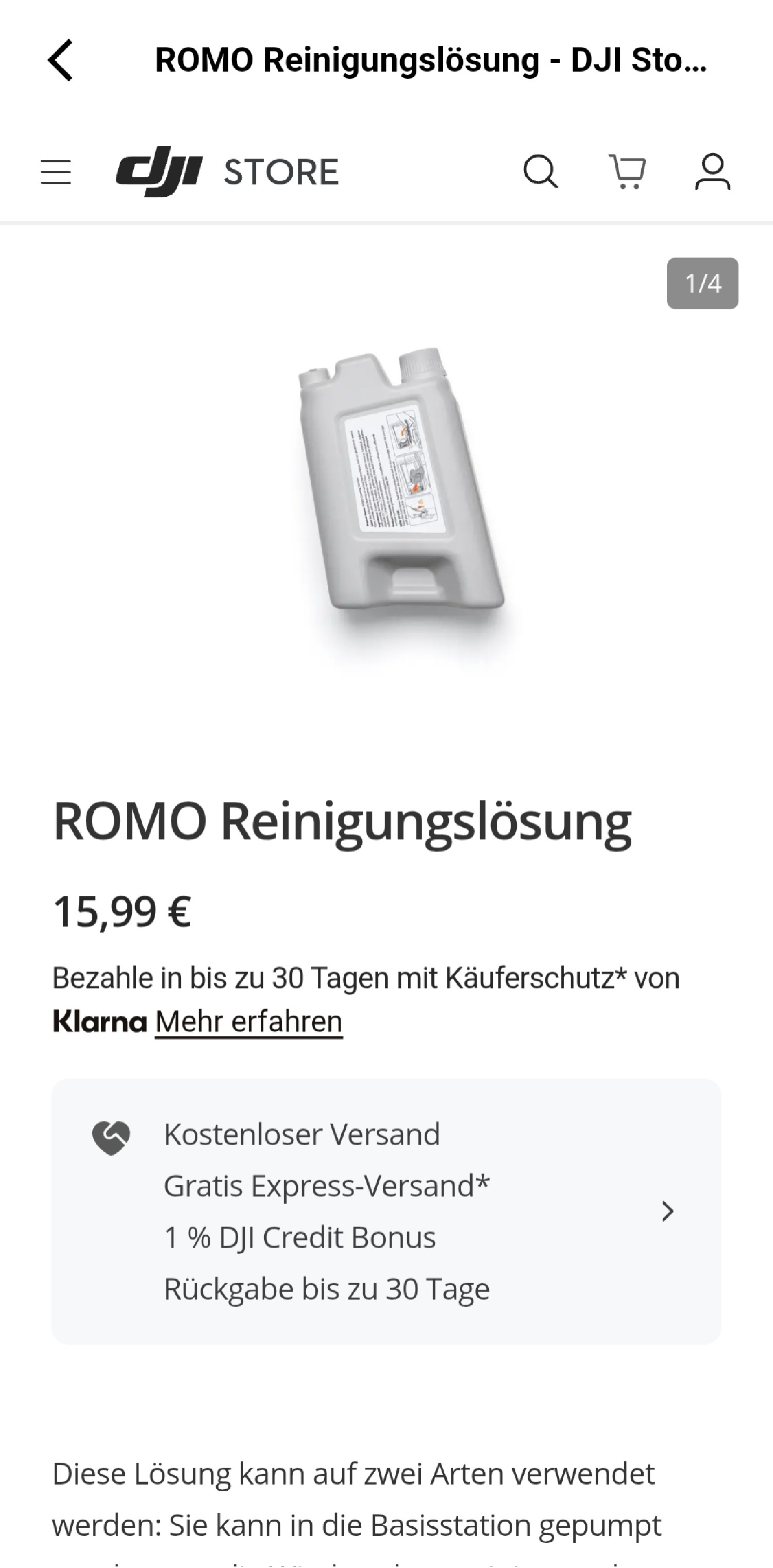
The P model also includes a few extras. These include UV treatment of the dust bag and drying of the dust box, as we already know from Narwal. Cleaning agent is dosed automatically. There is a separate compartment for a floor odor remover.
However, the advertised 200 maintenance-free days should not be taken too literally. That figure refers only to the station’s washboard and not to the entire system. The exact washing temperature also cannot be stated clearly. Depending on the measurement, values between 60 and 75 degrees are mentioned.
All in all, the station is one of the most comfortable parts of the ROMO P. It takes a lot of work off the user and stays comparatively clean. But of course, it is not completely maintenance-free.
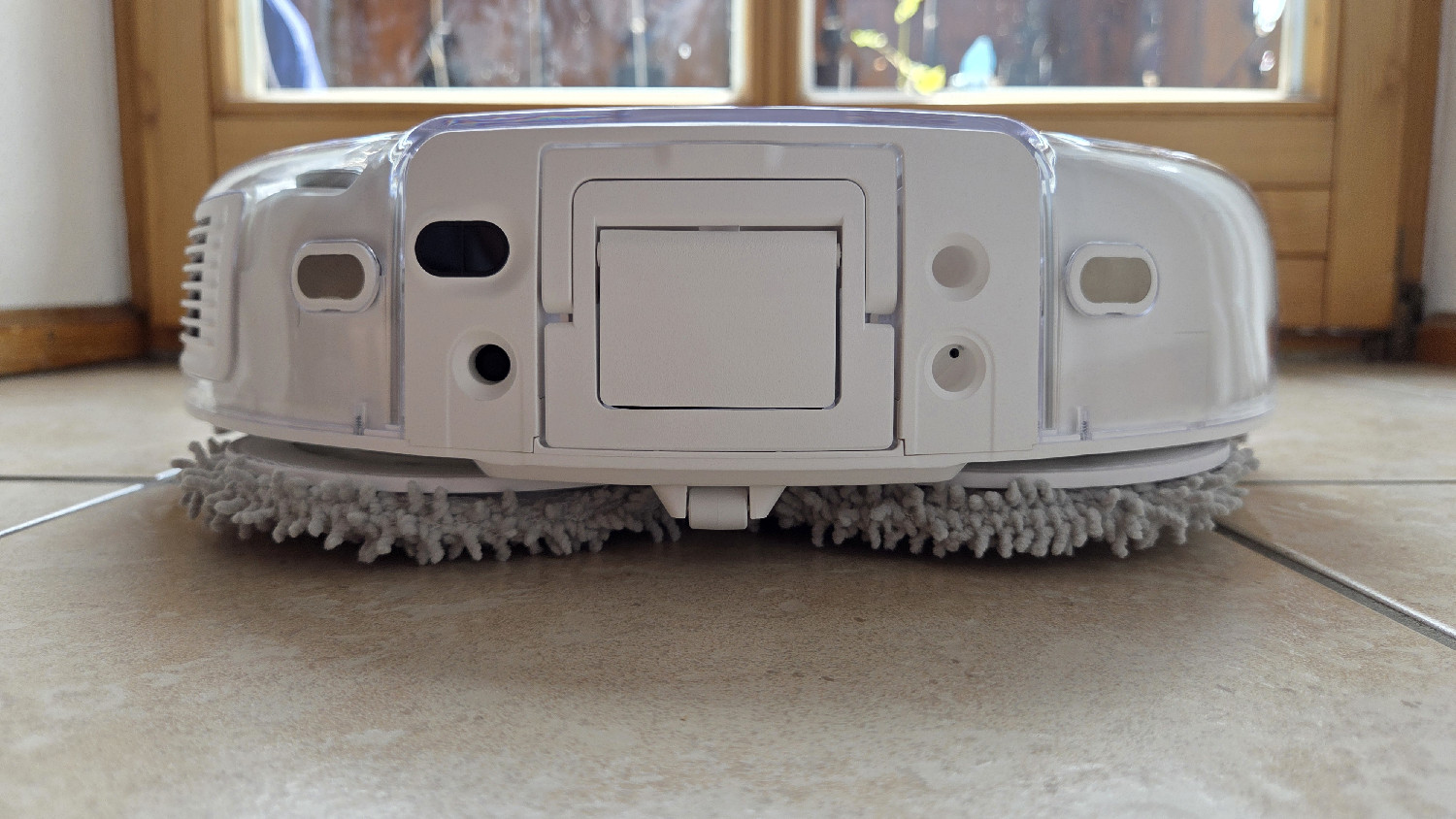
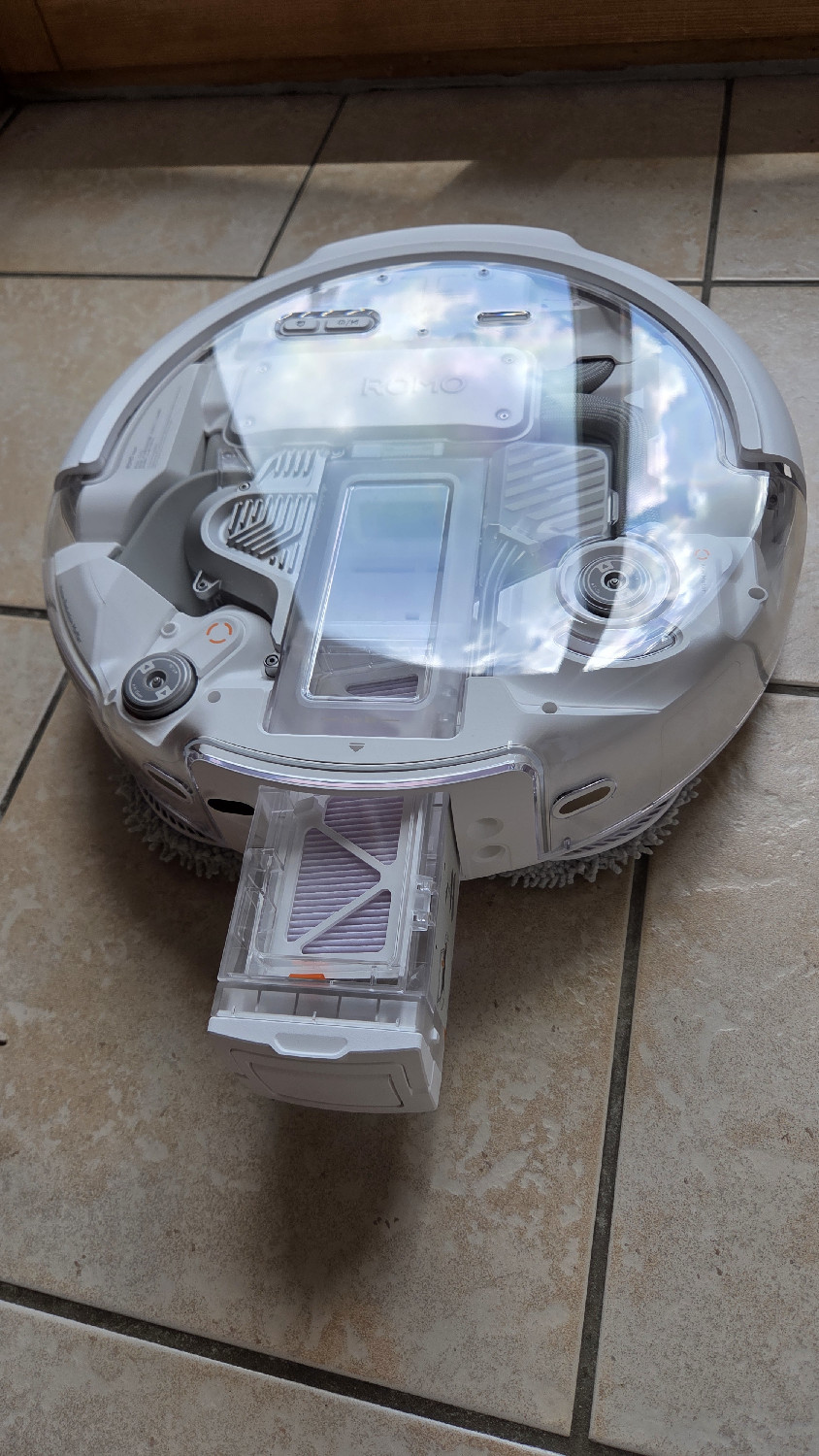
Another practical feature of the Romo P is the rear access to the dustbin, which should also be checked from time to time. DJI’s solution is simple and low-dust (see the following images).
Noise level and battery
When it comes to noise, the DJI ROMO P is pleasantly restrained. While many powerful robot vacuums sound as if a small vacuum cleaner has started up in the living room at the latest on high power, the ROMO P remains comparatively discreet. DJI states around 56 dBA when vacuuming and mopping. That fits well with the impression in everyday use. Conversations or the TV are hardly disturbed by it.
Of course, the robot becomes more audible at higher power levels. But it never becomes unpleasantly loud. Overall, the tuning feels very suitable for everyday life. Anyone wanting to let the ROMO P run during working from home or in the evening does not automatically have to flee to the next room.
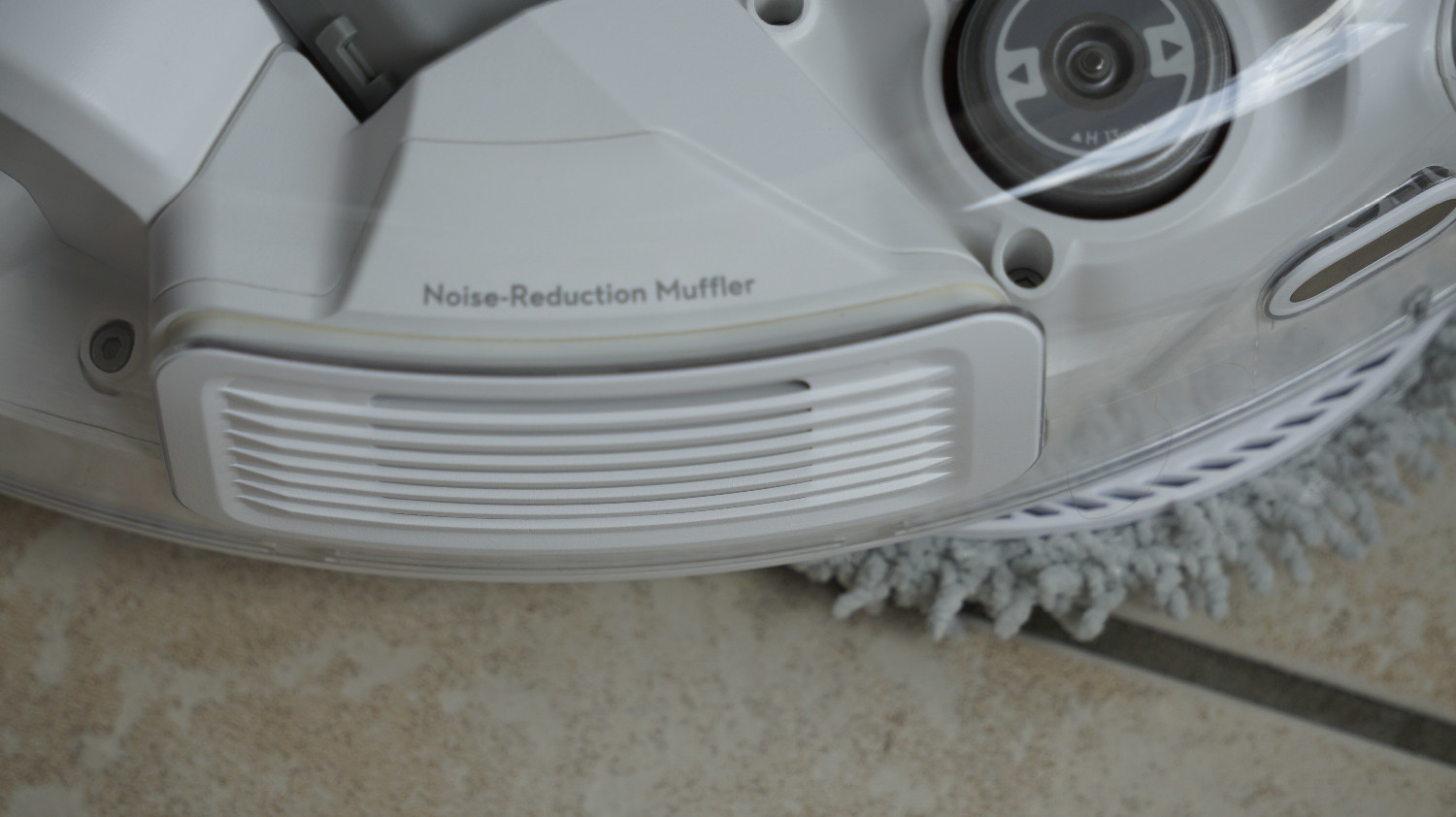
The station makes itself much more noticeable during automatic dust emptying. Here, DJI states around 65 dBA. However, the process only lasts a short time. A multi-stage noise reduction system is also supposed to dampen the sound further. The suction process is certainly not whisper-quiet, but it is within an acceptable range. Of course, if you have just put your baby to sleep, you should schedule that process for another time instead (I speak from experience) .
When drying the mop pads, the station keeps pleasantly in the background again at around 40 dBA. That is important because the drying process runs much longer than the actual dust extraction.
The ROMO P also proves enduring in terms of battery life. With its 5,000 mAh battery, roughly three hours of runtime are realistic at moderate power. That is more than enough for most apartments. It also handles larger areas without stress. If energy does run low, the robot returns to the station on its own and recharges. It then resumes cleaning at the point where it left off.
All in all, the low noise level is one of the clear strengths of the ROMO P. Battery life also fits well with its premium ambitions.
Setup and app
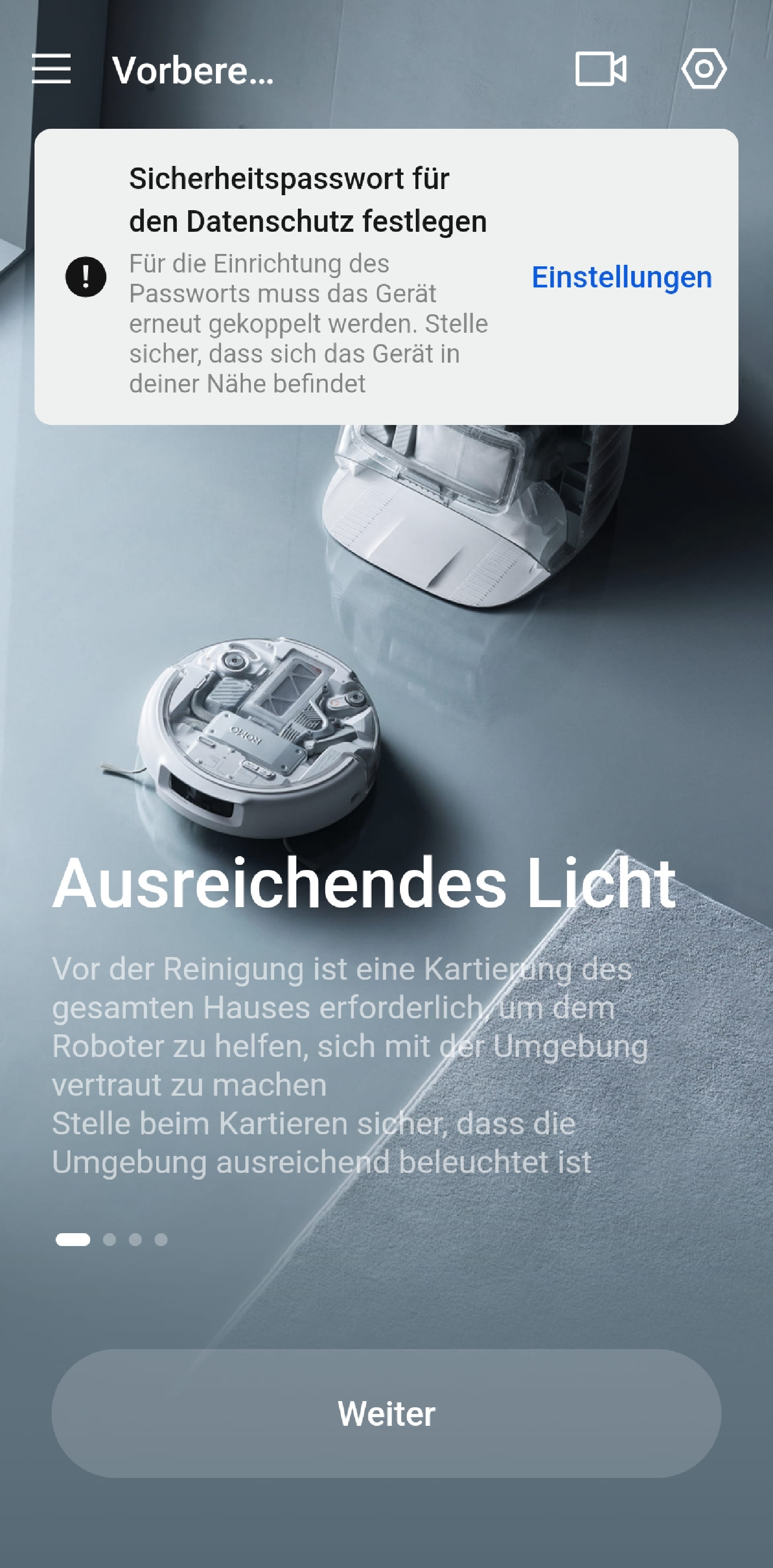
Setting up the DJI ROMO P is done via the DJI Home app and is pleasantly straightforward. The only thing that always makes me pause is the fact that DJI, just like with its drones, does not offer the app via the Play / App Store. In the end, the usual thought tends to win: "Nothing will happen" 😝. After connecting to Wi-Fi, the app guides you step by step through the startup process. What stands out is that there is plenty of guidance and explanation for the functions.

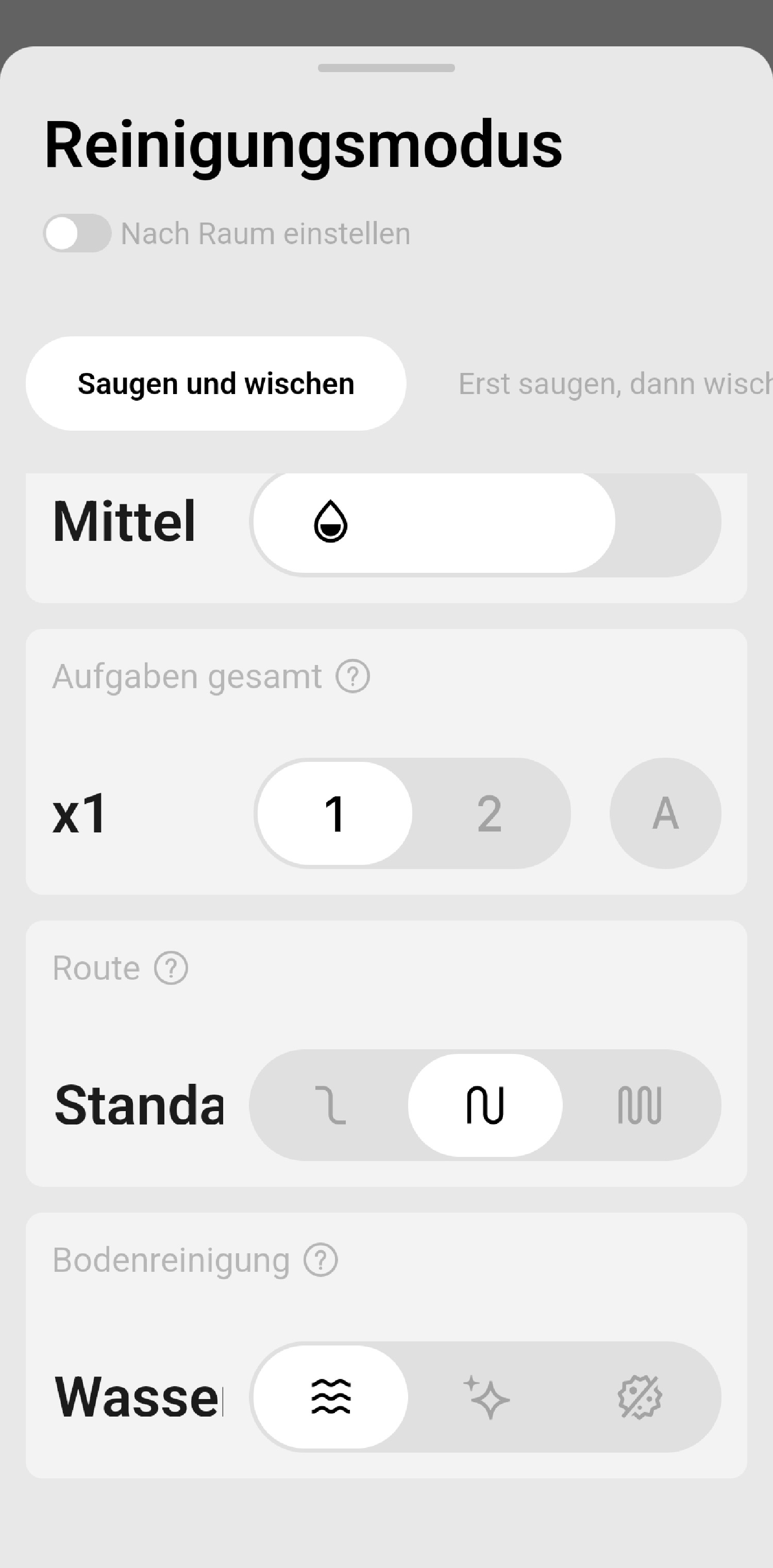

The initial mapping is completed pleasingly quickly by the robot. For an area of around 70 square meters, it needs about ten minutes. The result is an accurate map that can then be edited directly. Rooms can be separated and renamed. Multiple floors can also be saved.

When it comes to features, the app is generous. Virtual walls and no-go zones are included, as are separate areas for vacuuming or mopping restrictions. Suction power and water volume can be set individually for each room. In addition, cleaning sequences and repetitions can be planned. That way, the kitchen can get two passes if needed while the rarely used bedroom gets by with one quick round.
Via the live camera feed, the ROMO P can be controlled remotely. Two-way audio is also on board. That lets you check while away whether everything is okay at home or send the robot specifically to a certain area. Maintenance notes and adjustable quiet times round out the package.
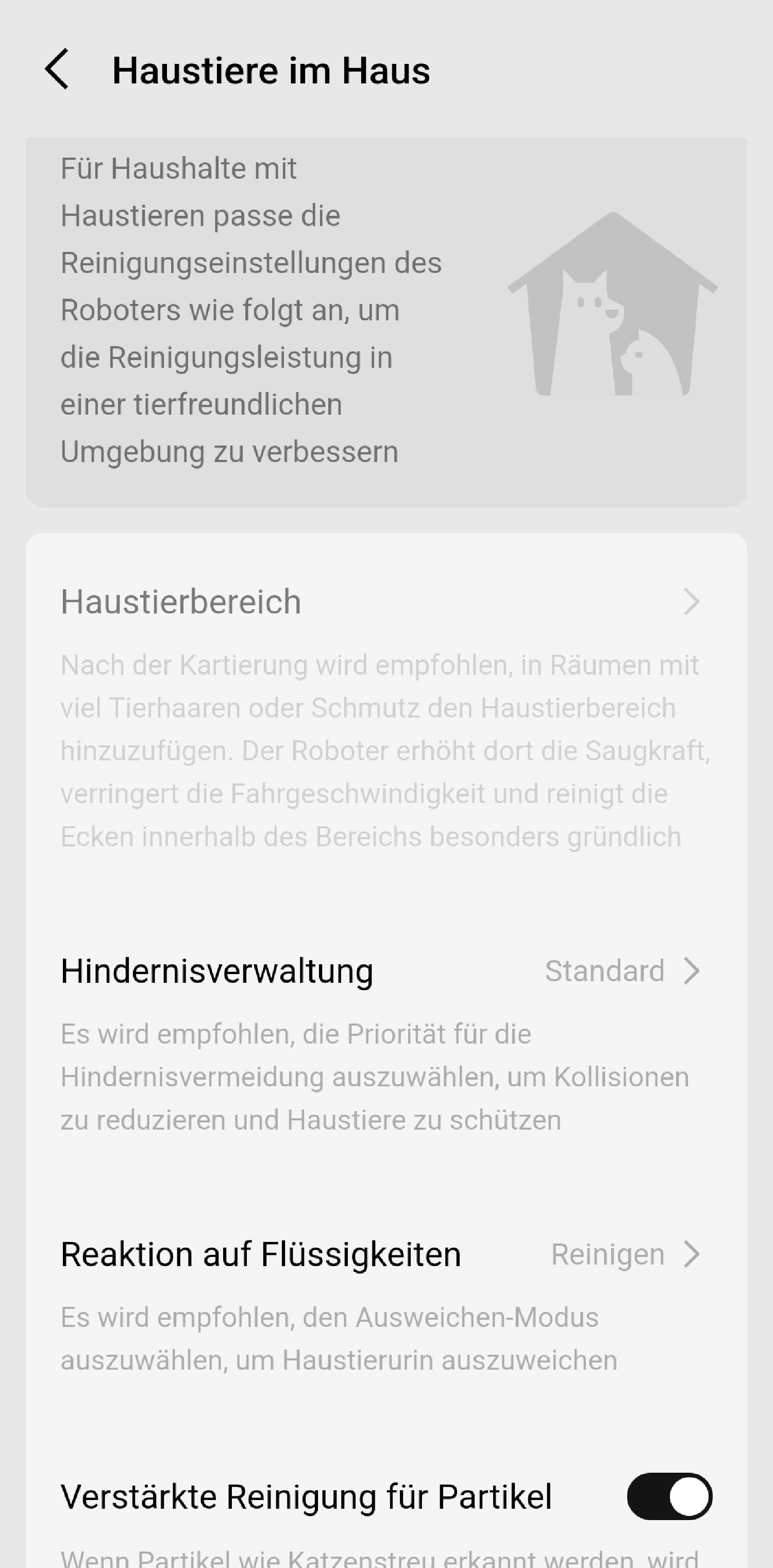
However, the software still does not feel entirely error-free. Some translations sound a bit clunky, and some menus could be structured more clearly. A 3D map is also missing. At the time of testing, there was also no full integration with Alexa, Google Home, Siri, or Matter (update: Matter is now available). The integrated voice assistant only understood Chinese and English.
All in all, however, the app offers many functions while remaining largely understandable. DJI still has room for improvement when it comes to polish and smart home integration.
Data protection and security
The live camera is practical if you want to check on things while away from home. Thanks to two-way communication, the ROMO P can even be used as a mobile guard post. But that is exactly what makes the function security-relevant as well.
A critical weakness in the MQTT authorization check could potentially have enabled access to third-party devices. According to DJI, it closed the central vulnerability on February 8 and 10, 2026 through server-side updates. Other less severe vulnerabilities may still exist, however.
We would therefore only activate the camera deliberately and always install updates promptly. Use of the camera itself is password-protected, so strangers cannot activate it via smartphone. The robot then announces the activation of remote video mode. The live view is a useful extra that most home robots now support, but it is always also a security-critical feature, because a seamless IT security infrastructure simply does not exist.
Value for money
With an original MSRP of 1,899 euros, the ROMO P was clearly positioned in the premium class at launch. Cheap is something else. Since its launch at the end of last year, however, quite a bit has changed – the device can now be had from around 900 euros, and that is also much more realistic in view of the features and the current market. One thing should be clear: you are also paying for the design here. With a transparent chassis, DJI has to pay much more attention to creating a tidy interior than comparable competitors, which increases manufacturing effort. Accordingly, the tiered ROMO A and ROMO S variants are significantly cheaper, with either partial transparency (robot only) or a completely covered design.
[asin="B0FPRK3FNV",type="standard"]
[asin="B0FPRCXJMB",type="standard"]
[asin="B0FPRJLLNB",type="standard"]
The DJI ROMO P in the manufacturer’s store: Buy now
Navigation, suction performance, and brush system are largely identical on the ROMO S, ROMO A, and ROMO P. The surcharge mainly goes toward the transparent design as well as the station’s UV function, odor remover, and additional hygiene features. Not a major issue.
Technically, the ROMO P is strong. But it does not offer the best value for money. If you can do without the extras, you may find the cheaper variants to be the more sensible overall package. The deciding factor remains the current street price…
Of course, you should also keep the prices for spare parts in mind, which you can find here. Overall, the prices are average and comparable to original spare parts from other manufacturers in this class.
Conclusion on the DJI ROMO P
For me, the DJI ROMO P is above all an excellent navigation- and comfort-focused robot with a futuristic design. Its greatest strength is not the highlighted Pascal figure, but the way it moves through the home so safely and intelligently. Mapping is precise, it detects obstacles reliably, and it works pleasingly confidently even in winding rooms. Especially in households with cables, shoes, chair legs, or pet accessories, that is worth more in everyday life than pure performance promises.
When it comes to cleaning, the picture is mixed but overall good. On hard floors, the ROMO P vacuums thoroughly, reaches deep along edges, and deals with hair with pleasingly few tangles. The mopping function is also suitable for daily use, especially the combination with cleaning agent and odor remover leaves a good impression when coming home every day. Stubborn stains do require several passes, however. But that is nothing new for robot vacuums in this class.
The station is very well done. It takes a lot of work off the user, empties the dustbin, cleans the mop pads, and keeps maintenance effort low. On top of that come extras such as the UV function and odor removal. That is convenient, but it also costs extra. The price is noticeably above the simpler ROMO models. And the camera and cloud functions should also be viewed soberly if privacy is a sensitive issue.
All in all, the DJI ROMO P is particularly well suited to households with lots of hard flooring, hair, pets, and obstacles. If you are looking for maximum carpet power or the best value for money, you are more likely to find alternatives elsewhere. But if you want a quiet, smart, and pleasantly low-maintenance everyday helper, you get a capable all-around package of a special kind here.
Very strong navigation, mapping, and obstacle detection
Good cleaning on hard floors
Thorough edge cleaning
Very good hair and pet hair pickup with few tangles
Quiet operation
Convenient cleaning station
Extensive app with live camera and two-way audio
Striking transparent design and stylish interior
Stubborn stains require several mopping passes
No automatic mop removal for high-pile carpets
Limited voice integration
Privacy concerns due to camera and cloud
High price and a clear surcharge over the ROMO S and A
You can buy the device, among other places, on Amazon:
[asin="B0FPRK3FNV",type="standard"]
[asin="B0FPRCXJMB",type="standard"]
[asin="B0FPRJLLNB",type="standard"]
Technical data of the DJI ROMO P
Category | Technical specification |
|---|---|
Device type | Vacuum and mop robot with automatic cleaning and auto-empty station |
Robot model number | CR8E |
Robot dimensions | 351 × 351 × 98 mm |
Robot weight | 4.4 kg |
Housing | Transparent |
Maximum suction power | 25,000 Pa according to the manufacturer |
Dustbin in the robot | 260 ml |
Integrated water tank | 164 ml |
Main brushes | Two counter-rotating anti-tangle brushes |
Side cleaning | Extendable side brush |
Mopping system | Two rotating mop pads with extendable mop arm |
Navigation | Binocular fisheye sensors and wide-angle solid-state LiDAR |
Obstacle detection | Cables from 2 mm in diameter and obstacles from 15 mm in height under suitable conditions |
Battery | 5,000 mAh or 72 Wh |
Battery voltage | 14.4 V |
Maximum runtime | About 3 hours in quiet vacuum-only mode |
Area coverage per battery charge | According to DJI, up to around 178 m² in quiet vacuum mode |
Charging power | 55 W |
Charging time | About 2.5 hours from 0 to 100 percent |
Cleaning modes | Vacuuming and mopping, vacuum only, mop only, and vacuum first followed by mopping |
Noise level during vacuuming and mopping | About 56 dB(A) |
WLAN | Wi-Fi 4 and Wi-Fi 5: 802.11 b/g/n and 802.11 a/n/ac |
Bluetooth | Bluetooth 5.0 |
App | DJI Home App |
Camera | Live camera feed, remote control, and video and voice communication |
Operating temperature | 0 to 40 °C |
Charging temperature | 5 to 40 °C |
Obstacle climbing | up to max. 2 cm |
Technical data of the station
Category | Technical specification |
|---|---|
Model number | CS8E |
Dimensions | 425 × 453 × 440 mm |
Weight | 10 kg |
Fresh water tank | 4 liters |
Dirty water tank | 3.2 liters |
Dust bag | 2.4 liters |
Mopping area per tank filling | According to DJI, up to around 200 m² |
Power connection | 220 to 240 V at 50 to 60 Hz |
Power while charging | 55 W |
Power while drying and charging | 110 W |
Power during dust extraction | 635 W |
Power during hot-water self-cleaning | 1,100 W |
Noise level during dust emptying | About 65 dB(A) |
Noise level while drying | About 40 dB(A) |
Mop washing | Automatic cleaning with high-pressure water jets |
Mop drying | Automatic warm-air drying |
Dustbin drying | Available |
Cleaning agent dosing | Automatic dosing of the cleaning solution |
Floor odor remover | Separate compartment, ROMO P only |
UV function | UV lamp for the dust bag |
Bluetooth | Bluetooth 5.1 |

