The S70 Ultra Roller comes with a modern mopping roller at a moderate price. In the test, I was convinced by the mopping and suction performance of the flat device and came away positively impressed.
MOVA S70 Roller review: Does the mopping roller make the difference?
In recent years, the technical specifications of robot vacuums have outdone one another. 20,000, 25,000, or now more than 30,000 Pa of suction power look impressive on the spec sheet, but they say only so much about actual cleaning performance. Self-cleaning stations and extendable cleaning elements are also no longer unique selling points in the premium class.
Aside from suction power, what interested me most about the MOVA S70 Roller was to what extent the mopping roller is actually better than the widely used rotating dual mops and whether it can approach the performance of a wet vacuum, as well as whether navigation without a laser turret still enables efficient cleaning.

[asin="B0GTM5HFWW",type="standard"]
With the S70 Roller, MOVA relies on a HydroForce system. During cleaning, the wide roller is continuously supplied with fresh water, scraped off at the same time, and the dirty water is collected again. This means the principle feels much more reminiscent of conventional wet-dry vacuums than classic robot vacuums.
Whether the roller concept really offered an advantage in everyday use and whether the MOVA S70 Roller also impressed beyond mopping is what I clarify in the following review.

[toc]
Design and technical features: flat despite extensive sensor technology
At 350 × 350 mm, the S70 Roller initially matches the typical dimensions of a round robot vacuum. More striking is its height. Instead of a laser turret mounted on top, distance measurement is integrated into the housing. MOVA therefore markets it as a 90 mm flat robot; however, the technical data lists 91.5 mm.
That may sound like splitting hairs, but technically it is quite relevant. Especially under sideboards or sofas, a few millimeters determine whether the robot can drive underneath at all. In the test, the S70 did get under furniture where models with a classic LiDAR turret had already failed at the front edge.

Underneath the robot, the unusual layout is immediately noticeable. Instead of two round mop pads, there is a 27 cm long mopping roller mounted across the rear. It can extend toward the edge and be lifted by 12 mm for carpets. There is also an extendable side brush.
In contrast to the S70 Ultra Roller, the S70 Roller does not have an additional extendable carpet protection cover in front of the mopping roller and uses a simple rubber main brush without a cutting mechanism. For deep carpets and long hair, the Ultra variant clearly offers the better technical solution. For better differentiation, below is a table with the differences between the S70 Roller and the S70 Ultra Roller:
MOVA S70 Roller | MOVA S70 Ultra Roller | |
|---|---|---|
Suction power | 28,000 Pa | 32,000 Pa |
Battery | 5,200 mAh | 6,400 mAh |
Hot-water roller washing | up to 80 °C | up to 100 °C |
Main brush | Rubber brush | CleanChop 3.0 |
Carpet protection | Lift roller | AutoShield + 12 mm lift |
Obstacle detection | simpler system | RGB AI camera |
Thresholds | classic | StepPro 2.0 |
Detergent dosing | no | automatic |


Technical specifications of the MOVA S70 Roller
Feature | Technical data |
|---|---|
Robot dimensions | 350 × 350 × 91.5 mm |
Base station dimensions | 340 × 456 × 496 mm |
Max. suction power | 28,000 Pa |
Battery capacity | 5,200 mAh |
Mopping system | HydroForce roller mop (mopping roller) |
Roller mop width | 27 cm |
Nozzles on roller mop | 12 |
Downward pressure | 17 N / 4,700 Pa |
Roller mop lift | 12 mm |
Side brush lift | 10 mm |
Fresh water tank | 5.0 liters |
Waste water tank | 4.5 liters |
Dust bag | 3.2 liters |
Robot dustbin | > 240 ml |
Navigation | CovertSense DToF |
Obstacle detection | simpler sensor system without RGB AI camera |
Obstacle crossing | classic level |
Mop washing | up to 80 °C at the station outlet |
[topdeals]
The figures for suction power, downforce, roller width, and other performance values naturally come first and foremost from MOVA's internal lab measurements. From experience, such numbers should always be read as technical guidance, not as a one-to-one transferable real-world benefit.
The scope of delivery was average for a model in this class. In addition to the robot, station, and mopping roller, one dust bag is included.


Vacuuming and mopping in the practical test: the roller is the star
MOVA specifies the S70 Roller with a maximum suction power of 28,000 Pa. That is less than the S70 Ultra Roller with 32,000 Pa, but usually not the decisive point.
On hard floors, suction performance made a very good impression in the test. Crumbs, dust, and coarser dirt mostly disappeared on the first pass. The extendable side brush helped particularly along straight baseboards, although round robots, by design, still cannot reach every millimeter in deep 90-degree corners.
It became more interesting with long hair. Here, to be fair: the regular S70 Roller is solid at picking up hair, but the Ultra version is clearly better prepared for hair tangles with CleanChop 3.0. On the S70 Roller, more tends to collect on the rubber brush, which has to be removed manually from time to time. Households with long hair or pets may therefore want to go for the Ultra version.
HydroForce worked differently from classic dual mops
The real strength showed up in mopping. The 27 cm wide roller was continuously moistened via twelve nozzles while driving. At the same time, the system scraped dirt off the roller and vacuumed up the dirty water again. This means the same increasingly dirty mop surface was not used across the entire room.
With normal everyday dust and shoe marks, the roller delivered a very even mopping result. Even with heavier dirt, the high mechanical pressure of a nominal 17 N was able to show its advantages. Depending on the level of soiling, dried-on stains still required several passes, but they were visibly worked on mechanically instead of merely being wiped over with a damp pad.
This also aligns with my general assessment of the system: based on my observations, I consider the mopping roller principle more effective than two permanently dirty round mops, which tend to smear dirt and require frequent intermediate cleaning.
Classic rotating mops | HydroForce roller | |
|---|---|---|
Mopping surface | two round pads | continuous 27 cm roller |
Fresh water while driving | usually limited / indirect | continuous supply |
Remove dirt from the mopping element | only in the station | while driving |
Collect dirty water | usually no | yes |
Mechanical pressure | depends on the model | up to 17 N according to MOVA |
Carpet protection | Lift/remove mop | 12 mm lift |
The roller and the side brush extend sideways with "MaxiReach." MOVA states an extension of up to 4.4 cm and a possible distance of less than one millimeter from the edge. In my test, the advantage was especially visible along long baseboards: there the roller practically sits flush against the wall.


Carpet protection: solid, but without the full Ultra package
On carpets, the S70 Roller lifts its roller by 12 mm. In everyday use, that worked properly. Especially on flatter carpets, the damp roller reliably keeps its distance that way.
But here too, the important distinction from the Ultra version applies, which additionally offers AutoShield, meaning an extra barrier between roller and carpet. This then ensures 100% contact-free carpet cleaning even on deep carpets.
On very high carpets or sensitive high-pile models, I would still work with a no-go zone or an adjusted carpet setting even with the Ultra version, since otherwise the robot may get stuck and individual fibers can become entangled, especially in the side brushes.
Navigation and obstacle detection: flat design, but simpler than the Ultra
For its flat form factor, MOVA also dispenses with the classic 360-degree LiDAR turret on the S70 Roller. Instead, CovertSense works with a concealed integrated DToF laser.
During the initial mapping, the system proved fast enough and created a usable room layout. Automatic room detection did not work reliably in the test. During cleaning, the S70 mostly followed systematic paths. Due to the lack of all-round view, however, it had to reorient itself a bit more in some situations than a classic LiDAR robot.
The RGB AI camera is reserved for the Ultra version. The standard S70 Roller instead uses a simpler camera-based obstacle detection system. In practice, that means: it navigates in a structured and overall decent way, but does not reach the same object-recognition class as the Ultra, which can additionally react more precisely via camera to cables, small objects, or pet-related environments. Larger objects such as furniture legs or shoes were handled sufficiently in typical everyday situations during the test. With flat cables, small objects lying around, or cluttered areas, compromises have to be made – the S70 sometimes gets a little too close here, so a cable can occasionally end up wrapped around the main roller.

Base station and app: lots of automation, but not everything at Ultra level
At 340 × 456 × 496 mm, the base station is not small. Above all, it is quite slim but built tall. Behind the upper cover are a generous 5-liter fresh water tank and a 4.5-liter waste water tank. A 3.2-liter bag is available for dust.
The basic operation is familiar by now from other premium systems: the robot is emptied, supplied with fresh water, and the mopping system is cleaned automatically.
Among other things, the station handles:
washing the mopping roller with hot water
subsequent drying
automatic dust extraction
supplying the robot with fresh water
MOVA advertises the S70 Roller with hot water up to 80 °C. However, that does not mean the robot mops the floor with water at 80 °C. The temperature explicitly refers to the maximum value at the station outlet during roller cleaning.
The Ultra version adds more here and is advertised with up to 100 °C as well as automatic detergent dosing.
In everyday use, the large tanks are very pleasant because they last an exceptionally long time. How long five liters actually lasts, however, depends heavily on the set mopping intensity, the area, and the frequency of roller cleaning.

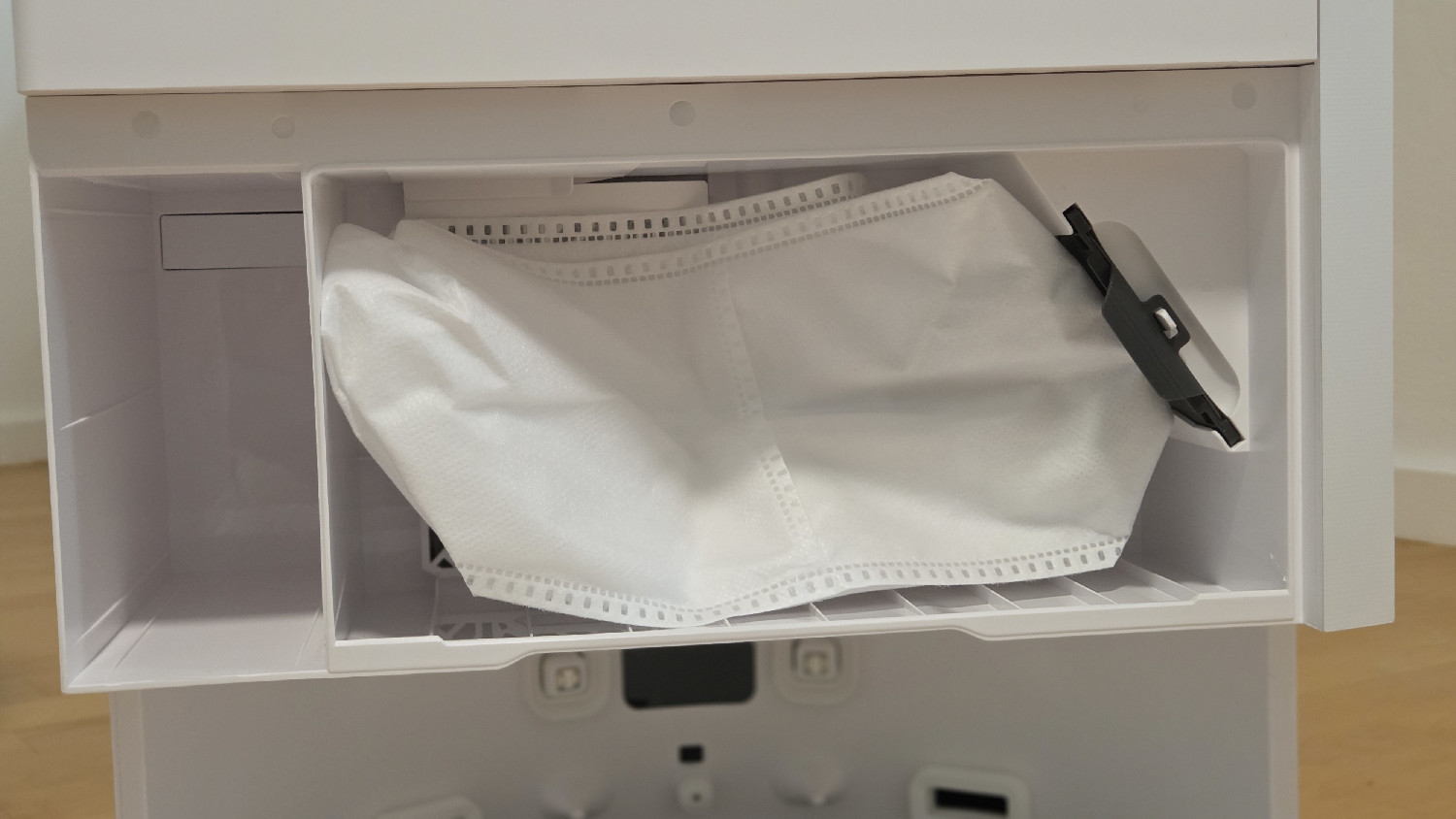

Regarding cleaning the station, I noticed that quite a lot of dirt remains in the drip tray. You have to clean the tray with a brush from time to time, which fortunately is easy to do.
I found the noise during roller cleaning a bit unusual, and for my taste somewhat loud. I would therefore position the unit a little out of the way or let it run when nobody is around.
MOVAhome offers lots of fine-tuning
The MOVAhome app offers the usual functions such as maps, rooms, and no-go zones, etc. More interesting were the deeper settings around carpets and the mopping system. Depending on the room, I could adjust cleaning intensity and behavior and determine how intensively or water-efficiently the roller should operate.
On lightly soiled areas, maximum water supply is unnecessary, while the kitchen and dining area can tolerate more moisture. On oiled parquet, on the other hand, I set the moisture to the minimum level. All of it can be customized very well.
MOVA also integrates its own voice assistant. With “Hey MOVA”, cleaning tasks could be started or settings adjusted by voice without necessarily addressing an external smart home device.
Here too, it is worth clearly separating the models: functions involving camera view, photo and video recordings, or a special AI pet mode are tied to the camera equipment of the Ultra version and are not part of the core feature set of the regular S70 Roller.
Below are screenshots from the app:


Battery performance
The S70 Roller uses a 5,200 mAh battery, which is basically the standard for mid-range models on the market. The S70 Ultra Roller, incidentally, is a bit more enduring with 6,400 mAh.
In my everyday impression, the battery of the S70 Roller was sufficient for typical cleaning rounds on one floor of around 75 m². For the entire area, the robot needs about 60 minutes, which varies depending on the furnishings (many vs. few objects).
Value for money: S70 Roller or S70 Ultra Roller?
The truly interesting competition here comes from within the same brand. The regular MOVA S70 Roller exemplary uses the core principle of an extendable fresh-water mopping roller. So if you are looking at the S70 exclusively because of the roller, you already get the full benefit with the base model.
The S70 Roller is therefore the more interesting value-for-money model if the mopping roller is the main priority. The S70 Ultra Roller is primarily worthwhile if lots of hair, carpets, small obstacles, or higher thresholds play a larger role in the household. For example, it is the better choice for homes with children and pets.
[asin="B0GTM5HFWW",type="standard"]
Conclusion: The mopping roller really does make a difference
For a model in this class, the S70 Roller performs very well thanks to HydroForce.
The mopping roller, continuously supplied with fresh water and cleaned at the same time, was more convincing in everyday use than many classic systems with two rotating mops. Especially on more heavily soiled hard floors, the concept was able to play to its strengths because dirt was not simply carried across several rooms in the same mop pad.
With the MOVA S70 Roller, this exact mopping technology is the strongest buying argument. Suction performance is good, the flat design is practical, and the station is convenient. What the original, incorrectly titled text mixed together too strongly, however, is this: some of the especially luxurious extras do not come from the S70 Roller itself, but from the S70 Ultra Roller.
These include in particular more suction power, a larger battery, CleanChop 3.0, RGB AI camera, AutoShield, StepPro 2.0, automatic detergent dosing, and hotter roller washing up to 100 °C. These points make the Ultra the more complete technical package, but they do not change the fact that the regular S70 Roller already brings the central innovation: a fresh-water mopping roller that is cleaned during operation.
very strong mopping performance with continuously cleaned fresh-water roller
good suction performance on hard floors and solid results on carpets
only around 9 cm high and therefore well suited to lower furniture
extendable mopping roller visibly improves edge cleaning
extendable side brush for good edge cleaning
large water tanks and convenient station automation
very good value for money, especially compared with the Ultra
limited scope of delivery
no detergent intake
limited obstacle detection without RGB AI camera
no AutoShield for carpets
roller system and station somewhat more maintenance-intensive than rotating mops
If you are primarily looking for the best possible robot vacuum for mopping hard floors, you should seriously consider the S70 Roller. The real innovation is the combination of a modern flat housing and a strong mopping system that is technically much closer to a true floor cleaner.
[asin="B0GTM5HFWW",type="standard"]
My assessment: If you want the roller technology but do not necessarily need the camera, CleanChop, AutoShield, and the other comfort upgrades, the MOVA S70 Roller is clearly the more coherent device. If, on the other hand, your household is more "complicated," the S70 Ultra Roller is much more likely to justify its higher price.
S70 Ultra Roller or P70 Pro Ultra?
If you are looking at MOVA for a powerful model around 600 to 700 euros, you will quickly also end up at the new P70 Pro Ultra, which I have already tested (to the review). On paper, both "Ultra" devices are close to each other: the P70 Pro Ultra reaches 30,000 Pa, the S70 Ultra Roller 32,000 Pa. The decisive difference lies in the mopping system.

The P70 Pro Ultra relies on the established dual-mop principle. Its two mop pads rotate at up to 260 rpm and are pressed onto the floor with a nominal 12 N. This works well for normal maintenance dirt, and the robot can also leave the mops completely in the station for vacuum-only runs.
The S70 Ultra Roller takes a technically different approach. Its roller is permanently supplied with clean water while driving, scraped off, and the dirty water is collected again directly. Especially on larger mopping areas and more heavily soiled hard floors, this system is more thorough because the same increasingly dirty mop surface is not guided across the entire room. In other words, the S70 Ultra Roller smears less dirt and instead picks it up better.
The S70 is also more modern in design: at 91.5 instead of 103.8 mm in height, it is a good centimeter flatter, offers the larger 6,400 mAh battery, and gets over higher thresholds with StepPro 2.0. The P70, on the other hand, remains interesting if mopping is not the top priority and it is offered at a significantly lower price. Its pure vacuuming and everyday cleaning are closer to the S70 Roller tested here, even though it carries Ultra in the name. Accordingly, it is also significantly cheaper than the S70 Ultra.
In summary: The P70 Pro Ultra is the classic all-rounder with a very well-equipped station. With the S70 Ultra Roller, you are primarily paying for the more technically elaborate and, in my view, stronger mopping concept, the flatter design, and the more modern obstacle and carpet technology.
The following table compares both models:
P70 Pro Ultra | S70 Ultra Roller | |
|---|---|---|
Max. suction power | 30,000 Pa | 32,000 Pa |
Mopping system | two rotating mops | 27 cm HydroForce roller |
Mopping movement | 260 rpm, 12 N | continuous roller, 17 N |
Fresh water during mopping | no | yes |
Dirty water collection while driving | no | yes |
Carpet protection | Lift / remove mops | 12 mm lift + AutoShield |
Battery | 5,200 mAh | 6,400 mAh |
Height | 103.8 mm | 91.5 mm |
Threshold climbing | 22 mm | up to 30 mm single-step |
Fresh/waste water tank | 4.0 / 3.5 l | 5.0 / 4.5 l |
To the offer |

