The test of the X-Sense XS0B-MR121 focused on how well the smoke detectors perform in a residential house in terms of smoke detection, networking, voice announcements, and app functionality.
X-Sense XS0B-MR121: Smart Smoke Monitoring
It was high time to bring the conveniences of smart smoke monitoring into my home. I wanted to avoid a basic problem in an emergency: If, for example, the detector in the basement goes off, in the worst case you might not notice it in the bedroom, and even if you do, it is hard to tell which detector is actually sounding and therefore where the smoke was detected. Disorientation in a dangerous situation is no joke – and that is exactly where the smart X-Sense XS0B-MR121 smoke detectors come in.
So, that settled it – my choice fell on the set from X-Sense, which includes twelve interconnected XS0B-MR smoke detectors + SBS50 base station . If one detector detects smoke, all the other devices sound the alarm as well. Particularly helpful is the additional voice announcement with room indication: the system not only warns acoustically, but also tells you at the same time in which area the alarm was triggered.

The X-Sense Home Security app also adds push notifications, status information, and various convenience features. Very important: the actual alarm networking does not depend on Wi-Fi – an important difference compared to pure Wi-Fi smoke detectors.
[asin="B0DCWXLYP6",type="standard"]
In the test, I looked in particular at how reliably the networking across multiple rooms and floors, the voice warning, and the app worked, and what advantages the extensive set actually offers in everyday use.
[toc]
Features and Technical Data: A Lot of Technology Under the White Cover
Visually, the X-Sense XS0B-MR looks classically modern. On the one hand, the white plastic housing is barely noticeable on the ceiling, and on the other, the honeycomb pattern makes it look a bit like a classic ceiling speaker. According to my wife, quite stylish and acceptable. Inside, each smoke detector houses a photoelectric smoke sensor. Power is supplied by a replaceable CR123A lithium battery. I generally prefer this to permanently installed batteries because after a few years you do not necessarily have to dispose of the entire smoke detector. However, the service life of the smoke detectors themselves is still specified as 10 years. An appropriate replacement date is affixed to each detector.


The real special feature, however, is in the radio module. Up to 24 compatible Link⁺ or Link⁺ Pro detectors can communicate directly with each other. In addition, the SBS50 base station connects the devices to the app and supports up to 50 X-Sense devices in total, including CO detectors and other sensors.
Feature | X-Sense XS0B-MR / SBS50 |
|---|---|
Smoke sensor | Photoelectric |
Battery | CR123A, replaceable |
Battery life | approx. 5 years or 3–5 years with base station |
Smoke detector alarm | ≥ 85 dB at 3 m |
SBS50 alarm | up to 100 dB |
EU radio frequency | 869.25–869.3 MHz |
Detector range | up to 500 m in open field |
Directly networkable detectors | up to 24 |
Devices on SBS50 | up to 50 |
Wi-Fi | 2.4 GHz, IEEE 802.11b/g/n |
App | X-Sense Home Security for Android/iOS |
Link to the manufacturer’s offer |
The stated 500 meters of radio range explicitly applies to open terrain. For everyday use, what matters much more is how well the signal passes through walls and floor slabs – more on that later.

Setup and Installation: Twelve Smoke Detectors Without a Settings Marathon
Before the detectors went onto the ceiling, I first set up the SBS50 base station. It is powered via a 5 V power supply and connects exclusively to a 2.4 GHz Wi-Fi network. A 5 GHz network alone is therefore not sufficient.

In my test, setup via the X-Sense Home Security app was overall straightforward. After registering, I added the base station and then connected the individual smoke detectors. Especially with twelve devices, it is helpful that a location can be assigned directly to each detector on the device itself.
The voice function is helpful here. While devices can be named individually in the app, only a selection of predefined labels is available for the spoken room announcement. That is sufficient for typical rooms such as bedroom, kitchen, hallway, or basement, but it does limit customization somewhat. For example, I would have liked to assign a hobby room, but had to use common room instead.
The installation itself is done in the classic way using a mounting plate screwed to the ceiling with 3 screws. The smoke detector is then twisted into place. Anyone installing twelve devices will spend some time on the ladder at first. I needed about 3 hours for the installation throughout the whole house.
Then came the pairing – briefly press the smoke detector twice (the voice announcement "Pairing active" sounds) and start the search in the app. In my test, this worked smoothly and, although you are supposed to stay close to the base station, it also worked across two floors. After that, you have numerous options for centrally monitoring the status of the detectors. Instead of having to check each smoke detector individually, I was able to neatly assign the devices in the app and view their respective status.

Practical Test: Twelve Detectors, One Alarm – and It Is Immediately Clear Where It’s Burning
Detecting smoke and then using the networking, that was the central requirement in the test. So if I trigger a single smoke detector, all integrated devices should react. That worked wonderfully in the test run. In addition to the classic warning tone, there was also a voice announcement with the location of the detector that triggered the alarm. That means I no longer have to run through the house looking for the blinking LED, but can act directly – I do not want to sound too dramatic, but time can definitely mean survival.

Of course, the set is particularly designed for single-family or multi-family houses and offers less added value in a manageable apartment.
According to the manufacturer, the smoke detectors themselves reach at least 85 dB at a distance of three meters, while the SBS50 base station can alarm at up to 100 dB. In the practical test, the warning was very loud and quite intimidating for my children. More important to me, however, was that the spoken room designation remained understandable despite the loud alarm tone. If you do not like the sound at all, you can at least choose 2 alternative tones for the base station and also reduce the volume.

The radio connection also proved stable in the test. In the European model, the detectors communicate directly with each other via the 869 MHz range. That means: the SBS50 is not required for the actual alarm forwarding. The devices can also be networked with each other without the station.
I also tried that and was able to set up a local network of the smoke detectors without an active internet connection without any problems. Likewise, the basic alarm works regardless of whether there is currently a connection to the cloud or not.
The SBS50 therefore primarily expands the system with a few smart features. If it fails, you lose push notifications and remote access, among other things – but of course the smoke detectors can still continue to detect smoke and alarm each other.
You should not confuse the manufacturer’s stated up to 500 meters of radio range with the actual range inside a building. Walls, ceilings, and other obstacles reduce it considerably. However, in my test, the connection was entirely sufficient for distribution across multiple rooms and floors. The base station on the 1st floor maintained a good connection even to the smoke detectors in the basement two reinforced concrete floors below.
Temporary muting is also possible. The alarm can be silenced for a maximum of about nine minutes. This is practical in the event of a clear false alarm, for example if it is obvious that something has burned on the stove, but everything is under control.
App and Smart Home: More Than Just a Push Notification
In everyday use, the X-Sense Home Security app mainly handles convenience functions. In my test, it showed, among other things, the status of the individual smoke detectors, battery status, and past events. Devices can also be tested without having to press the button on the ceiling every time.
With twelve smoke detectors, I found that to be a real time-saver. Even more important are the push notifications, which the phone receives as soon as an event is triggered. That means the system can also provide information when no one is at home.
Other functions include, among others:
Status and battery monitoring
Alarm and event history
Test function via the app
Night mode for the LEDs
Sharing the system with additional users
Muting for supported alarm states


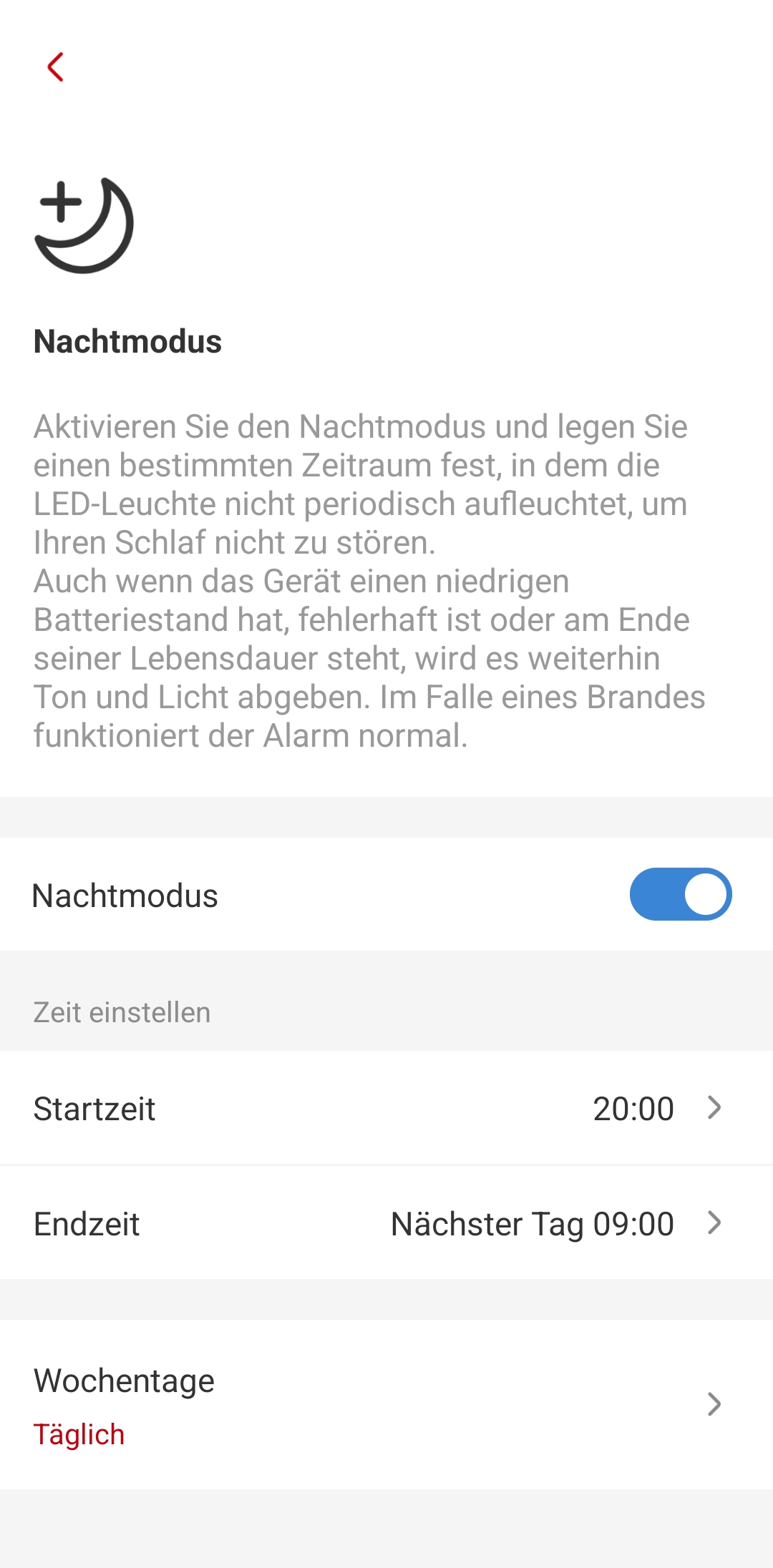
For traditional smart home users, however, there are limits. The system is not designed as a Matter or HomeKit smoke detector and cannot simply be integrated into just any ecosystem.
A connection to Home Assistant is nevertheless possible in principle, among other ways via MQTT or corresponding integrations. However, anyone expecting complex automations or complete local control must plan for significantly more effort than with a natively supported smart home device. In conjunction with Home Assistant, simple automations can then be set up, e.g. raising blinds, turning on lights, etc.
[asin="B0DCWXLYP6",type="standard"]
Battery and Fail-Safe Reliability: The Smoke Detectors Keep Running, the Base Station Does Not
When it comes to power supply, X-Sense uses two approaches. The XS0B-MR smoke detectors run on replaceable CR123A lithium batteries, while the SBS50 is permanently connected to the mains. Power plug and USB-C cable are included in the package.
X-Sense specifies a battery life of around five years for the smoke detectors if they are only wirelessly networked with each other and tested once a week. In combination with the base station, three to five years are specified.
This means the system does not reach the runtime of typical smoke detectors with a permanently installed ten-year battery. In return, the battery can simply be replaced afterward.
In my view, one notable weak point lies with the SBS50: The base station has no backup battery of its own. In the event of a power outage, the app connection is therefore also lost. However, thanks to their batteries, the smoke detectors themselves remain active and continue to alarm each other.
You should also observe the manufacturer’s limits when it comes to placement. X-Sense specifies an operating range of 4.4 to 37.8 °C and a maximum of 85 percent relative humidity without condensation. For damp basement rooms or bathrooms, the detectors are therefore not automatically the best choice.
In normal living areas, however, the system worked reliably.
Conclusion on the X-Sense XS0B-MR121: Particularly Strong in Larger Homes
The X-Sense XS0B-MR121 impressed me in the test above all where simple smoke detectors reach their limits: protecting a larger house with multiple rooms and floors. The twelve detectors worked as a shared system, and the voice announcement of the affected room proved to be much more than just a nice extra feature. In the event of an alarm, I immediately knew where the trigger was located.


The separation between local safety function and smart features is also sensibly implemented. Smoke detection and radio networking work independently of Wi-Fi and the internet, while the SBS50 offers additional convenience with push notifications, status display, and remote access. Especially with twelve installed detectors, the central management made everyday use noticeably easier.
However, the system does not come without compromises. The battery life of three to five years is shorter than that of smoke detectors with a permanently installed ten-year battery. In addition, the SBS50 has no backup battery, so the app connection is lost during a power outage. And anyone expecting deep integration into Matter, HomeKit, or other smart home systems will find more suitable solutions.
On the other hand, anyone primarily looking for a reliably networked smoke detector system with clear room announcements and a useful app extension gets a compelling overall package with the XS0B-MR121. Last but not least, the price at around 17 euros per smoke detector is quite fair.
[asin="B0DCWXLYP6",type="standard"]
reliable local radio networking
voice announcement specifying the affected room
app with push notifications and central status overview
alarm function independent of Wi-Fi and internet
replaceable batteries
particularly interesting for larger houses
SBS50 without backup power supply
only around 3–5 years of battery life when using the base station
limited integration into other smart home systems
voice announcements only with predefined room labels

