DJI ROMO P2 in review: How well do 36,000 Pa and the extended mop arm clean? My experiences with suction power, mopping performance, and obstacle detection.
The DJI Romo P2: Consistently refined and well on its way to becoming the market leader!
Even in my review of the DJI ROMO P, the transparent robot vacuum impressed me with thorough hard floor cleaning and reliable obstacle detection. Mopping, however, still left some room for improvement: dried coffee occasionally left marks, and dried-on food residue required several passes. The result was solid, but not yet absolute top class. But that has changed.
With the ROMO P2, DJI is now following through consistently. Maximum suction power increases from 25,000 to a beastly 36,000 Pa. Particularly exciting, however, is the extended mop arm: it swings out by up to 123 degrees and reaches 7.8 cm farther than its predecessor. That promises extra reach along furniture and under overhangs. Something to look forward to…
This review therefore focuses on vacuuming and mopping performance: How thoroughly does the P2 clean carpets, how well does it remove stubborn stains, and what difference does the new mop arm make? Added to that is the revised obstacle detection, which is now also supposed to detect transparent objects. The striking display-case design that has grown on me remains – now the second generation is supposed to raise the bar again when it comes to cleaning. Let's see whether I remain a DJI fan.
[asin="B0H8DJ99LD",type="standard"]

[toc]
Design and features: Familiar transparency, new mechanics
DJI sticks with the transparent housing for both the robot and the station. Cables, containers, and parts of the mechanics are therefore visible – the ROMO P2 continues to openly showcase its technical structure. I like this distinctive look, even if it certainly stands out among classic living room furniture. The good thing about it is that the manufacturer is forced to pay attention to order and quality on the inside as well. As a result, the device feels very tidy, high-quality, and sturdy. The motto here is: "Great inside, great outside"!
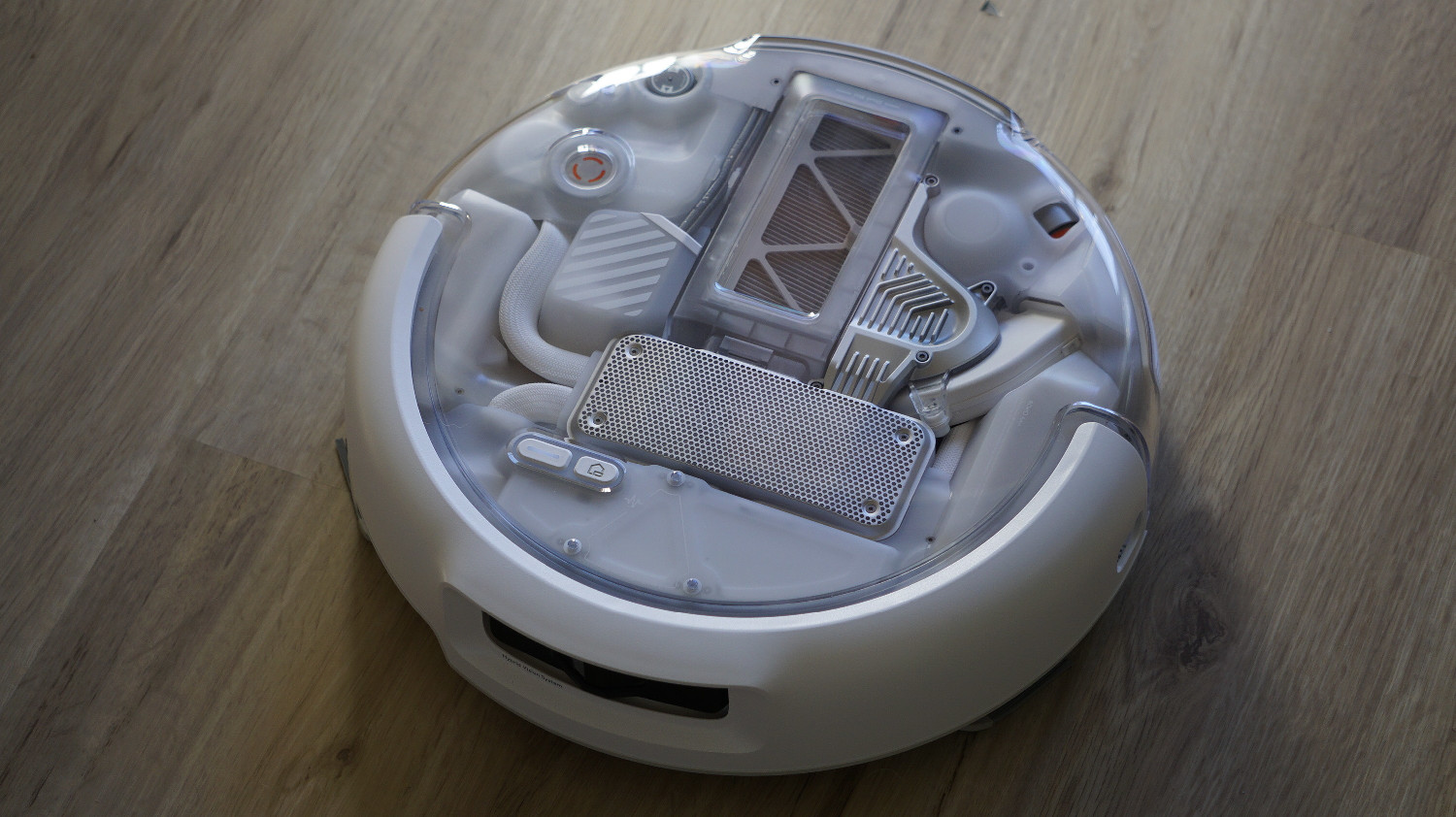

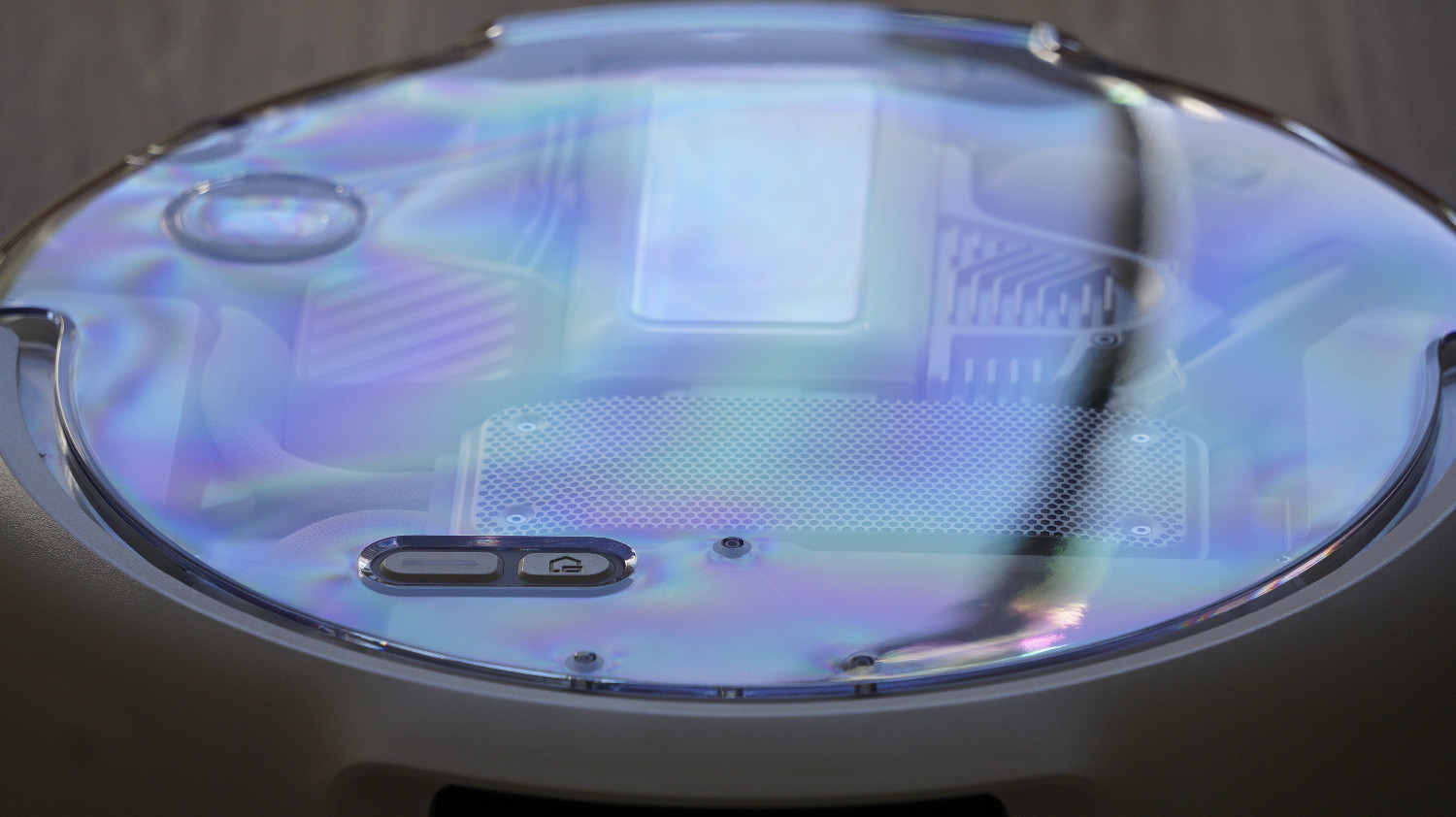
With a height of 9.8 cm, the robot is just as tall as its predecessor. Despite the lack of a laser turret, it is therefore not one of the particularly flat models. Before buying, I would therefore check the floor clearance under the sofa and sideboard very carefully. The station also requires sufficient space, especially above it for removing the water tanks. However, it is neither particularly tall nor wide and has standard market dimensions.
The Romo P2 can be purchased in different packages, similar to what you know from drones. For 1099 euros, you get a comprehensive combo with, for example, additional brush rollers and cleaning solution. The following table shows the package contents and the differences between them:
Package contents | ROMO P2 Standard | ROMO P2 Clean More Combo |
|---|---|---|
DJI ROMO P2 robot | 1× | 1× |
DJI ROMO P2 base station (water tank version) | 1× | 1× |
ROMO 2 series base station floor plate | 1× | 1× |
ROMO AC power cable | 1× | 1× |
ROMO cleaning solution (white bottle) | 1× | 1× |
ROMO floor odor remover (white bottle) | 1× | 1× |
Additional accessories from the cleaning accessories set | ||
ROMO rubber roller brush | – | 1 pair |
ROMO 2 series side brush | – | 1 pair |
ROMO mop pads | – | 4 pairs / 8 pieces |
ROMO 2 series high-performance filter | – | 2 pieces |
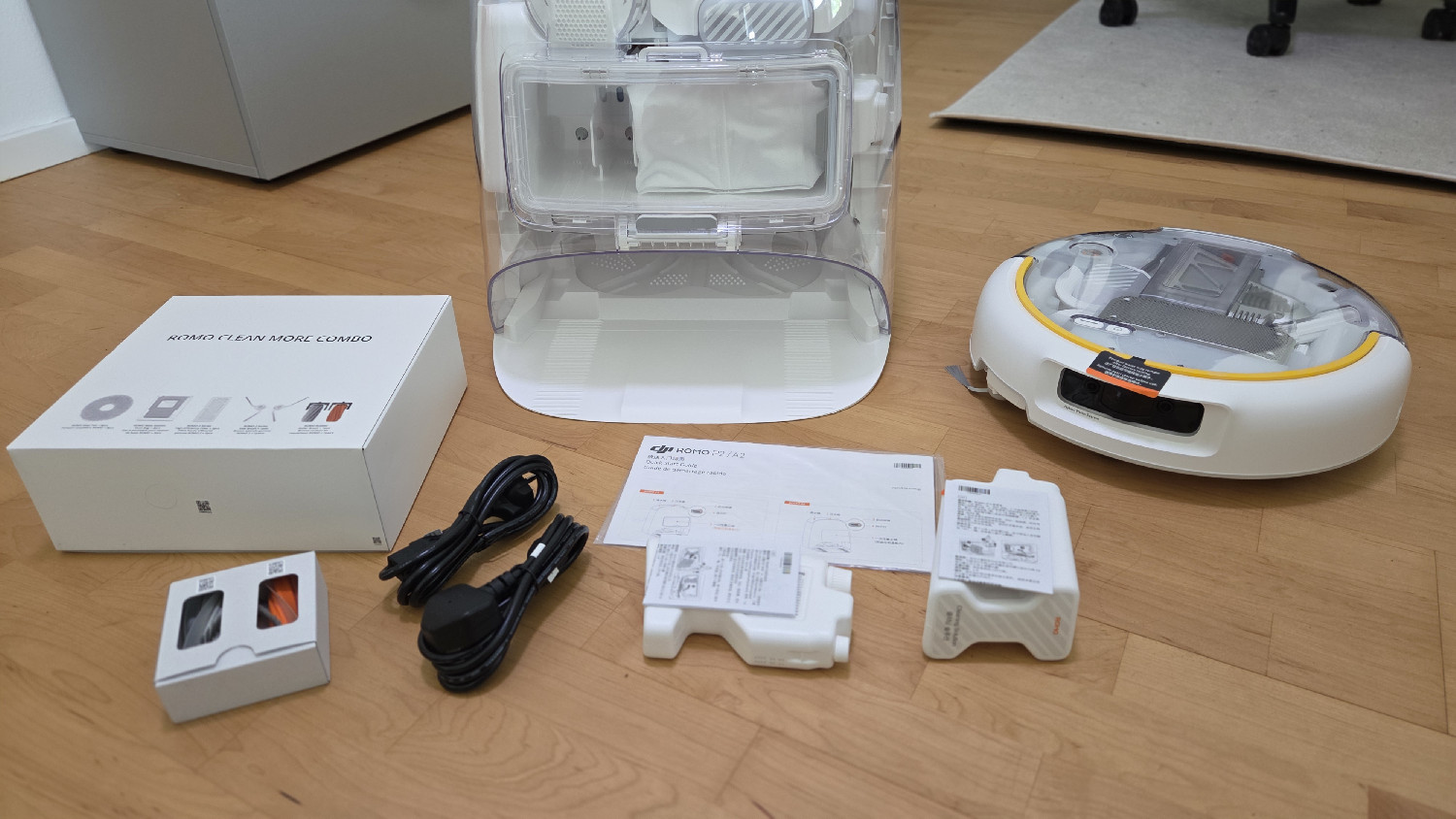
The key changes are hidden underneath the housing: a revised brush system, a lowering suction duct for carpets, active climbing aids, and the mop arm that swings out much farther.

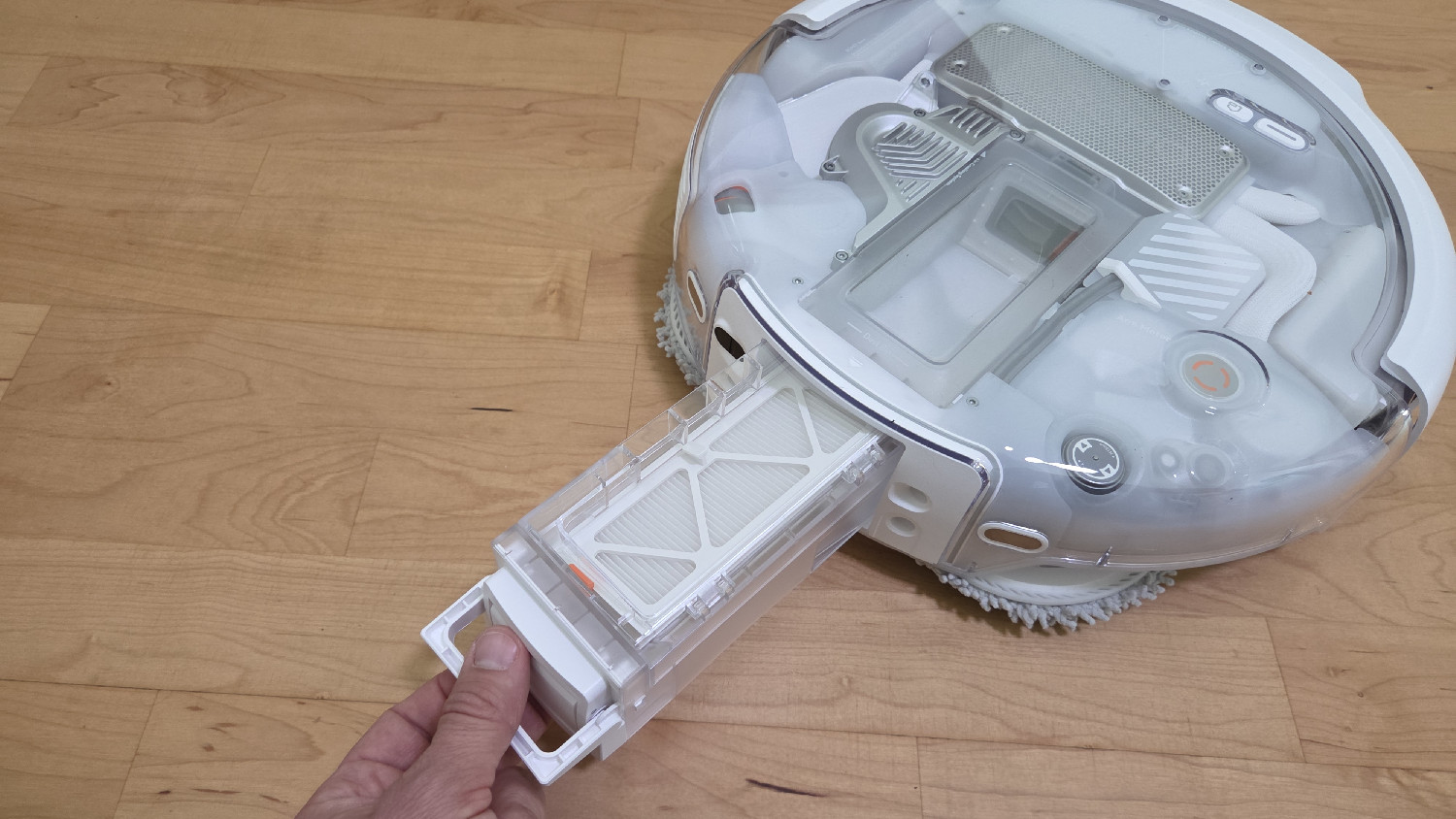
I have summarized the most important technical data of the DJI Romo P2 below:
Feature | DJI ROMO P2 |
|---|---|
Robot dimensions (W × D × H) | 351 × 351 × 98 mm |
Robot weight | 4.9 kg |
Maximum suction pressure | 36,000 Pa according to the manufacturer |
Robot dust container | 215 ml |
Mopping system | Two rotating pads, extendable mop arm |
Arm swivel range | Up to 123° |
Additional arm reach | 7.8 cm compared to the ROMO P |
Obstacle clearance | Up to 4 cm individually; up to 8.5 cm on defined double steps |
Battery | 5,000 mAh / 72 Wh |
Charging time | About 2.5 hours under laboratory conditions |
Station dimensions (W × D × H) | 425 × 453 × 440 mm |
Clean water / dirty water | 4 l / 3.2 l |
Dust bag | 2.4 l |
Connection | Wi-Fi with 2.4 and 5 GHz |
App | DJI Home (not in the App Store / Play Store) |
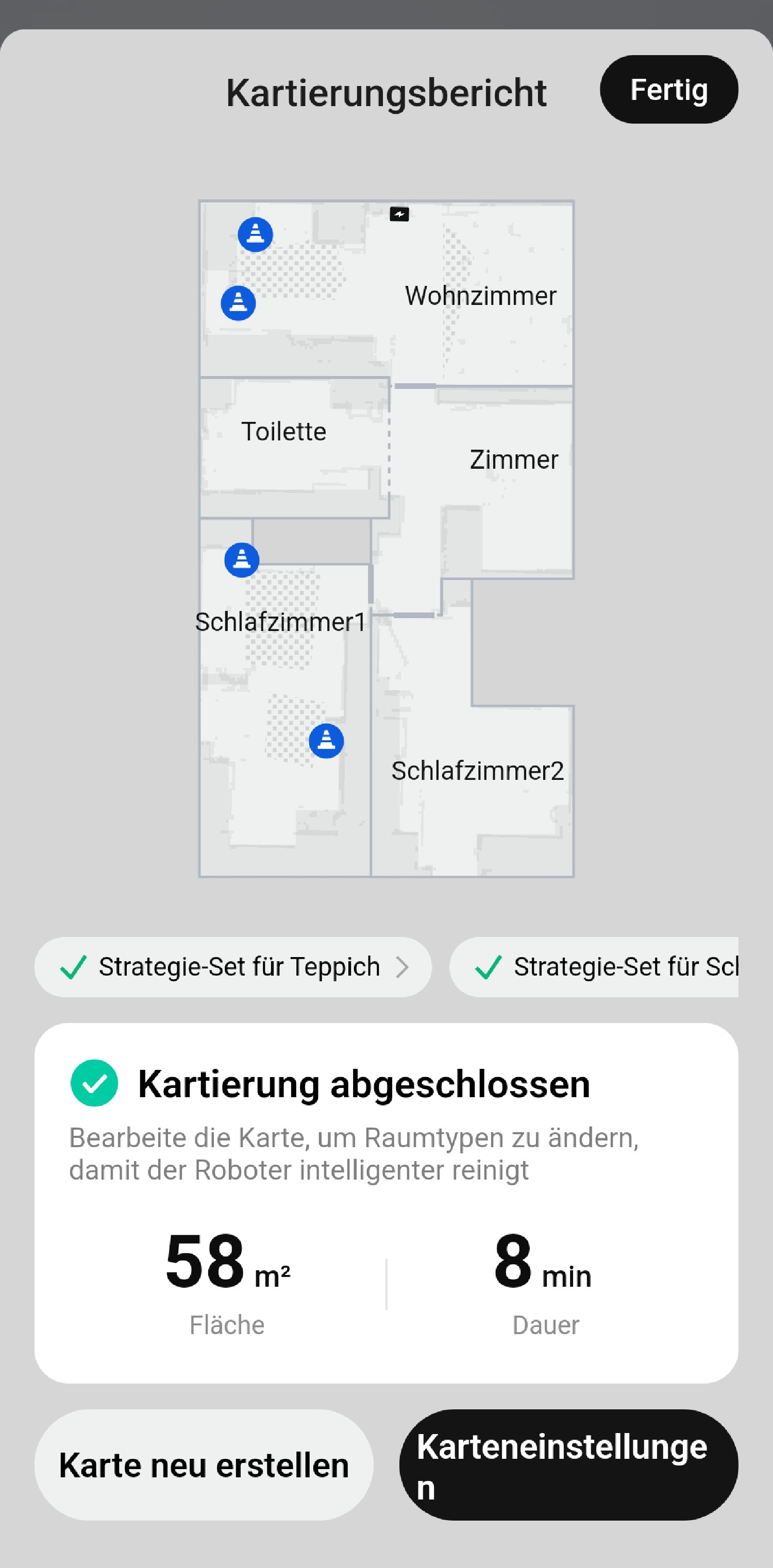
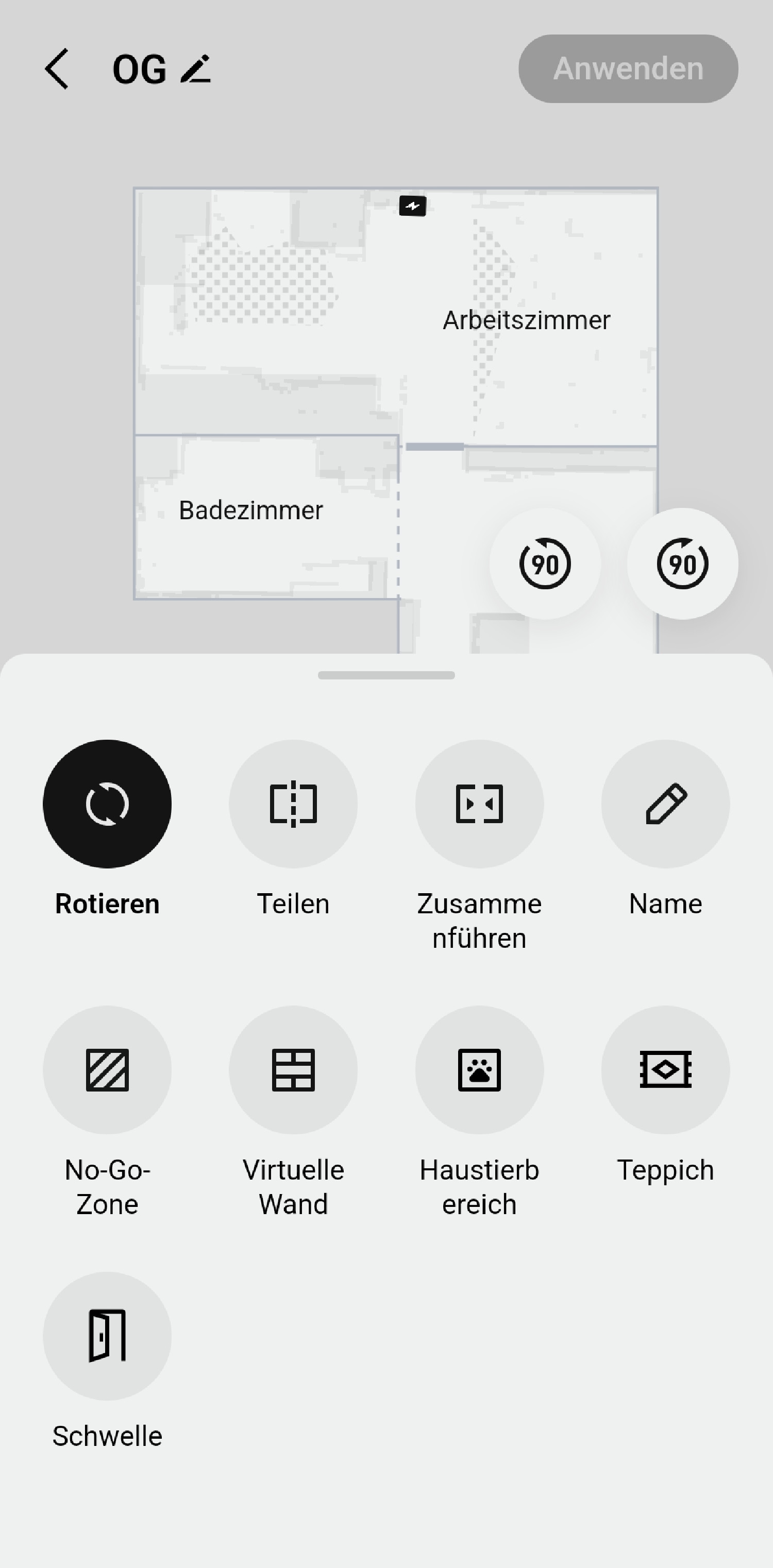
Before it could get started, the floor plan first had to be mapped. That went smoothly and matched the actual layout very well. The map was done within a few minutes.
Suction performance: The ROMO P2 steps up especially on carpets
When vacuuming, the ROMO P2 made a strong impression. On hard floors, it thoroughly picked up fine dust and coarser particles. The two side brushes guided dirt to the central intake while the robot systematically worked through open areas.
Compared with the ROMO P, carpet cleaning in particular moved more into focus for me. The predecessor had already impressed on hard floors. With the P2, DJI increases maximum suction pressure by 44 percent and adds a lowering pressure plate. This partially seals the suction channel against the carpet.
In practical use, the result matched the technical effort: even on carpets, it picked up dirt and hair thoroughly. However, the higher Pascal figure alone does not explain this – brushes, airflow, and driving strategy also contribute to the result.
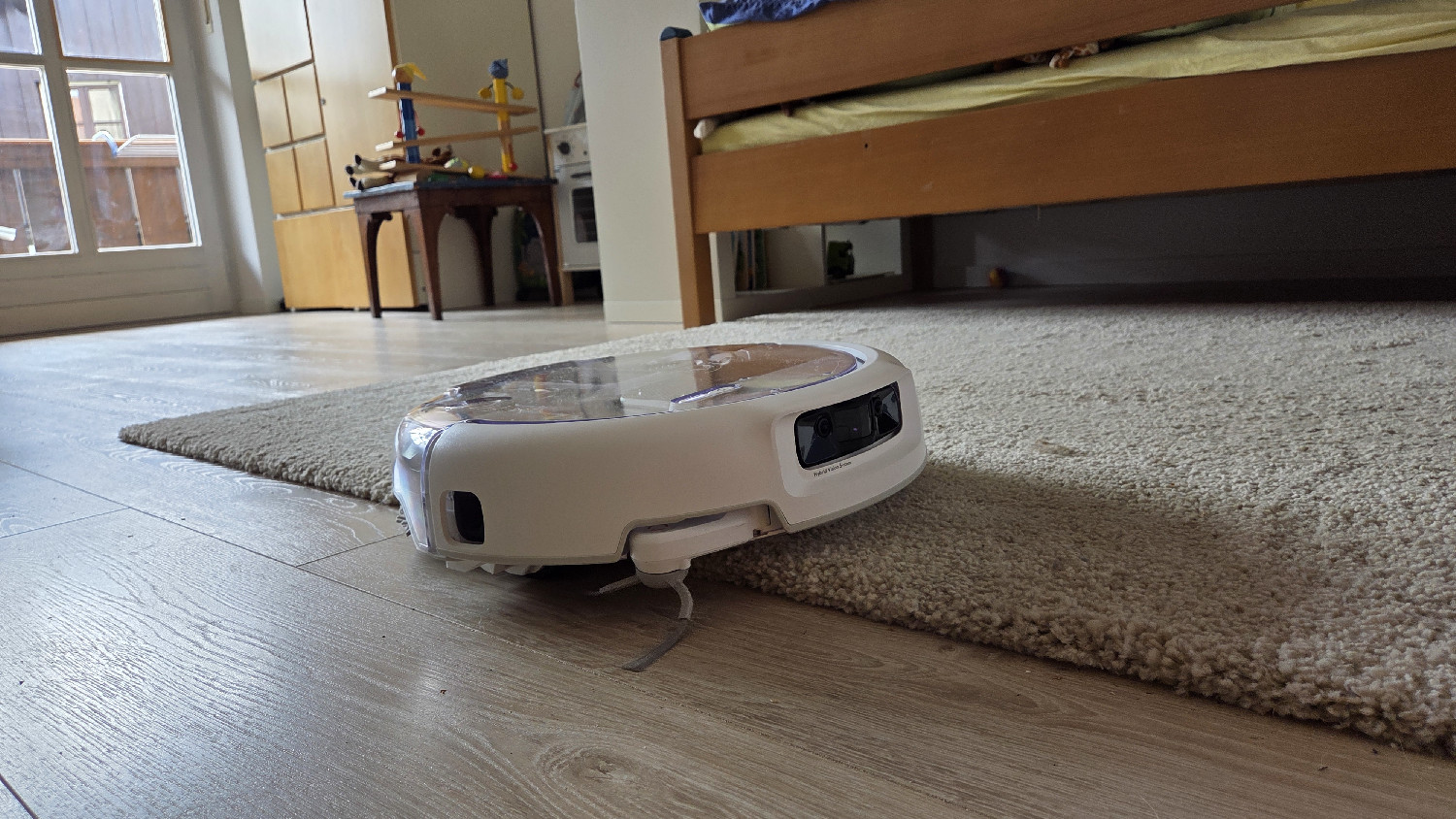
With high-pile carpet, I would still take a close look. The mops are lifted but remain attached to the robot. Depending on the pile height, they can touch the fibers. Automatic mop removal in the station would be the more flexible solution here.
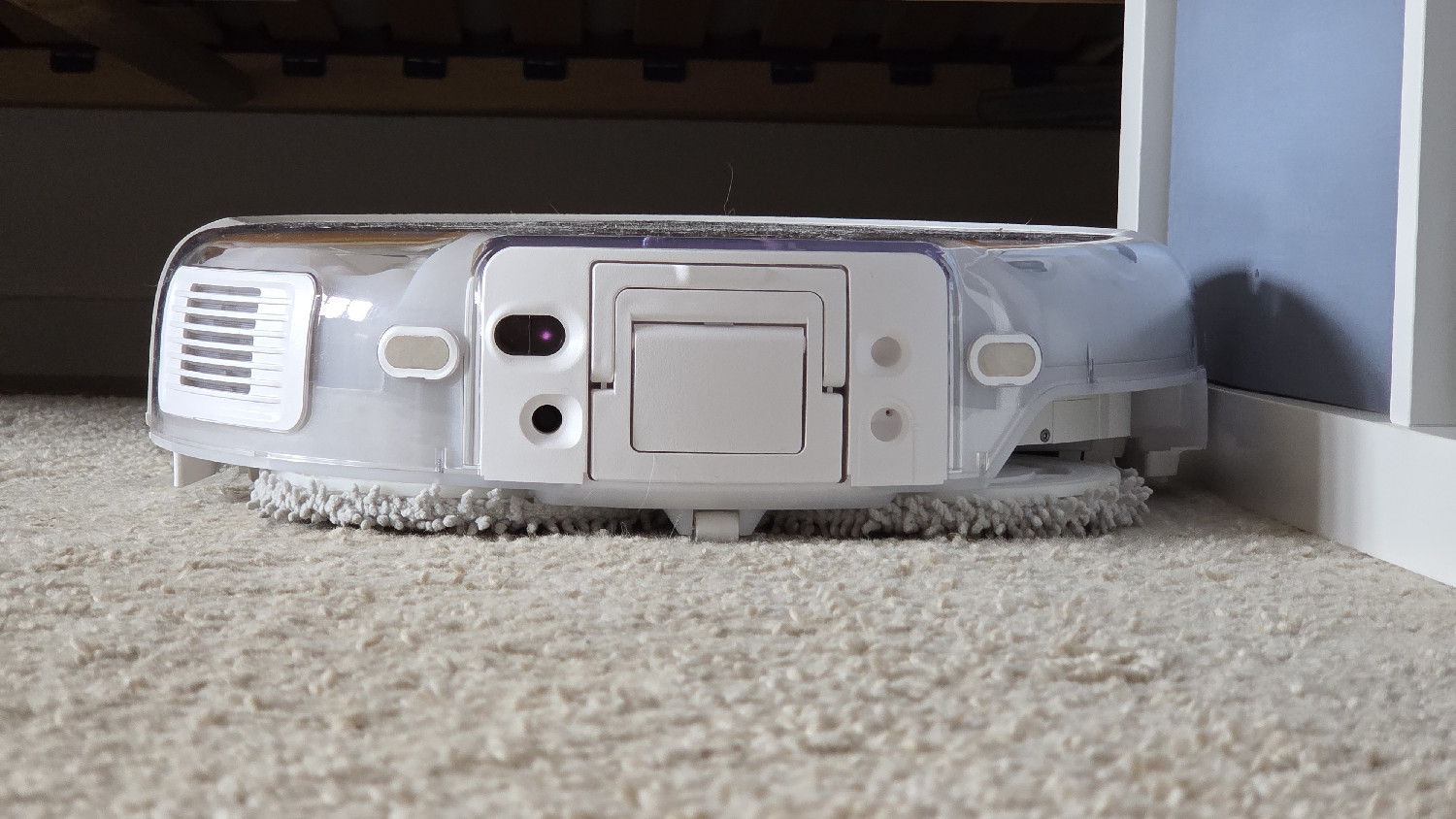
Hair and edges: Two side brushes work together
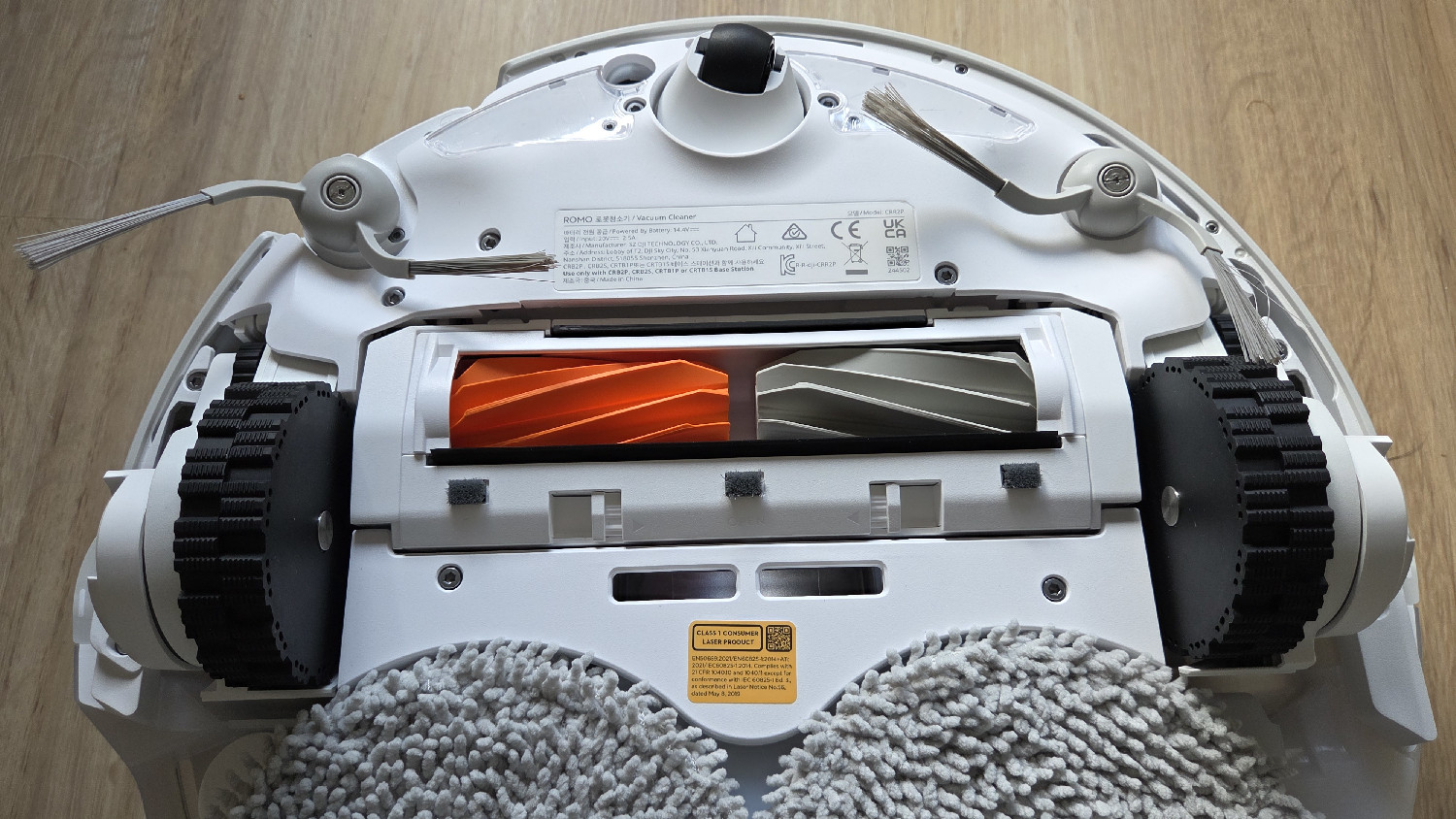
The brush system also made a good impression when handling hair. After the cleaning runs, very little remained stuck to the rollers, so the subsequent maintenance effort stayed within limits.
DJI calls the design DualSweep. Each side brush has two bristle tufts arranged at 120 degrees. Their sweeping areas overlap with those of the main rollers to transport hair as directly as possible to the suction intake.
For different floor types, there are rubber rollers as well as a version with bristles and rubber. Which version is additionally included depends on the package selected.
Along room edges, I noticed the slower, more deliberate working method. The robot first handled the open areas and then devoted itself to the edges. The result was thorough, even if the round design has its limits in tight corners.
Mopping performance: The longer arm makes the difference
When mopping, I paid particular attention to the new robot arm. The ROMO P already did a decent job along straight walls. The P2 expands this area: its arm swings out by up to 123 degrees and, according to DJI, reaches 7.8 cm farther. Under suitable furniture overhangs, it should therefore clean 4.5 cm deeper.
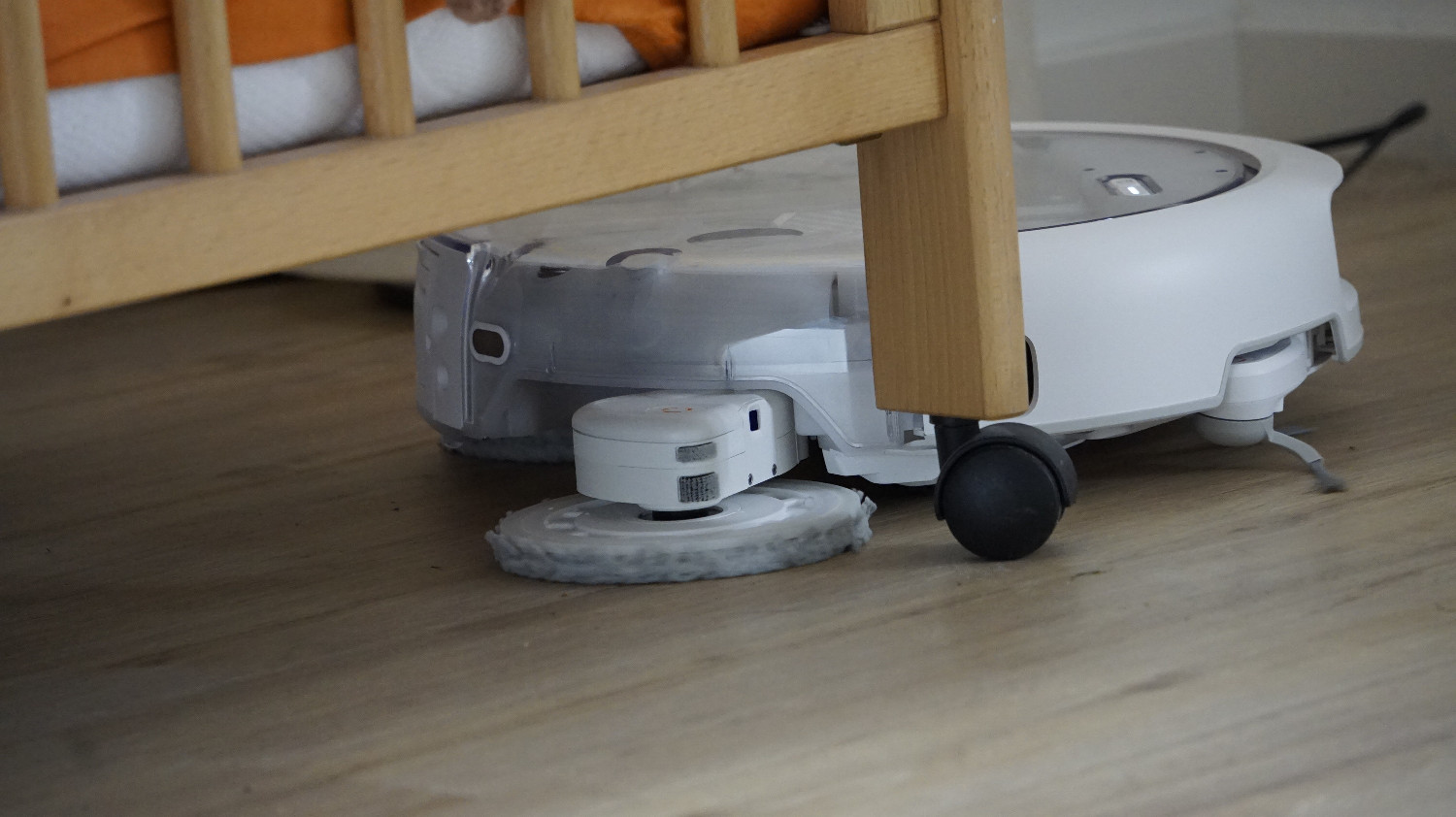
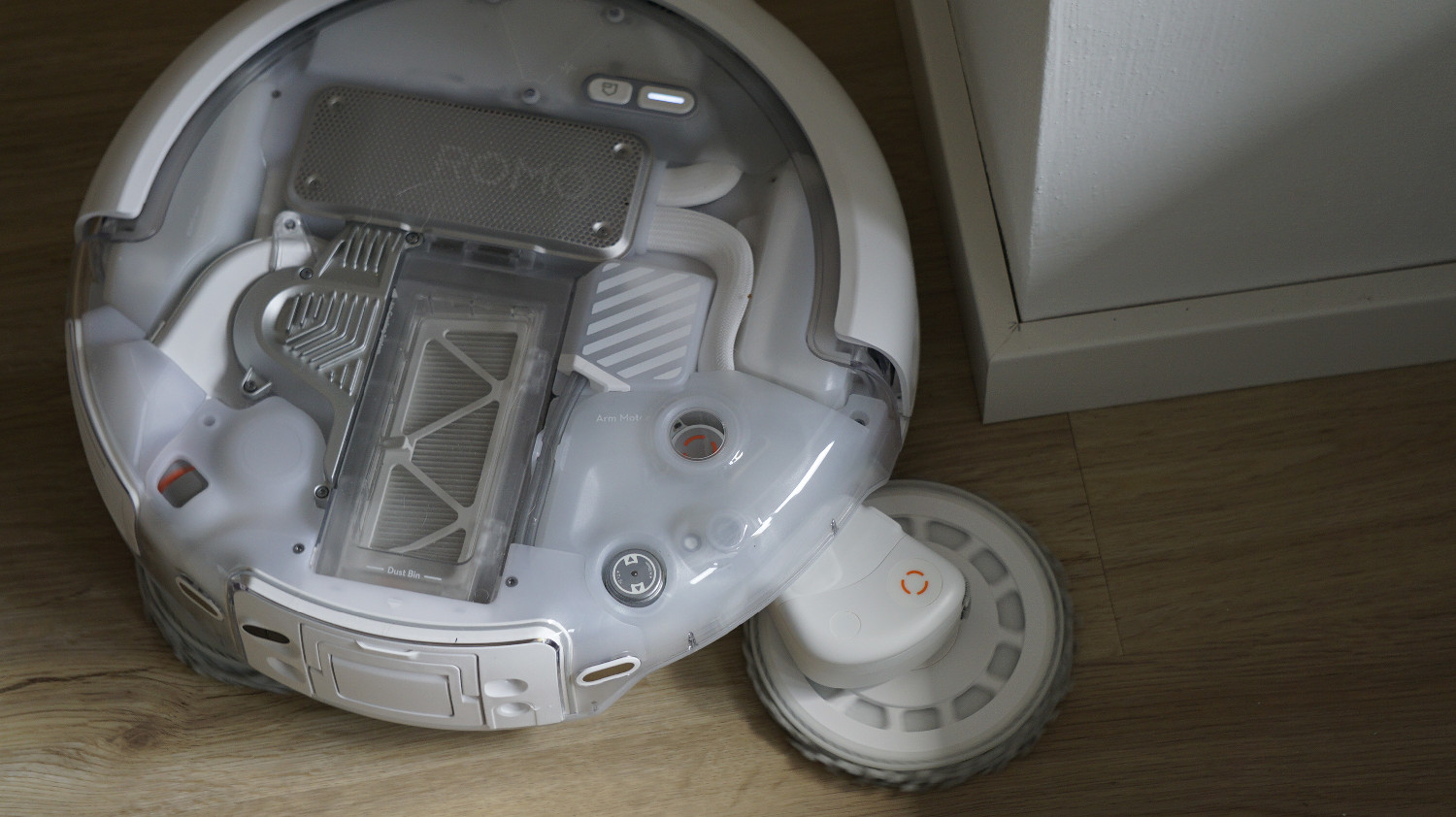
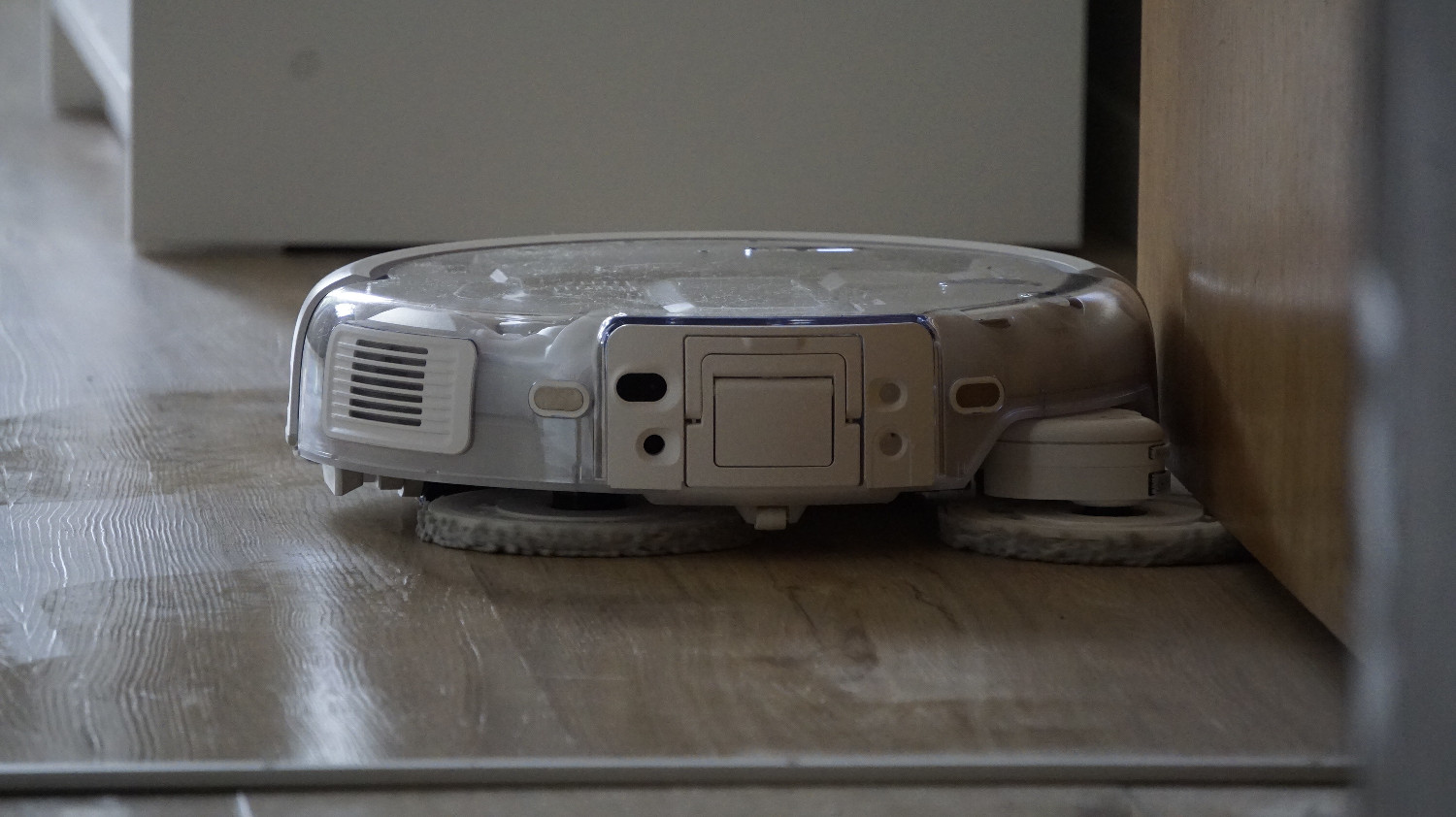

In use, what stood out most was how far the right mop pad protruded sideways from the housing. Along baseboards and around furniture legs, it was able to work on areas where the robot itself had no room. This made the predecessor's already good edge cleaning even more versatile.
I also liked the mopping result very much on open floor areas. Light stains disappeared reliably, and the P2 also worked relatively thoroughly on slightly dried-on stains. More demanding residues, however, still required additional passes. Especially here, it is worth adjusting the cleaning intensity accordingly and sending the robot out on regular cleaning tours.

The extended arm mainly improves the reachable area. It is not automatically a guarantee that every stubborn stain will disappear more quickly. After mopping, I therefore paid attention both to any remaining residue and to streaks in backlight. Overall, the Romo leaves a very even water film, mops streak-free, and leaves no gaps. A fabulous result.
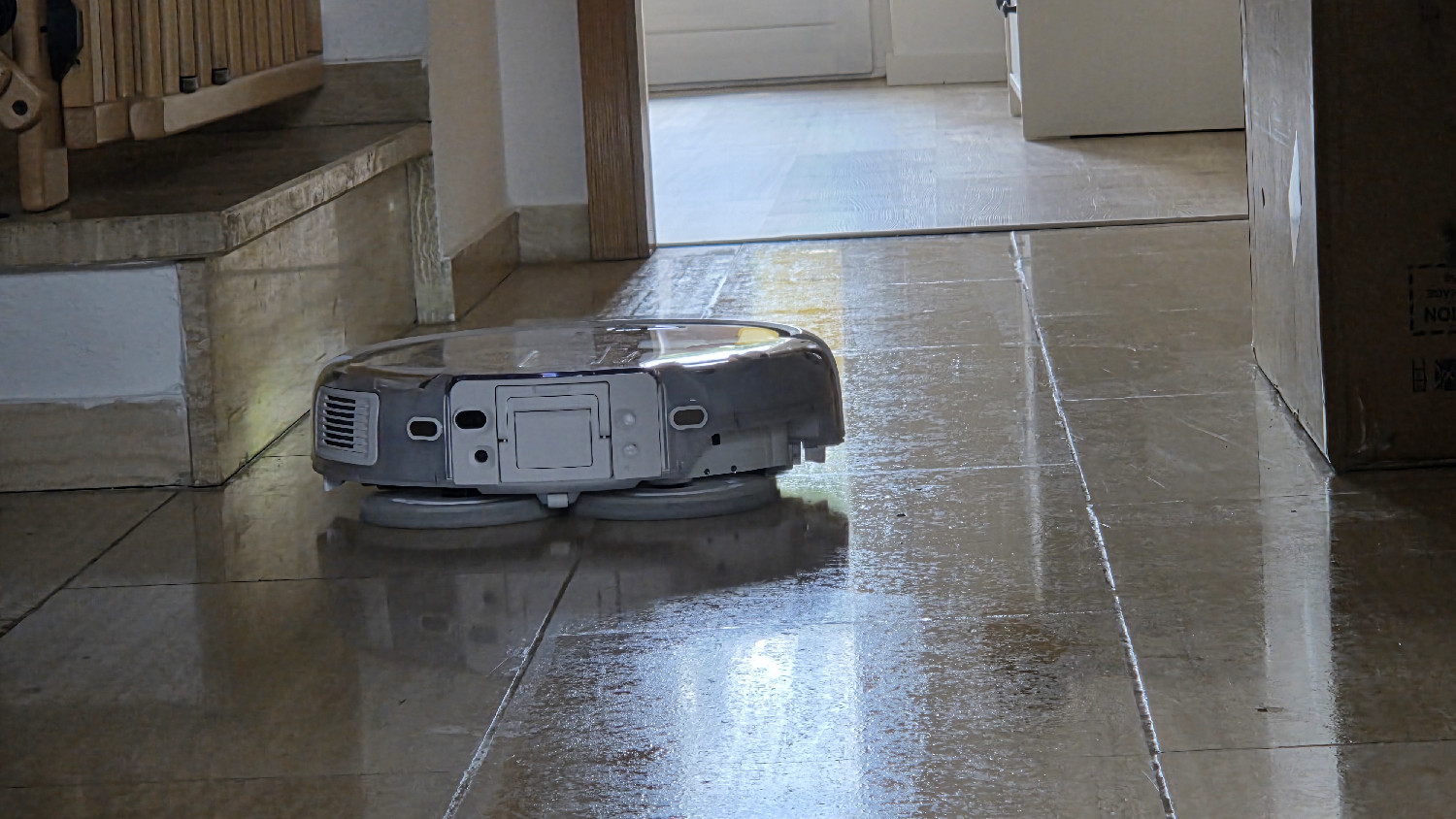
There is one more special feature – The function "Degrease floor." Here, the ROMO P2 cleans the floor in two steps:
Mop with cleaning solution: The damp, rotating pads loosen greasy residue.
Mop again with clean water: Another mopping pass picks up any remaining dirt and detergent residue.
This is intended to reduce grease films and streaks, especially on kitchen floors. So "degrease" describes a special cleaning sequence, not an additional mechanical function, but it is a welcome addition to the weekly mopping cycle.
Ultimately, I also tested the device on oiled parquet, and there I only had it dry wipe, using the setting "vacuum first, then mop." That worked wonderfully and gently enough for the delicate wood.
[asin="B0H8DJ99LD",type="standard"]
Obstacle detection: The reliable eye becomes even more versatile
Obstacle detection was already one of the ROMO P's greatest strengths. With the P2, DJI expands this strength to include the detection of transparent objects and adapted reactions to different types of dirt.
In everyday use, the robot moved in a controlled manner between furniture legs and loose objects, which is worth its weight in gold, especially in our household with children and dogs. Small obstacles were avoided without the cleaning constantly getting bogged down. In some tight passages, it behaved cautiously – here it is worth checking whether all accessible areas were actually reached, which can easily be verified via the app.

For detection, DJI combines a 3D ToF LiDAR with two fisheye image sensors. An additional sensor unit supports the extended arm. The advertised detection of cables from 2 mm in diameter applies under suitable conditions. In the test, at any rate, the P2 reliably handled typical mobile phone charging cables.
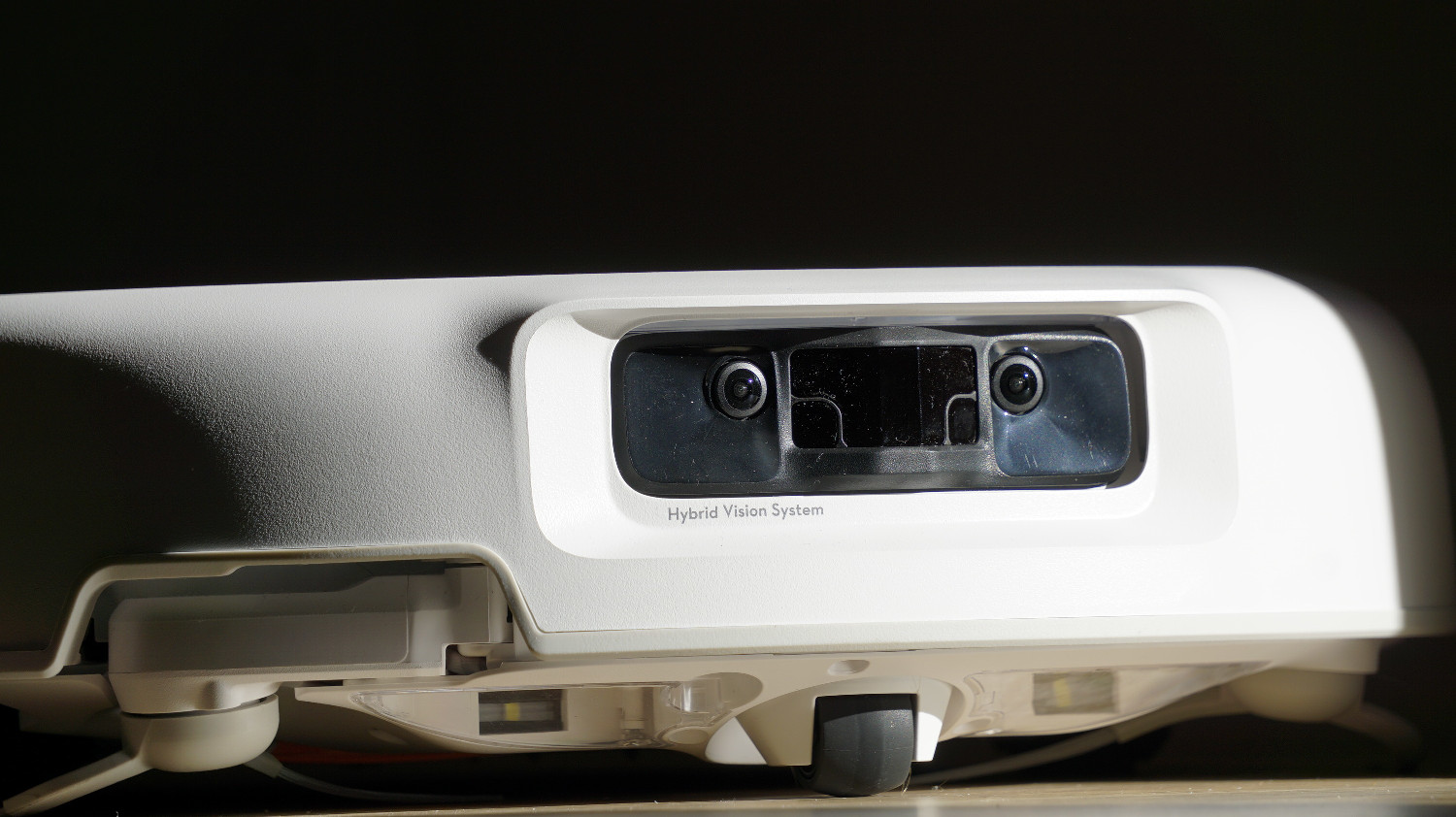
Transparent objects also remain subject to certain conditions: according to the manufacturer, solid obstacles must be higher than 6 cm. Vertical glass surfaces are easier to detect than angled ones. For certain detection functions, DJI also specifies at least 0.1 lux ambient brightness.
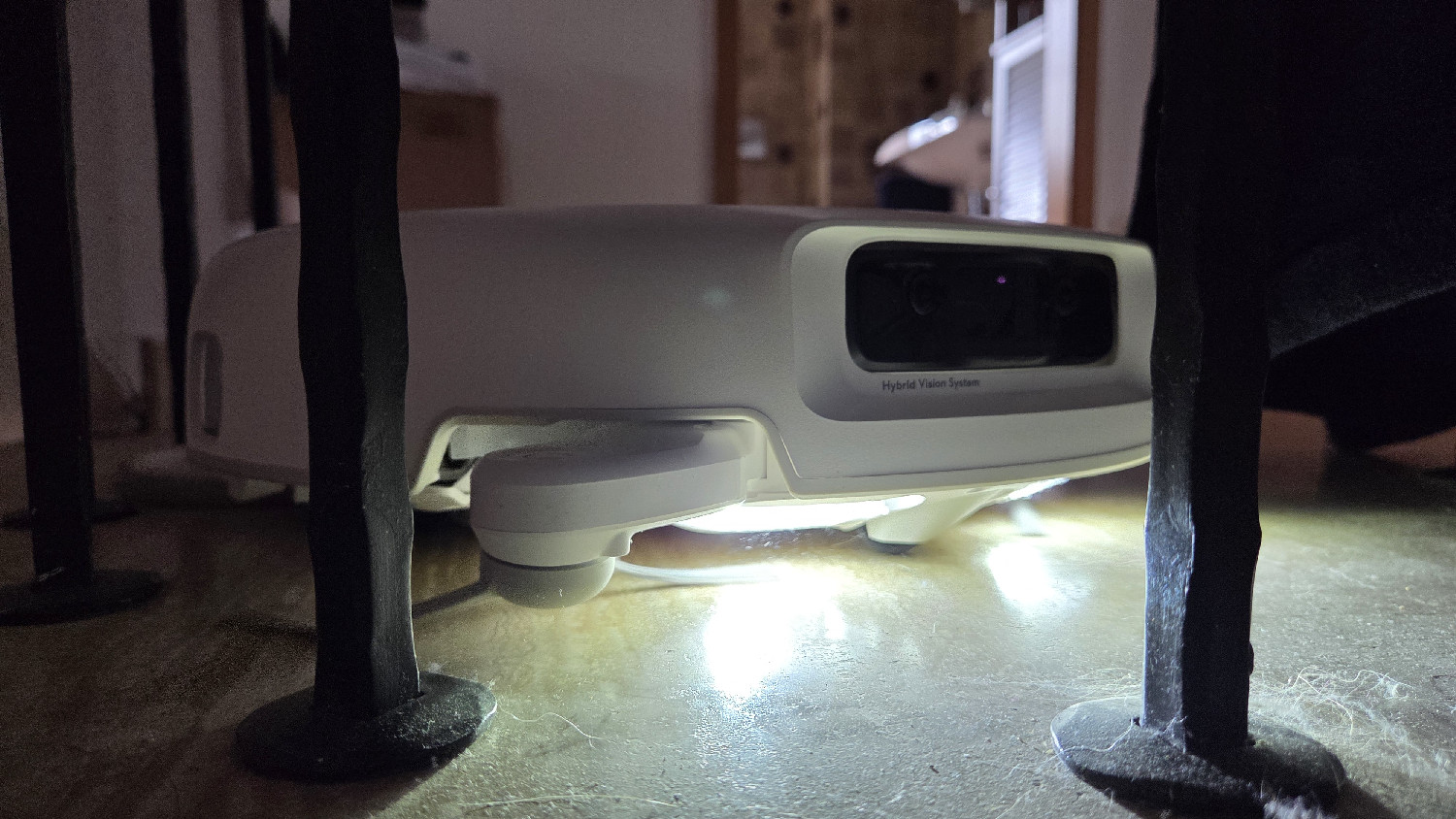
However, the Romo P2 can help itself in dark areas. The new and stylish underbody lighting (my term for it) generates enough light to effectively "open its eyes" in the dark. See for yourself:
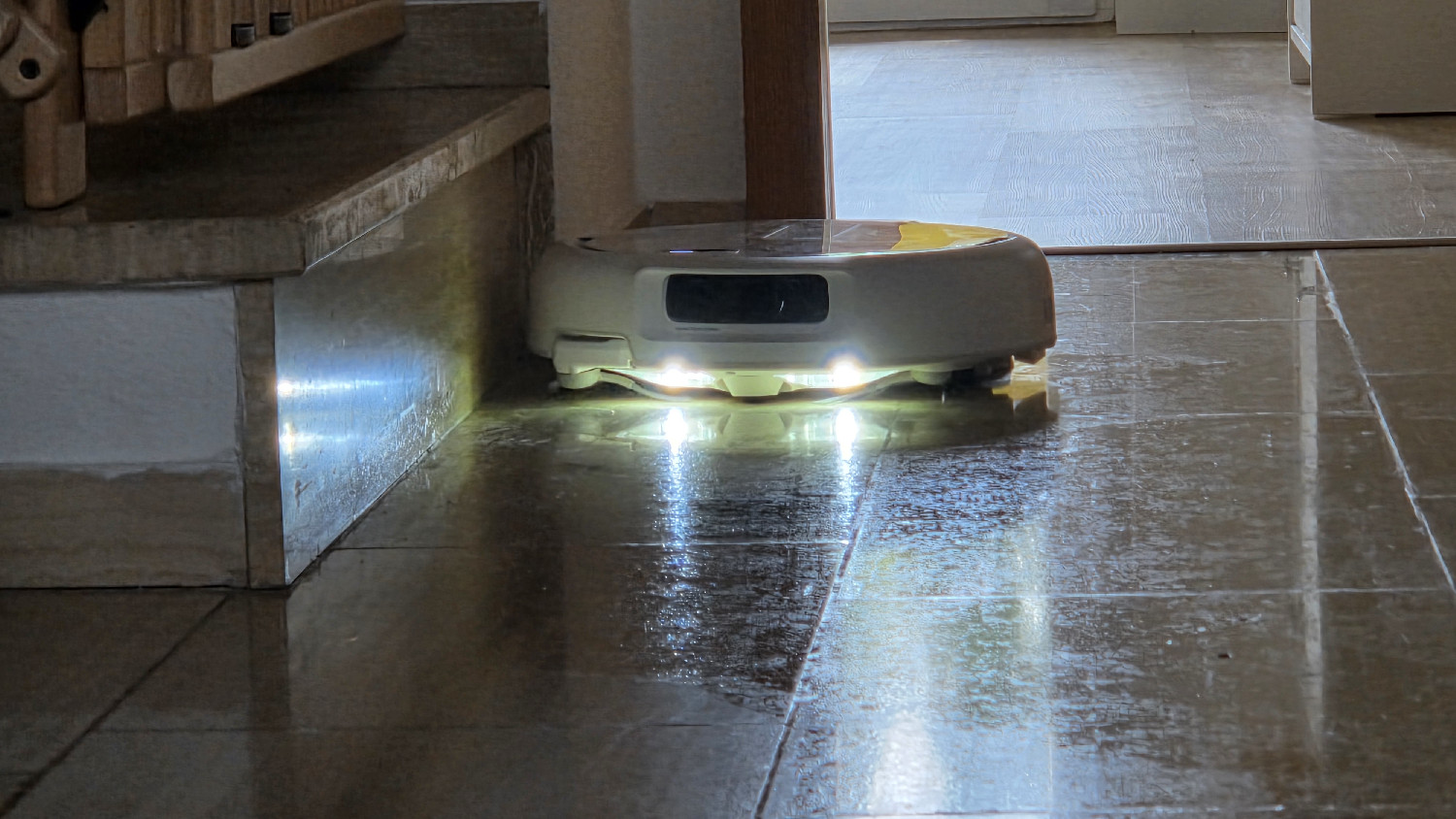
Overall, the navigation is pleasantly unobtrusive. More important to me was how reliably the P2 reacted to individual objects and how closely it could still clean around them while achieving a good end result.
Threshold climbing: Now the robot actively lends a hand
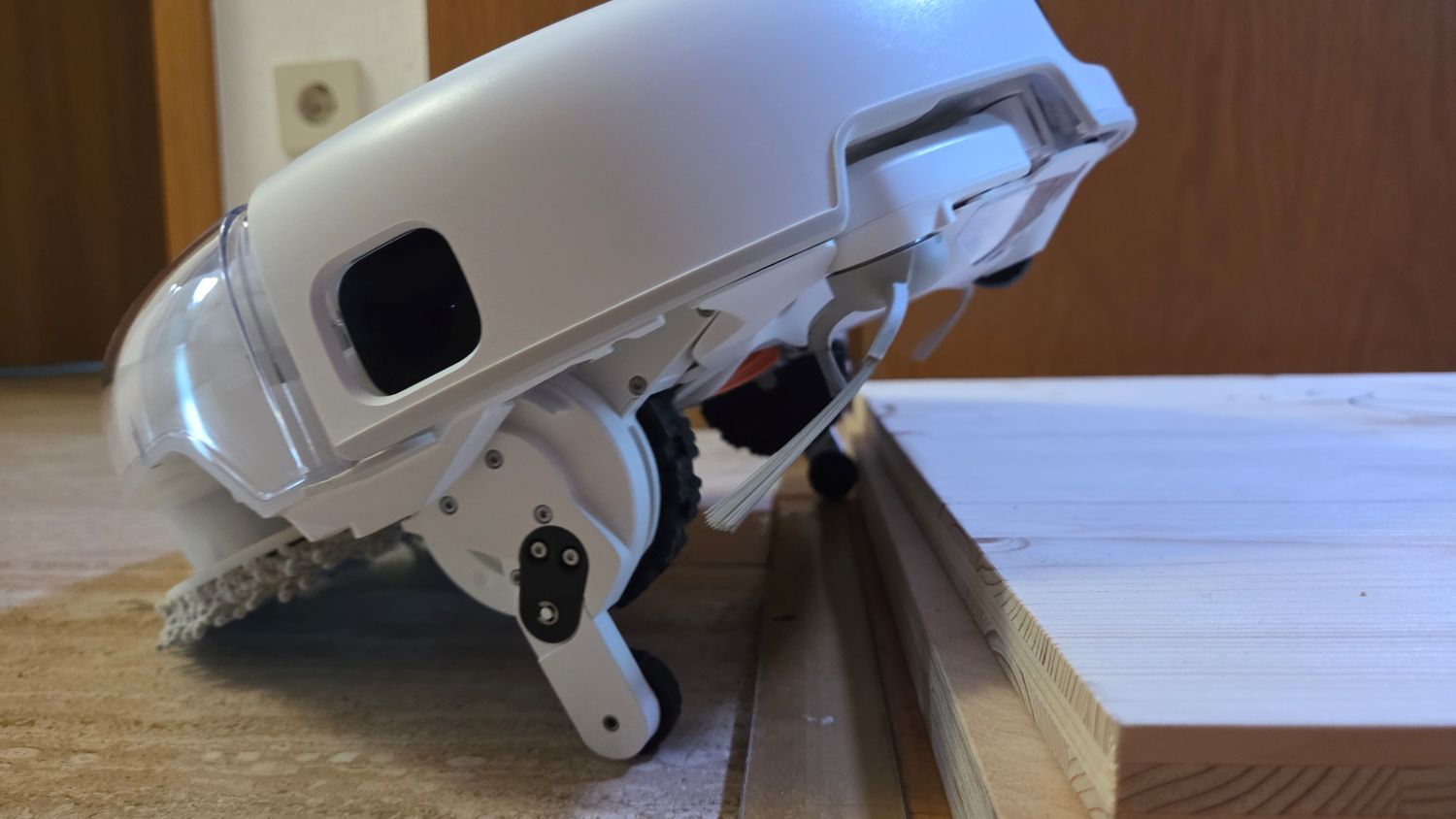
The new robot legs significantly expand the range of use compared with the predecessor. Instead of merely driving its traction wheels against an edge, the P2 can actively lift its housing.
However, the advertised 8.5 cm requires some explanation:
Obstacle | Manufacturer specification |
|---|---|
Single step | Up to 4 cm |
Double step | Up to 8.5 cm in total |
Construction of the tested double step | First step up to 4 cm high and 20–22 cm wide, second step up to 4.5 cm high |
This does not mean just any threshold with a height of 8.5 cm. For homes with pronounced door thresholds, however, the climbing aid is still an interesting addition. Height, shape, and space for approach remain decisive.


[topdeals]
Cleaning station: Lots of automation, but not a maintenance-free year
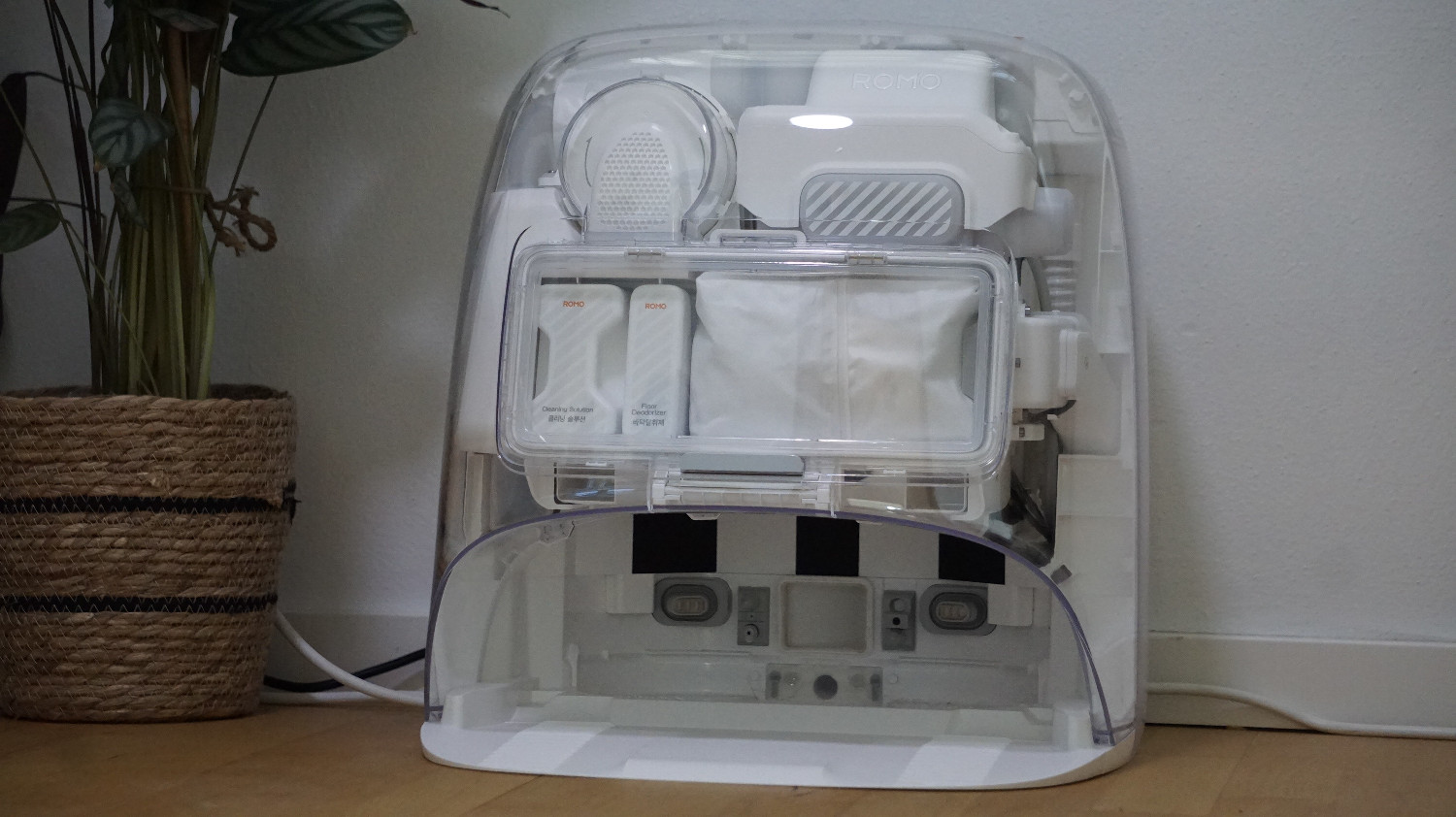
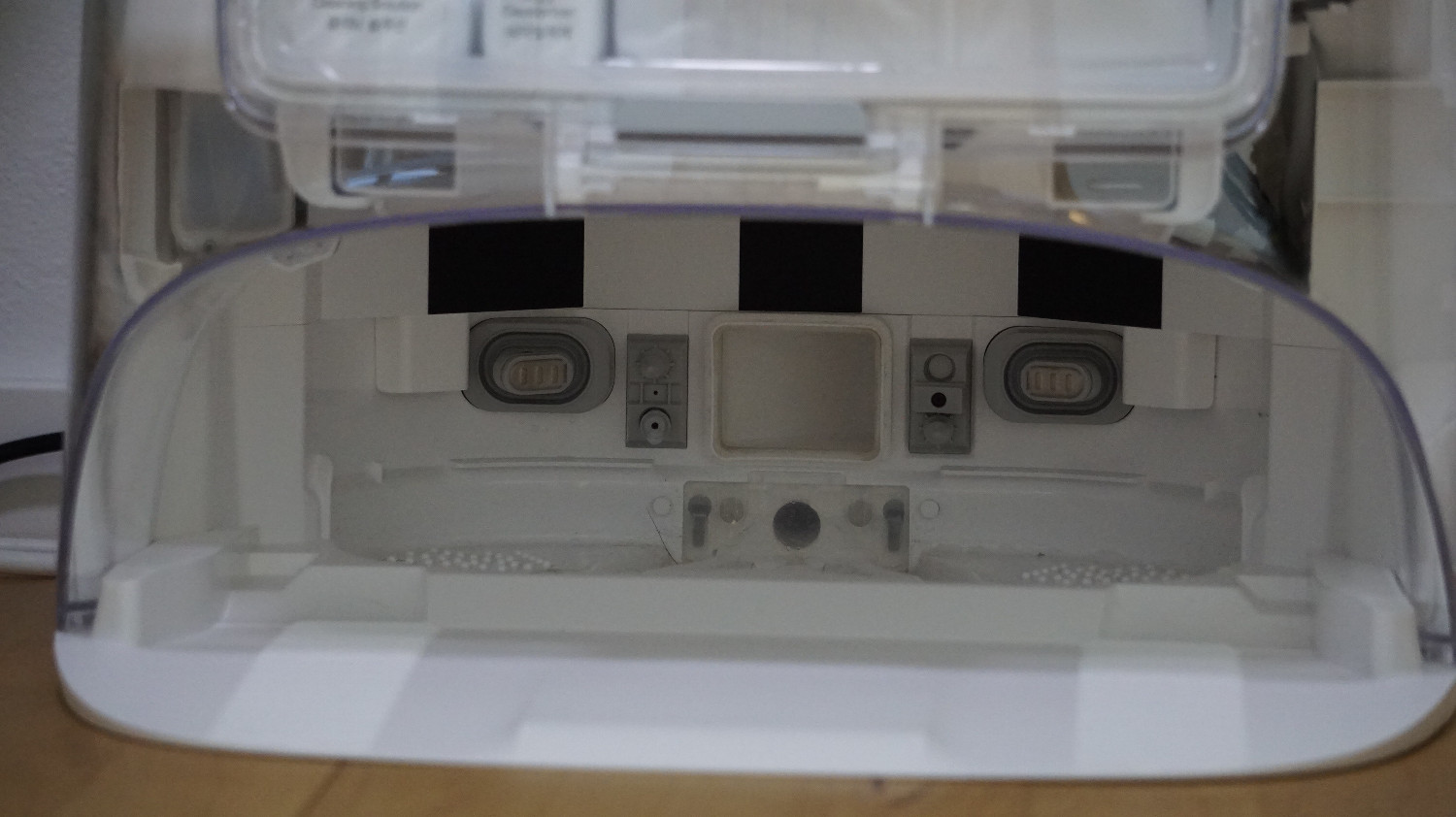
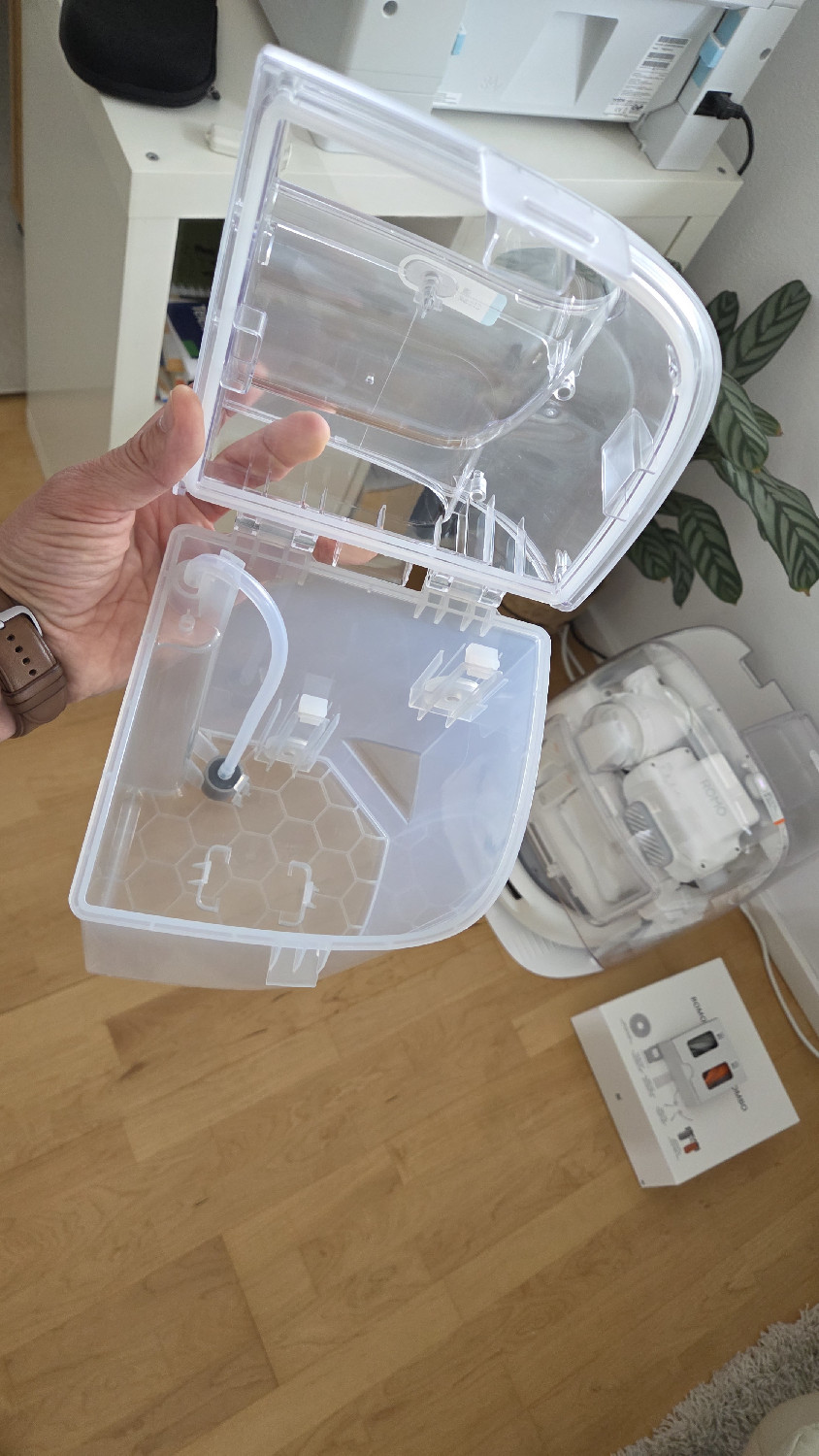
The station handles dust emptying, water supply, mop washing, and drying. The tanks hold 4 liters of clean water and 3.2 liters of dirty water, and the dust bag holds 2.4 liters – These are standard market dimensions.
With the P2, DJI adds a dirt-repellent surface to the washboard. Four high-pressure nozzles rinse residue toward the 16 mm suction opening. In use, the washing area therefore stayed pleasingly clean.
The claim "365 days maintenance-free" refers exclusively to this washboard and comes from a laboratory test. Emptying tanks, refilling water, and replacing consumables remain the task of the master or mistress of the house.
The temperature specification also deserves precision: according to the manufacturer, the advertised 80 °C is reached in the heating element. That does not mean the mop pads are continuously washed at 80 °C. For their drying, DJI specifies 60 °C. Even so, this helps kill bacteria and actively promotes hygiene on the floor.
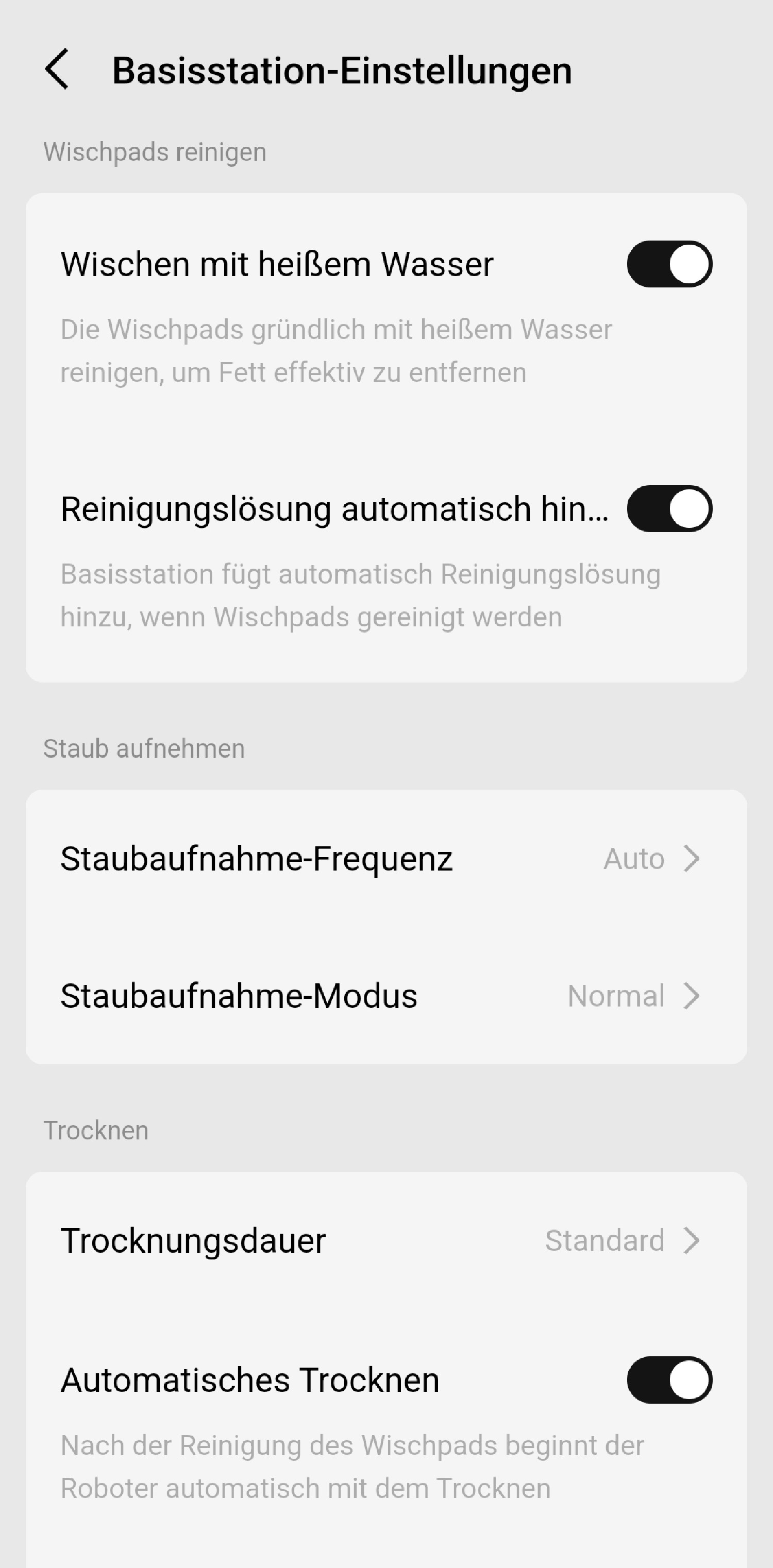
The P2 equipment also includes automatic detergent dosing, a floor odor remover, dust container drying, and UV light for the dust bag. When it comes to ongoing costs, the intended cleaning solutions and replacement bags should of course be taken into account. In the premium segment, however, there are hardly any models where these accessories are missing. One could of course still argue that a version with cyclone dust extraction would be more sustainable.
App and noise level: Plenty of settings, pleasant operation
The DJI Home app bundles maps, cleaning jobs, and maintenance notes. Rooms and cleaning routines can be configured individually, and multiple floor maps are also possible. The robot supports 2.4 and 5 GHz Wi-Fi.
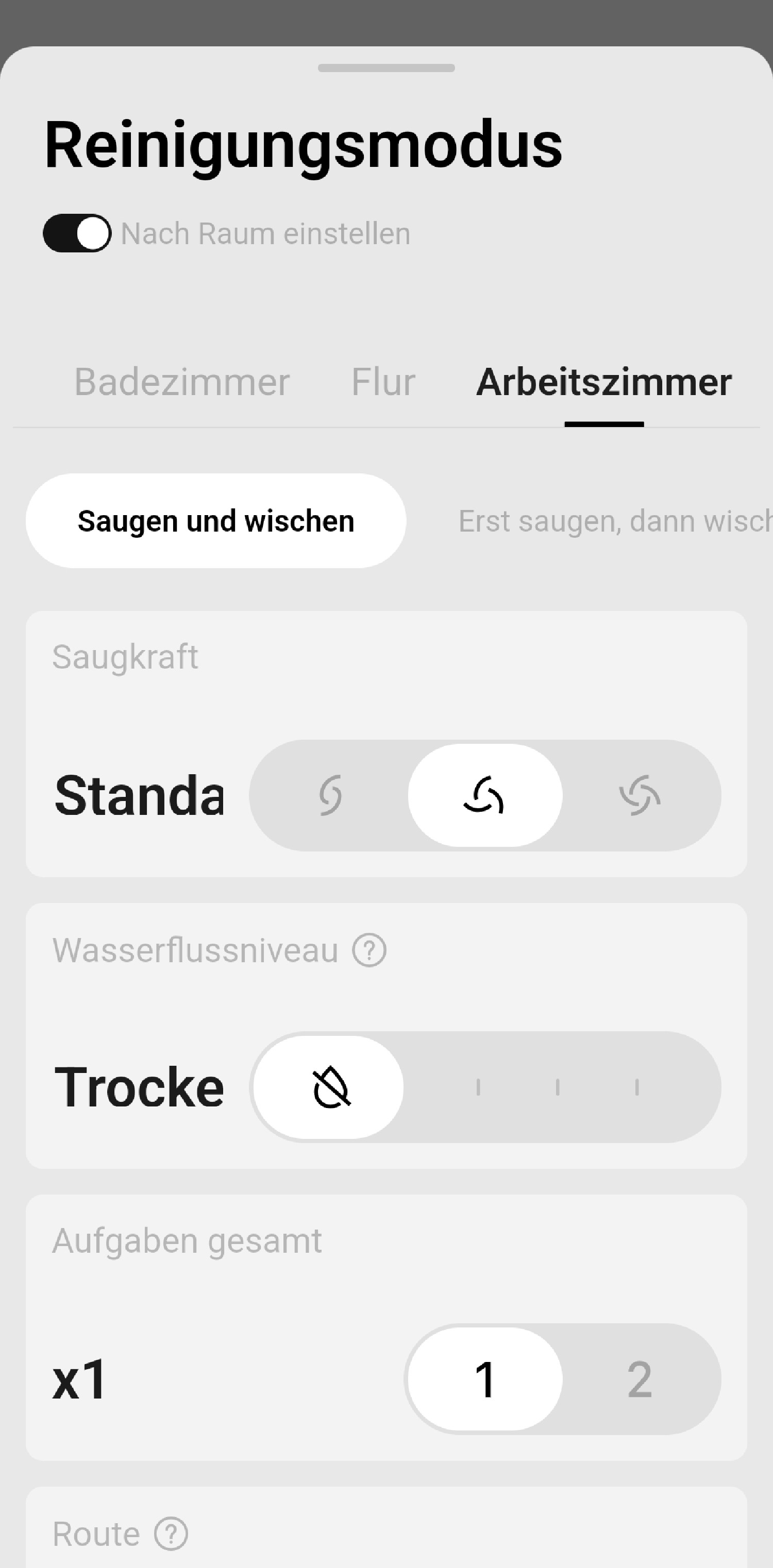
I find the choice between simultaneous vacuuming and mopping and separate passes practical. The announced handling of furniture within the map should only be considered an available function once the corresponding firmware update has actually been installed.
During operation, I found the P2 pleasantly quiet. The brief dust extraction was much more noticeable than the normal cleaning run. DJI specifies the following laboratory values:
Operating mode | Manufacturer specification |
|---|---|
Quiet mopping | 38 dBA |
Vacuuming and mopping | About 54 dBA |
Drying | About 40 dBA |
According to the manufacturer, the 5,000 mAh battery enables about three hours of quiet vacuuming. A full charge takes approximately 2.5 hours, measured with drying switched off. This means large areas are well covered and, in case of recharging, cleaning can also be finished quickly. Below, I have provided some images from the app for you:
Settings from the app
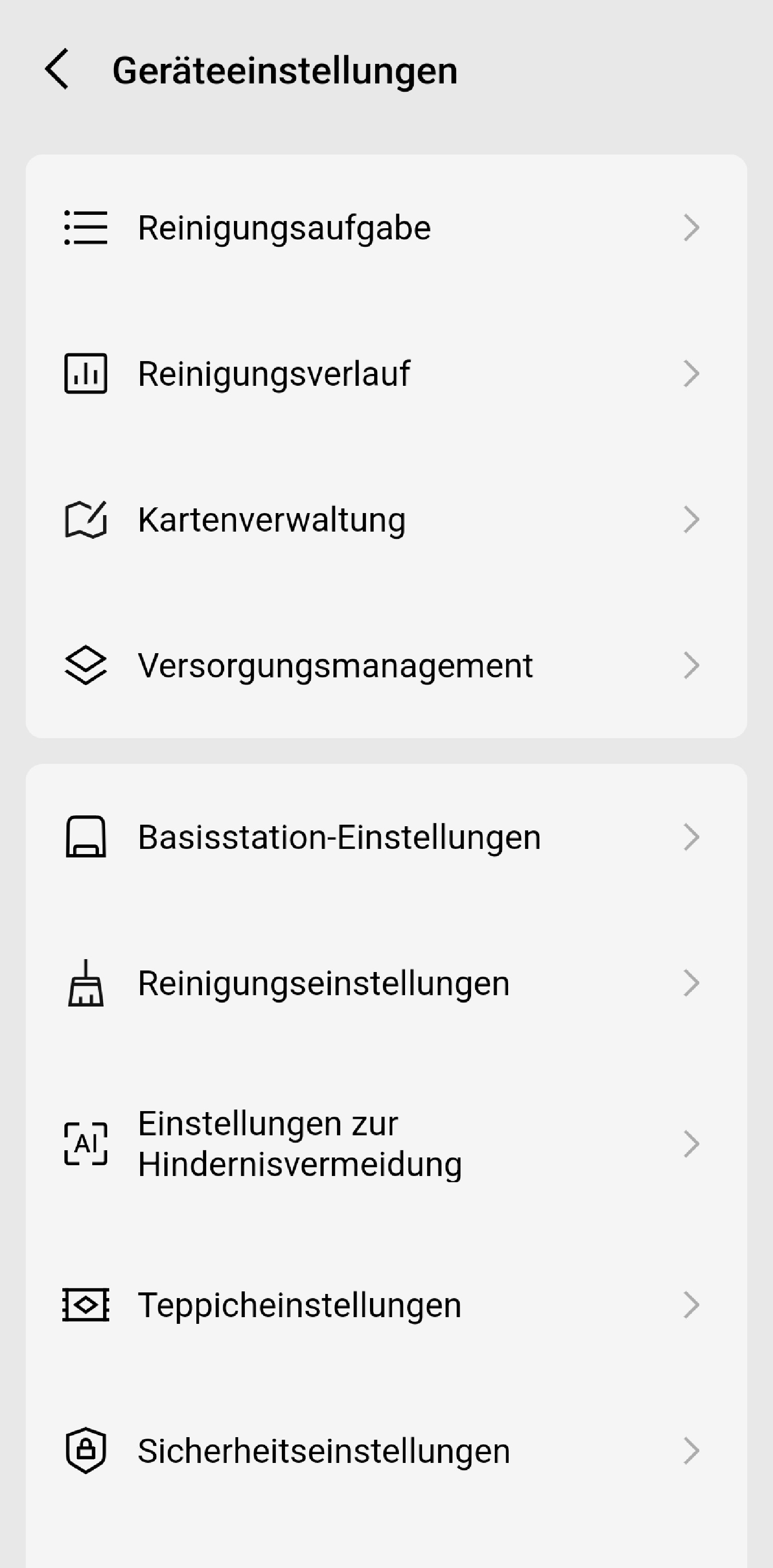
Set up base station
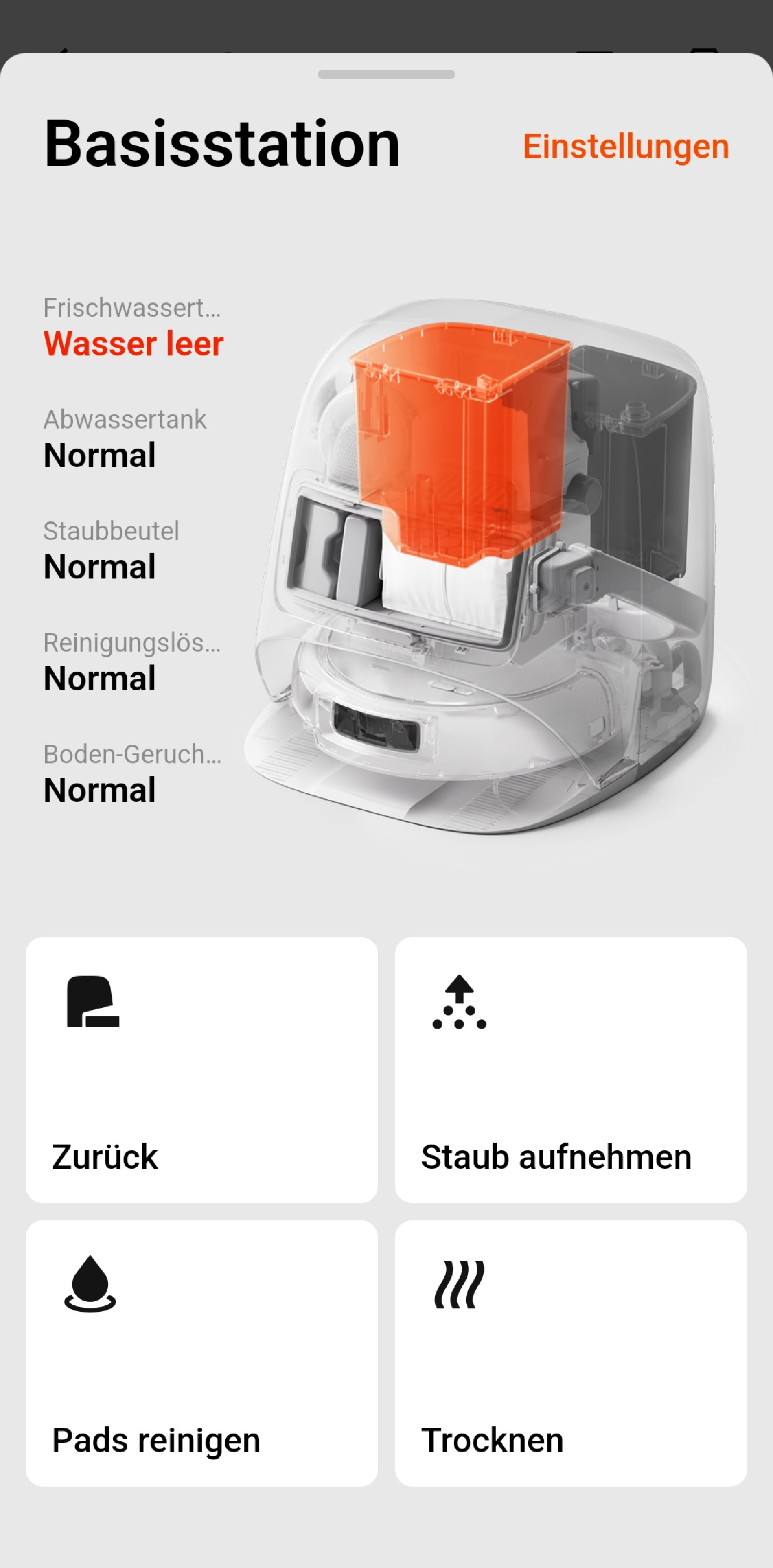
Start cleaning


Price and ongoing costs: Premium class with a manageable Combo surcharge
The ROMO P2 regularly costs 1,299 euros, and the Clean More Combo 1,349 euros. At the time of research in September 2026, offer prices were 1,059 and 1,099 euros respectively – 100 euro voucher in the DJI shop –> Link to the offer. For the 40-euro surcharge, I would prefer the Combo, which is otherwise offered for 100 euros: additional rollers, side brushes, eight mop pads, and two filters also make up a useful stock of spare parts.
Compared with the market, DJI is therefore below the launch prices of around 1,599 euros each for the Dreame X60 Pro Ultra Complete and the Roborock Saros 20 Sonic. Current offers can reduce this gap, however. Nevertheless, I currently see the DJI Romo P2, especially when you look at the major progress, good customer service, and high quality of the robot, as the more attractive overall package and would therefore keep my distance from Dreame and Roborock. Neither company has impressed me over the past two years in terms of durability and customer service.
Ongoing costs include dust bags, cleaning solution, possibly odor remover, as well as wearing parts such as filters, brushes, and mop pads. Added to that are electricity and water, especially for mop washing and drying. A reliable yearly total cannot be stated without longer-term consumption measurements. The advertised maintenance-free washboard saves maintenance effort, but it does not eliminate these running costs.
My conclusion: More reach for the rolling display case
The DJI ROMO P2 meaningfully builds on the strengths of its predecessor. What I found particularly interesting was the combination of thorough dirt pickup and the significantly more agile mop arm. This noticeably expands cleaning around furniture and overhangs and is, for me, the key innovation.
The reliable obstacle detection complemented the package in terms of more convenient and spontaneous cleaning without lengthy tidying beforehand. Added to that are active climbing aids and a convenient station with a high hygiene factor. Limitations remain with delicate high-pile carpets, very tight areas, and stubborn residue that requires extra mopping passes.
Anyone who already owns a ROMO P should mainly consider whether greater mopping reach and higher threshold climbing would make a difference in their own home. In most cases, upgrading from the predecessor is not worth it. For a new purchase, the P2 is particularly interesting if thorough vacuuming on hard floors and carpets, deep edge cleaning, and reliable obstacle detection are top priorities and perhaps children or dogs/cats also live in the household, making cleaning somewhat more complex and allowing you to benefit from the technical refinements of the Romo P2. It has my blessing!
All pros and cons at a glance:
Thorough dirt and hair pickup
Wide-swinging mop arm
Reliable obstacle detection
Active help when crossing thresholds
Pleasant operating noise
Extensive station automation
No automatic mop removal
At 9.8 cm, not especially flat
Sometimes cautious in tight spaces
Ongoing costs for bags and cleaning solutions
Maintenance promise applies only to the washboard
[asin="B0H8DJ99LD",type="standard"]

