The JIMMY Matrix M9 Pro + S9 in review: How good are the water filter, cooling, and sparkling function in everyday use really? We show the strengths and weaknesses in a practical test.
JIMMY Matrix M9 Pro + S9 review: Drinking made easy in the home office
Filtered drinking water, hot water for tea, and chilled sparkling water on demand – without a fixed water connection: With the Matrix M9 Pro and the S9 sparkling module, JIMMY combines several functions into a modular drinking water station. The basis is a reverse osmosis system with hot water dispensing, while the S9 handles cooling and carbonation.

For me, the system was used primarily in the home office as an independent water dispenser. That is where its biggest advantage for me became clear: because fresh water was always within reach, I drank significantly more. And not just more, but also with more variety – instead of hastily tossing back a glass of tap water during a hectic workday, I could now also enjoy a cozy tea, cool sparkling water in the hot summer of '26, and as a result, one or two fewer coffees.
Whether this combination can actually replace cases of bottled water, however, does not depend solely on the water options. The test also focused on ease of use, cooling, cleaning, and follow-up costs. In this regard, the M9 Pro impressed me more than the S9, which in my opinion is not yet fully refined.
Transparency note: The test device was provided to me by [url="https://www.zigbuy.de/wasserfilter/1055-jimmy-matrix-m9-pro-umkehrosmose-s9-sprudelmodul-6946499318131.html",name="zigbuy.de",title="Zum JIMMY Matrix M9 Pro mit S9-Sprudelmodul bei zigbuy.de"]. This report describes my independent experiences with the provided device, including the weaknesses and defect that occurred.
10% discount code at zigbuy.de: smj9f
[tableofcontent]
The most important test results at a glance
The M9 Pro made a good overall impression. Setup without a fixed water connection was straightforward, the touch display was clear, and the different temperature settings make preparing hot drinks convenient. Especially at the workplace, I found it practical not to have to go to the kitchen for every glass of water or cup of tea.
The modular AquaLink system also makes sense: if you initially only need filtered and hot water, you can use the base station on its own. The S9 later expands it with chilled water plus a sparkling water maker. However, the combination is not a fully automatic sparkling water station – carbonation is done separately via a mechanical lever, and the water inlet must be stopped manually so the bottle does not overflow.
Test area | My result |
|---|---|
Everyday usefulness | Especially high in the home office; ready-to-hand water had a positive effect on my personal drinking volume. |
Filtration | Significantly lower displayed TDS value and subjectively somewhat softer, more neutral taste. |
Hot water | Practical temperature selection, but no freely programmable dispensing quantities. Very fast dispensing. |
Cooling | Pleasantly cool water, but audible operation and limited cold water supply. |
Sparkling function | Carbonation strength can be dosed manually; unfortunately the lever is not particularly robust. |
Follow-up costs | Calculated at around €90 annually for replacement filters alone. |
Design and features: Modular, but requires space
The devices arrived well packaged at my home. My first impression was positive. With their rounded housings and uniform design, the M9 Pro and S9 visually go well together. The workmanship appears mostly decent. However, the housings are primarily made of plastic, which, given the price level, does not necessarily create an especially premium impression.
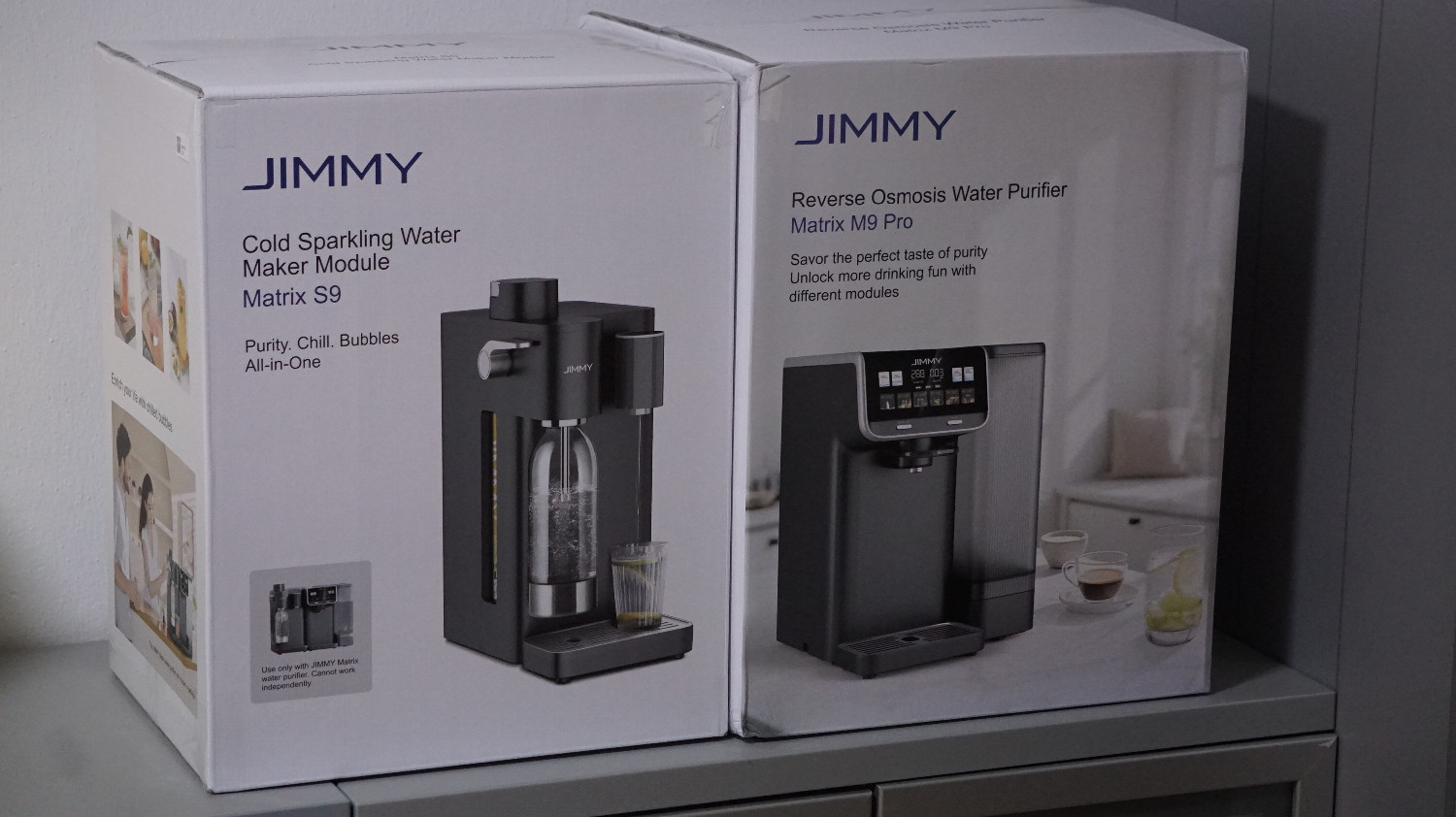
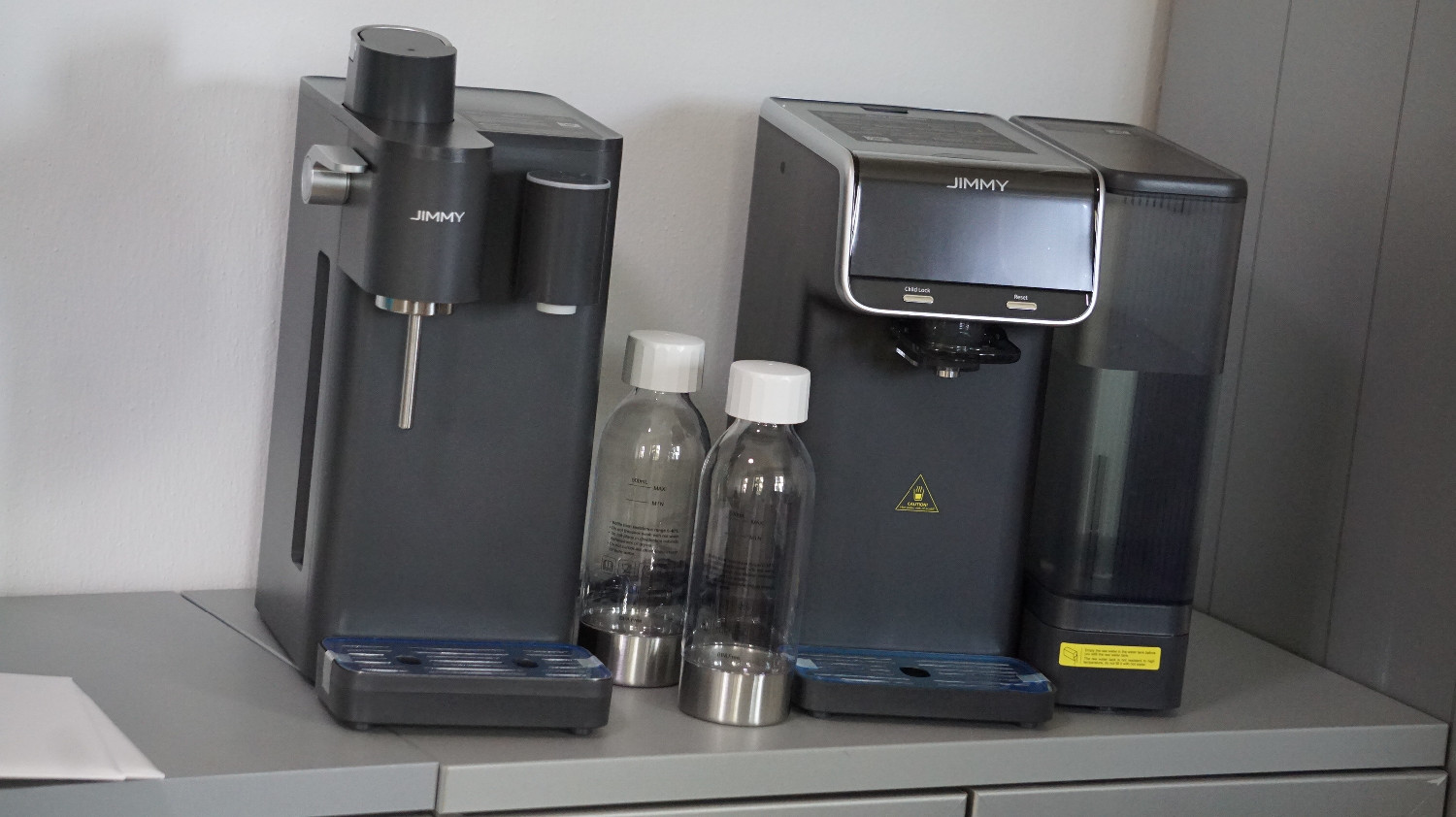
Together, the devices come to just under 48 cm in housing width. In addition, there is the space needed for operation, tank removal, and maintenance. For a small desk, the duo would therefore be too large for me; on a separate shelf in the home office, it can be accommodated well.
Additional modules can be connected to the M9 Pro via the AquaLink system. Besides the S9, JIMMY also offers the I9 for ice cube production, for example. At present, however, only one additional module can be connected at a time. Anyone wanting to use several expansions simultaneously will have to accept limitations in user convenience here.
A different approach is taken by the already tested [url="https://www.siio.de/hydrofast-c300-im-test-wasser-filtern-kuehlen-erhitzen-und-aufsprudeln/",name="Hydrofast C300",title="Zum Testbericht des Hydrofast C300"], which combines filtration, heating, cooling, and carbonation in one housing. JIMMY, on the other hand, offers more flexibility if you initially only need part of the functions.
Below, I have summarized a few key technical data points.
Property | JIMMY M9 Pro | JIMMY S9 |
|---|---|---|
Dimensions W × D × H | 27.8 × 31 × 36.6 cm | 19.8 × 31 × 40.2 cm |
Weight | 7.5 kg | 3.33 kg |
Water tank | 5 liters of raw water | 0.75 liters of chilled water |
Functions | Filtering and heating | Cooling and carbonating |
Rated power | 2,200 W | 100 W |
Water supply | Manually refillable tank | Via the M9 Pro |
Technical specifications according to the provided product information. Rated power is not the same as average electricity consumption.
Setup: No fixed water connection required
Setup was straightforward: insert the filter, fill the side 5-liter tank with tap water, and carry out the intended flushing cycles. The quick start instructions are attached directly to the M9 module. After that, the base station was ready for use. The S9 was connected to the M9 Pro via AquaLink.
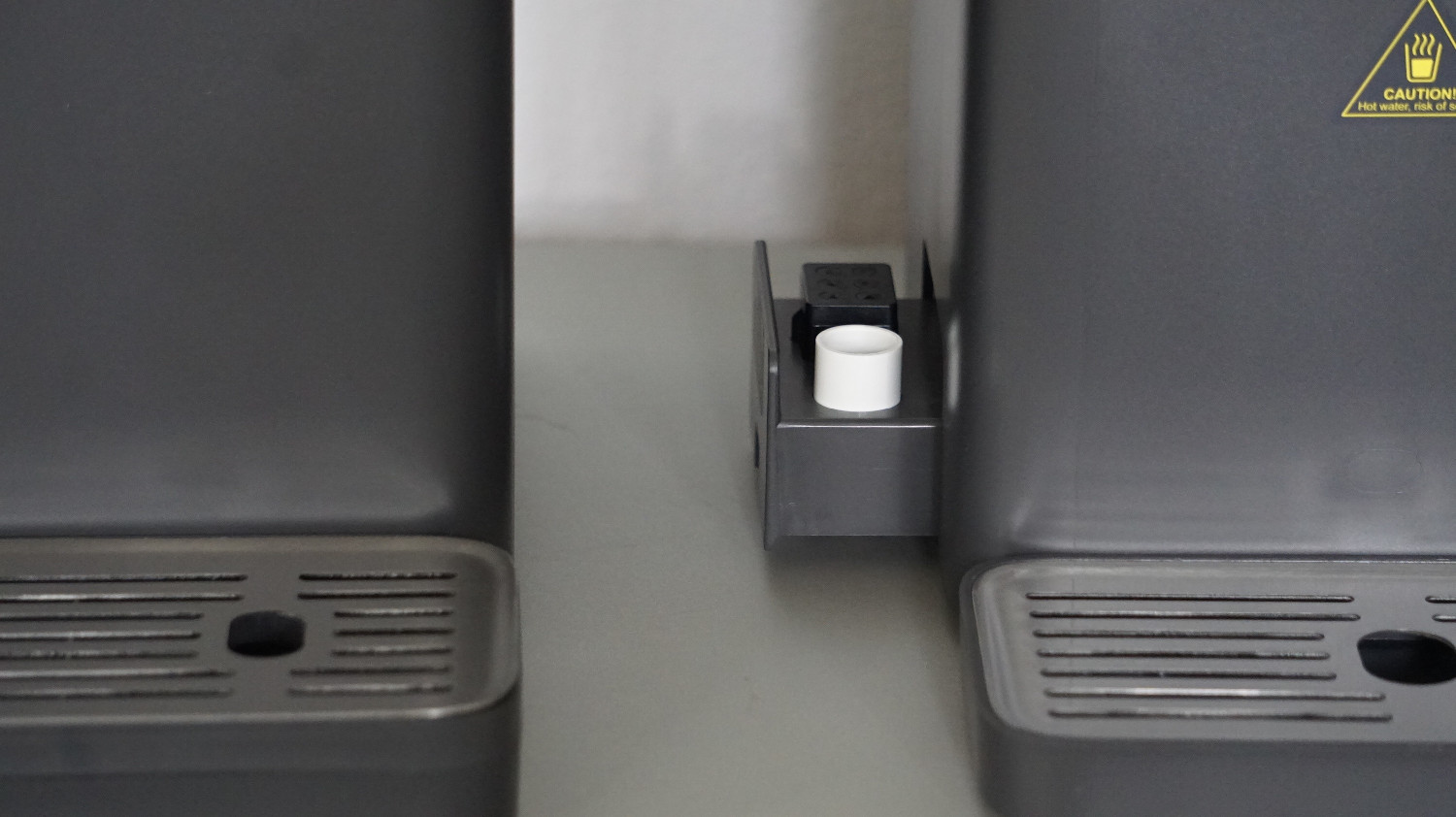
For the sparkling function, you also need a suitable CO₂ cylinder with a classic screw thread. This is not included in the scope of delivery. When choosing one, you should pay attention to compatibility: quick-connect cylinders such as SodaStream QuickConnect do not automatically fit into the screw system. Older SodaStream bottles with screw threads, on the other hand, are compatible (or third-party options like the ones you might find on the shelf at Aldi, for example).
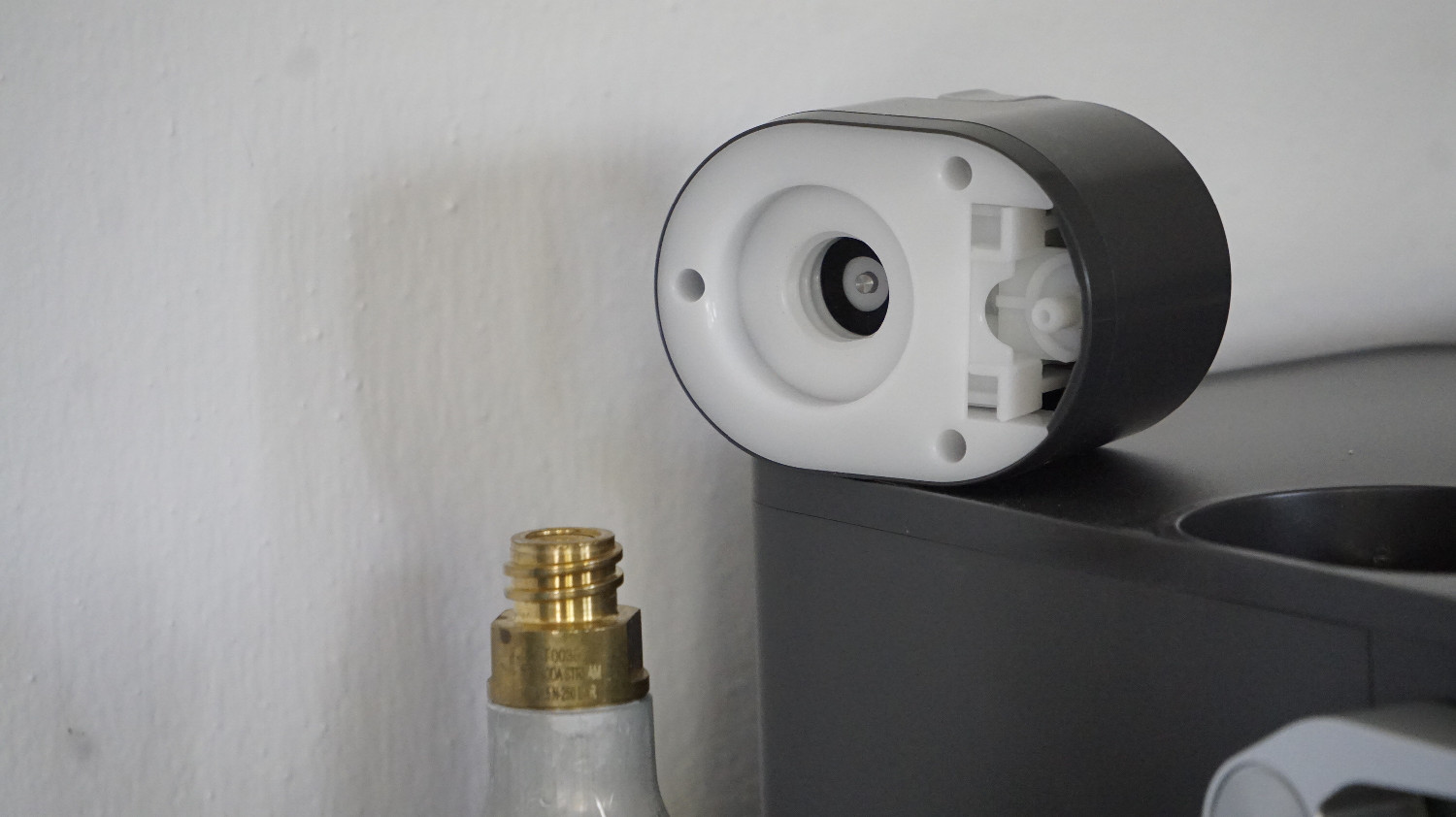
Not needing a fixed water connection was crucial for my use case. This allowed me to use the station independently of the kitchen installation in my upstairs home office. Of course, a suitable power connection and regular refilling are still necessary, but with 5 liters of capacity, it lasts a good 2–3 days.
Water filtration: What reverse osmosis changes in everyday life
According to the manufacturer, JIMMY uses a seven-stage water treatment system with three replaceable filter cartridges in the M9 Pro. A composite filter handles pre-cleaning. The RO membrane reduces numerous dissolved substances before a mineralization filter is intended to add back certain minerals and influence the taste. In addition, a UV-C treatment takes place.
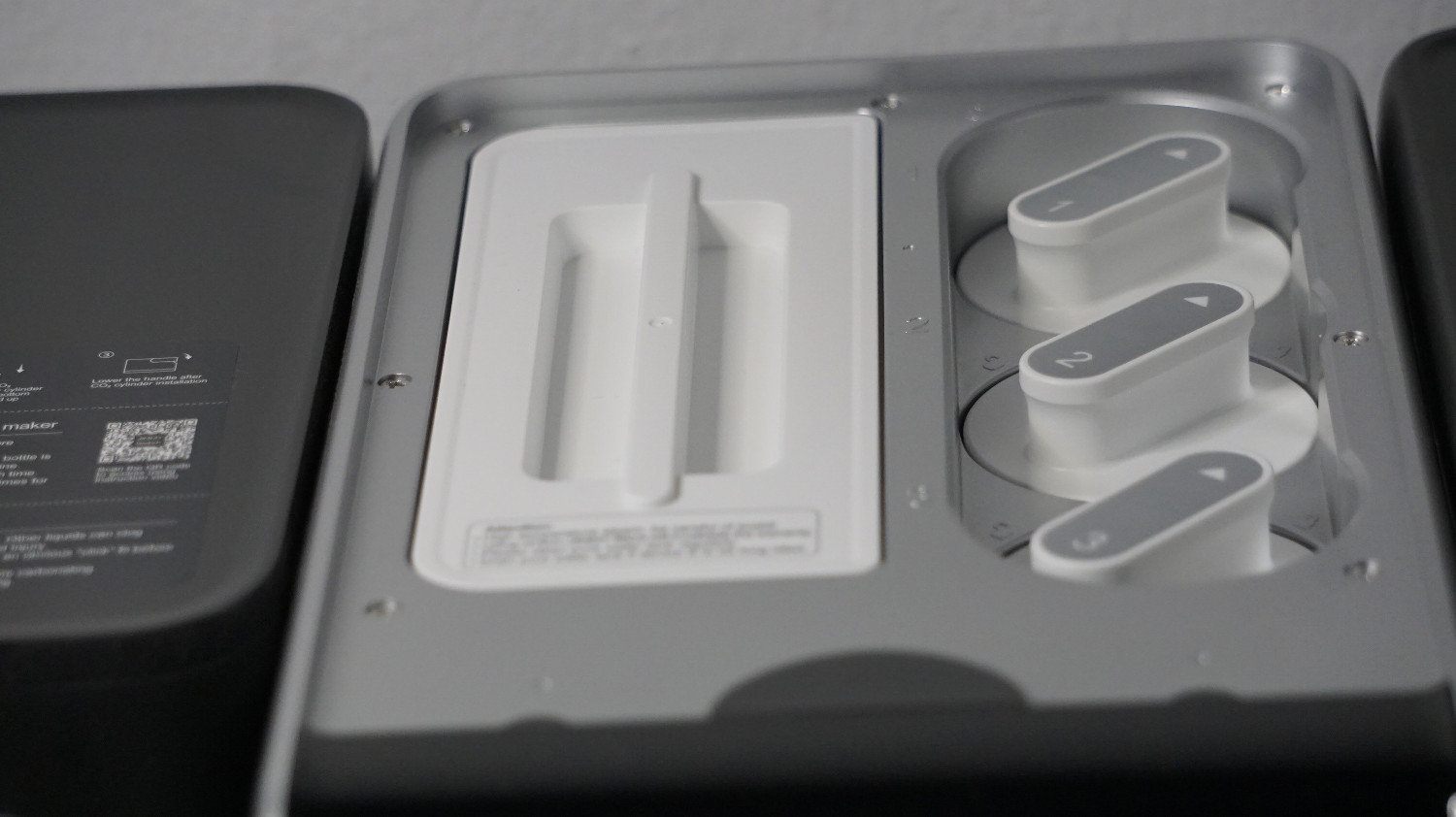
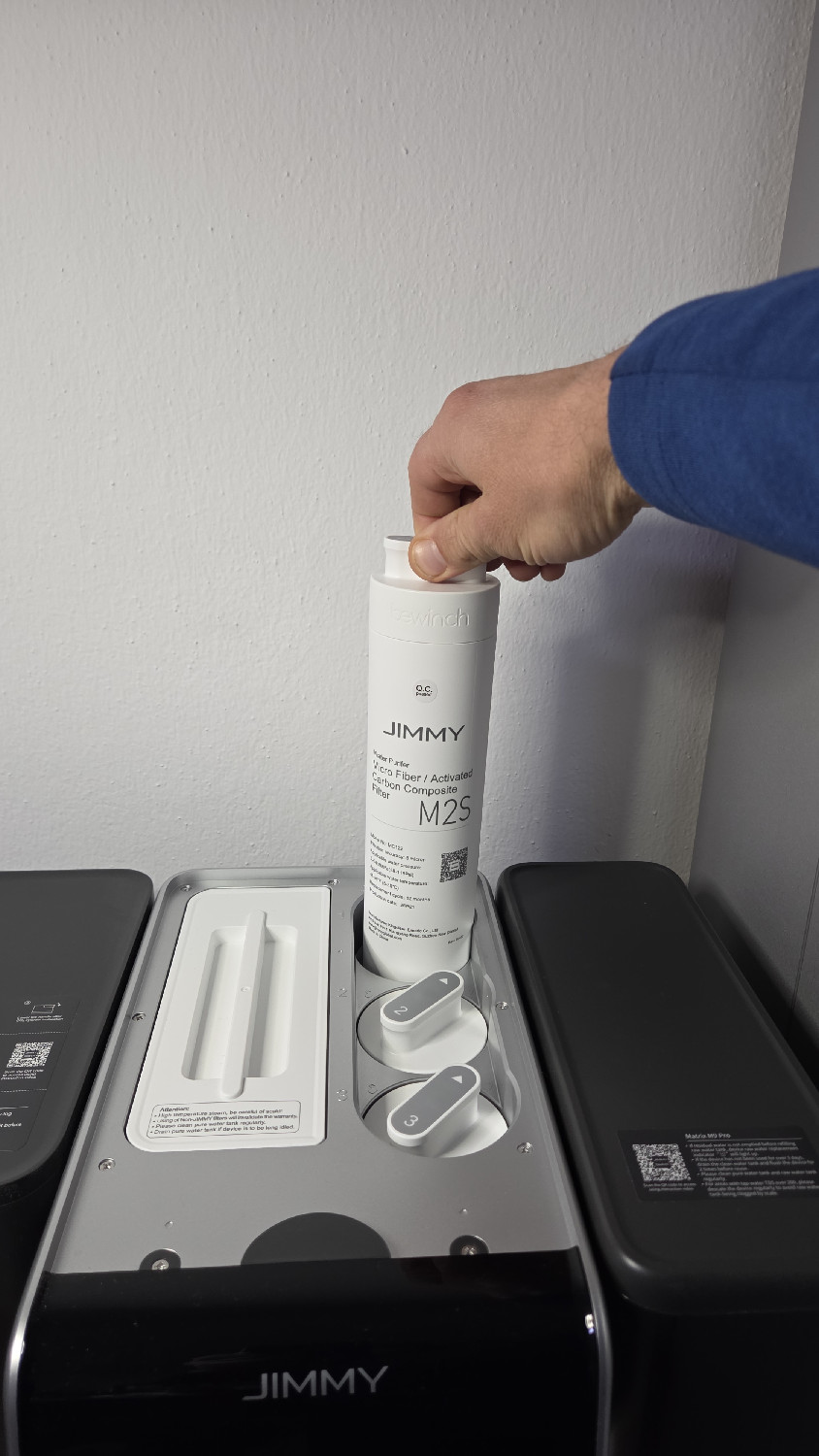
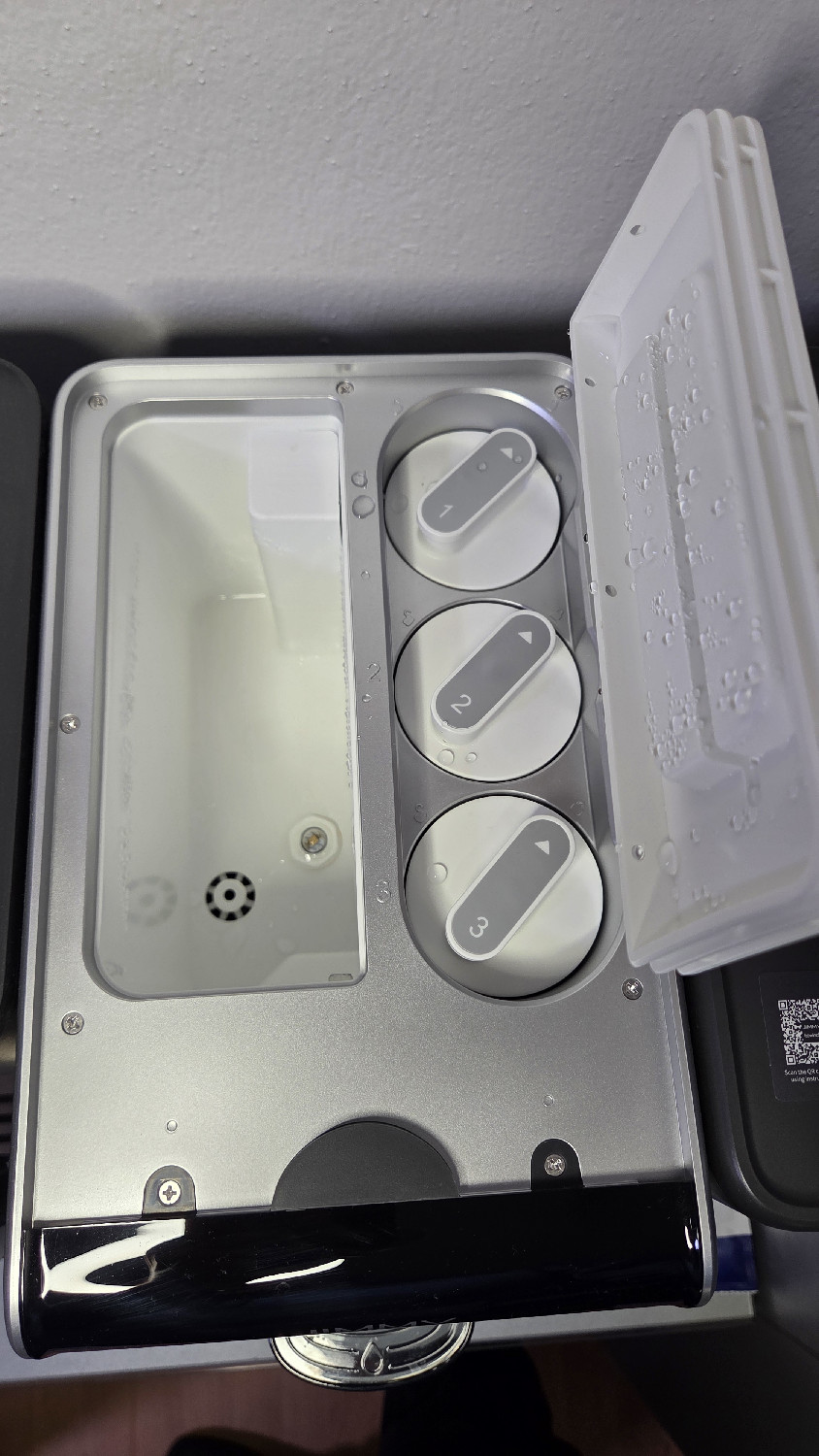
I found the TDS display for raw water and filtered water practical. In the test, the displayed value after treatment dropped significantly from an average of 400 to 4 TDS. In terms of taste, I found the filtered water somewhat softer and more neutral than the tap water used.
For tea or coffee, a changed mineral composition can also be relevant. Whether this improves the taste, however, depends on the source water and personal preferences. Neither my wife nor I could detect a significant difference. In general, our water in the Alpine foothills is very high in lime, but very pleasant in taste and odorless.
A low TDS value is not proof of the absence of harmful substances
TDS stands for Total Dissolved Solids and describes dissolved substances such as salts and minerals. The value helps to trace changes caused by reverse osmosis. However, a low TDS value neither proves the absence of contaminants nor generally indicates better water quality from a health perspective.
JIMMY advertises, among other things, the reduction of heavy metals and PFAS. A standard TDS display cannot reliably confirm the removal of individual substances like these. Appropriate laboratory testing would be required for that. Water quality in Germany is generally already very good. Filtration is therefore usually optional.
Wastewater is part of the process
With reverse osmosis, in addition to purified water, a concentrate containing retained substances is produced. JIMMY states a ratio of 3:1: for every three liters of purified water, about one liter of concentrate should result.
The concentrate remains in the raw water tank. Therefore, you should not simply top up with fresh water, but regularly empty, clean, and refill the tank according to the manufacturer's specifications. In everyday use, this was easy enough for me to manage. However, with high water demand, this routine becomes necessary more often. It should also be noted that after 72 hours of standing time (e.g. after a long weekend), the water should be completely replaced and the system flushed once.
Operation and hot water: Practical for a quick cup of tea
The front touch display can be used to select temperature and dispensing amount. It also provides information about water values and filter status. I found the operation self-explanatory, without unnecessary detours through submenus. Overall, by today's standards, very little can be adjusted on the device, which is due in part to the lack of connectivity. Water quantity and temperature, that's it. Anyone wanting individual quantities, schedules, display brightness, or standby times will come up empty-handed here. The device switches automatically into standby, with the display always on, only dimmed. That makes it unsuitable for use in bedrooms. A fully dark rest mode would be a useful addition here.
In addition to the mentioned values, the consumption status of the 3 filters is also displayed so you do not miss a replacement. Another indicator signals when purified water is available and when it should be replaced.
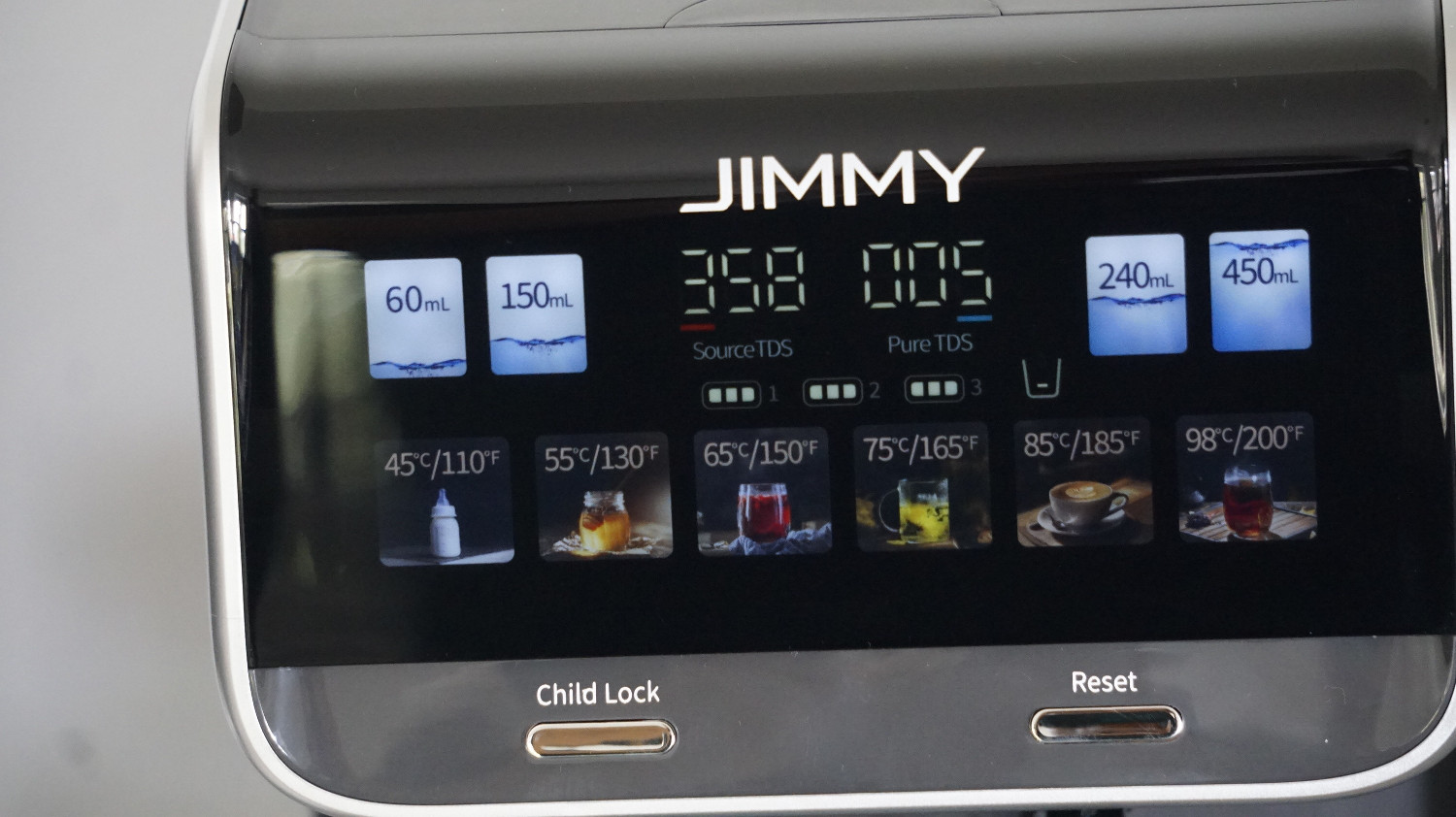
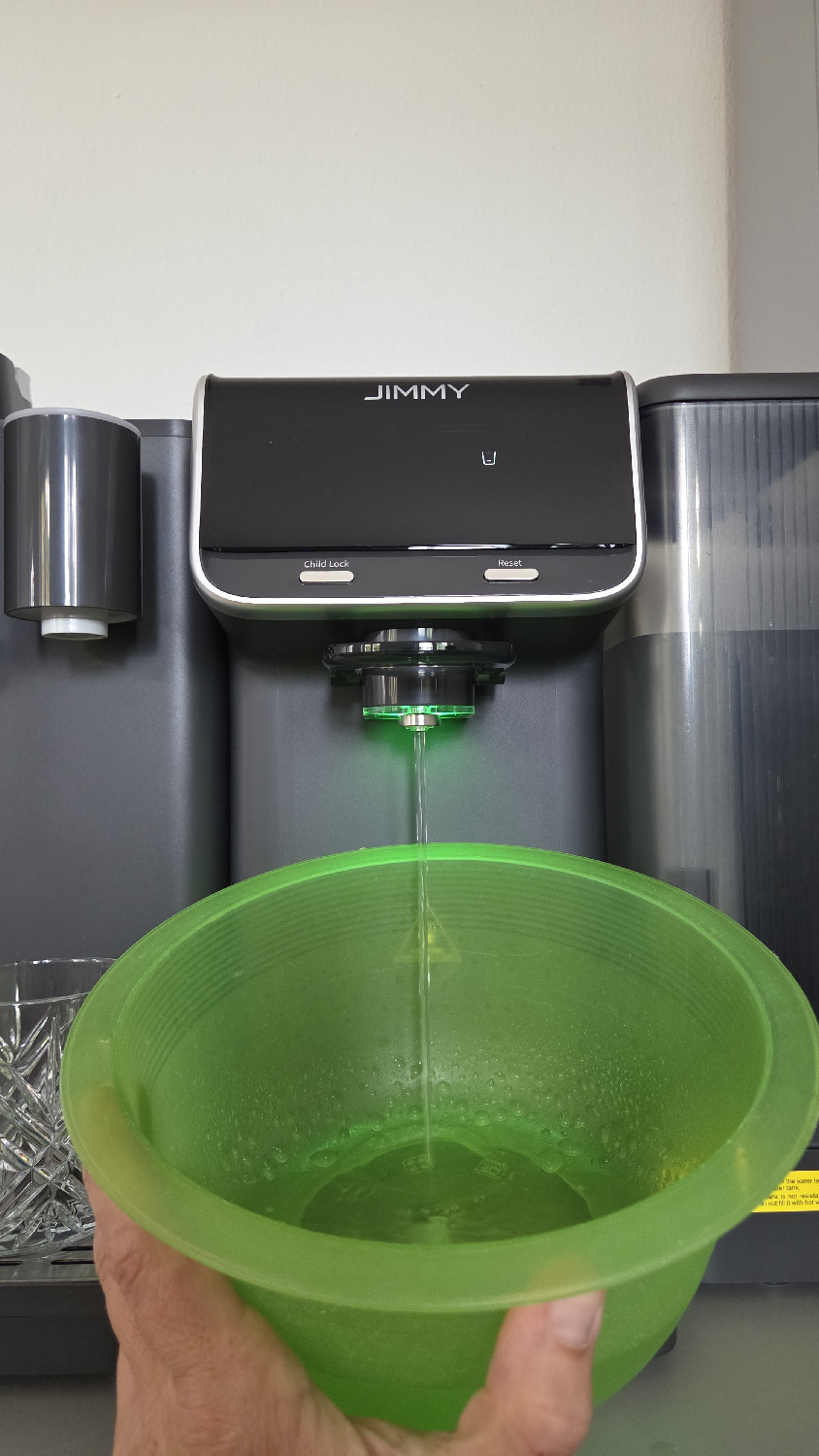
I especially liked using the hot water function while working. Also because it takes just 3 seconds to get 98 °C hot water into the cup. That is phenomenally fast. The 2,200-watt instantaneous water heater performs correspondingly well.
Temperature selection | Setting |
|---|---|
Unheated | Water at room temperature |
Lukewarm | 45 °C |
Warm | 55 or 65 °C |
Hot | 75 or 85 °C |
Very hot | 98 °C |
I did not conduct my own measurement series of the actual temperature in the cup. The stated temperatures should therefore be understood as device settings. In addition, 98 °C is not the same as vigorously boiling water. Where explicitly boiling water is required, a kettle still makes sense. For a good tea, however, it is completely sufficient.
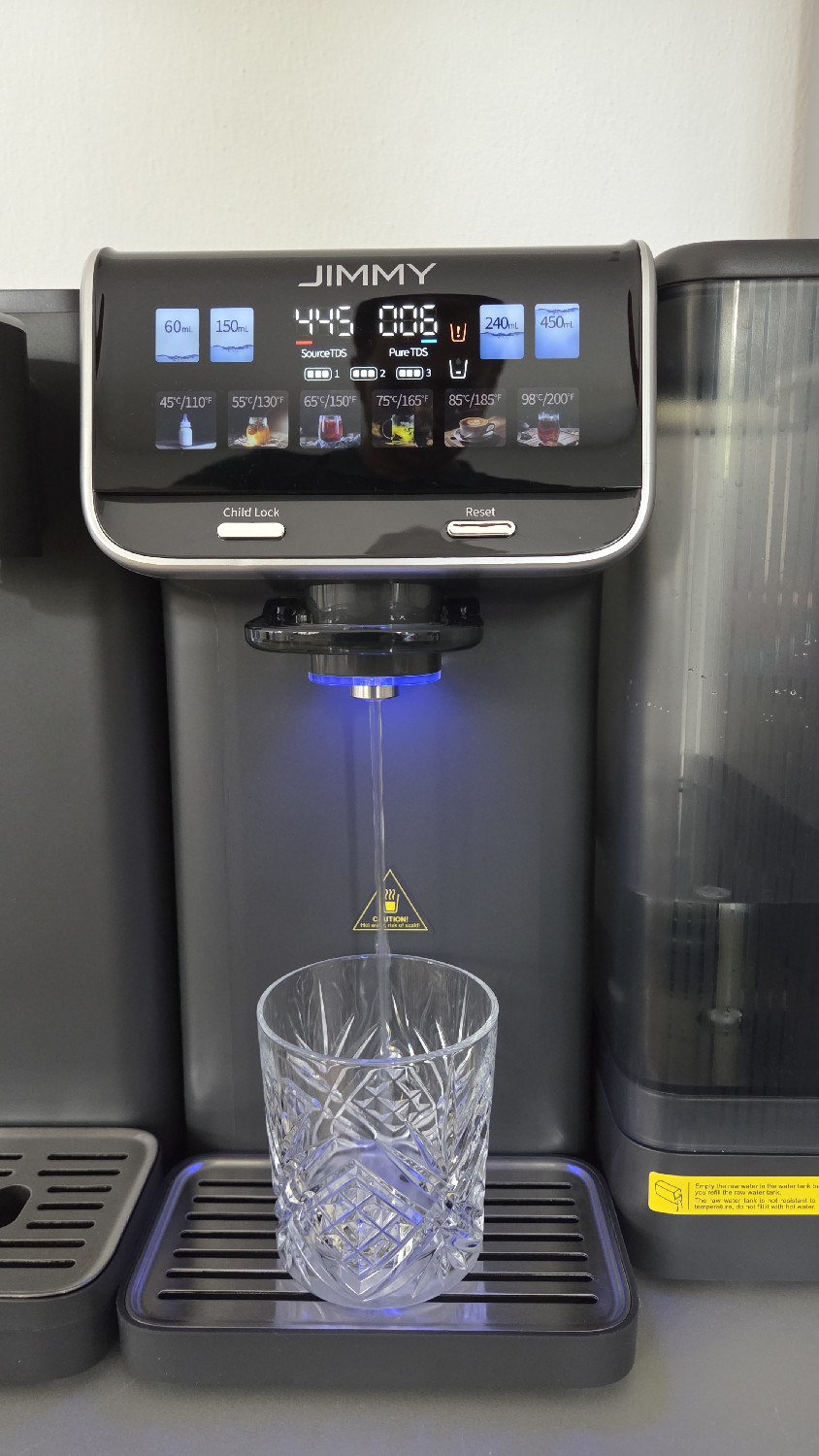
There is a lack of flexibility in quantity selection
60, 150, 240, and 450 ml are available for water dispensing. These increments suit many applications. However, an individual amount such as 180 or 300 ml cannot be saved. For containers of different sizes, I therefore had to stop dispensing manually.
For my taste, the dispensing speed could also be higher. Especially with larger containers, the waiting time was noticeable. A height-adjustable outlet would also make it easier to use cups and bottles of different heights. With about 19 cm between the base surface and the outlet, many conventional drinking bottles that you might want to fill for on-the-go use, for example, do not fit under the outlet.
S9 cooling: Pleasantly cool, but clearly audible
The S9 takes filtered water from the base station and cools it in a 750 ml cold water tank. According to JIMMY, temperatures between 10 and 15 °C are intended. This makes the water pleasantly cool, but not necessarily as cold as from a correspondingly set refrigerator.
The capacity is more suitable for individual glasses than for larger quantities. After more extensive dispensing, the incoming water has to be cooled down again. For several people who want cold water at the same time, this can become a bottleneck.
What bothered me most was the clearly noticeable cooling noise. Especially in a quiet home office, something like this stands out more than in a lively kitchen. A sound level measurement showed 43 dB at a distance of one meter; refilling the tank, which takes around 2 minutes, produces about 47 dB at a distance of one meter.
For a future generation, I would therefore primarily like quieter cooling with a larger storage capacity. Programmable operating times would also be helpful: cool during the day, pause after work. As already mentioned above, a corresponding timer function or app connectivity is missing. You have to switch off the module behind the device via a toggle switch. If the unit is placed against the wall, you may have to pull it forward to do this. That is cumbersome.
Sparkling water at the push of a button? Not quite
The S9 includes two BPA-free plastic bottles, each with a capacity of 500 ml. These are first filled with chilled water and then inserted into the designated holder for carbonation. Unfortunately, there is no water stop on the S9 module, so you have to stay with it while filling. Filling the 0.5-liter bottle took 1:04 minutes in the test.
The CO₂ is added via a mechanical lever. By pressing it multiple times, I could adjust the carbonation level to my preferences. This basically works, but it is not automatic dosing with a single button press, as we know it from electric sparkling water makers such as the one from Grohe Blue Fizz.
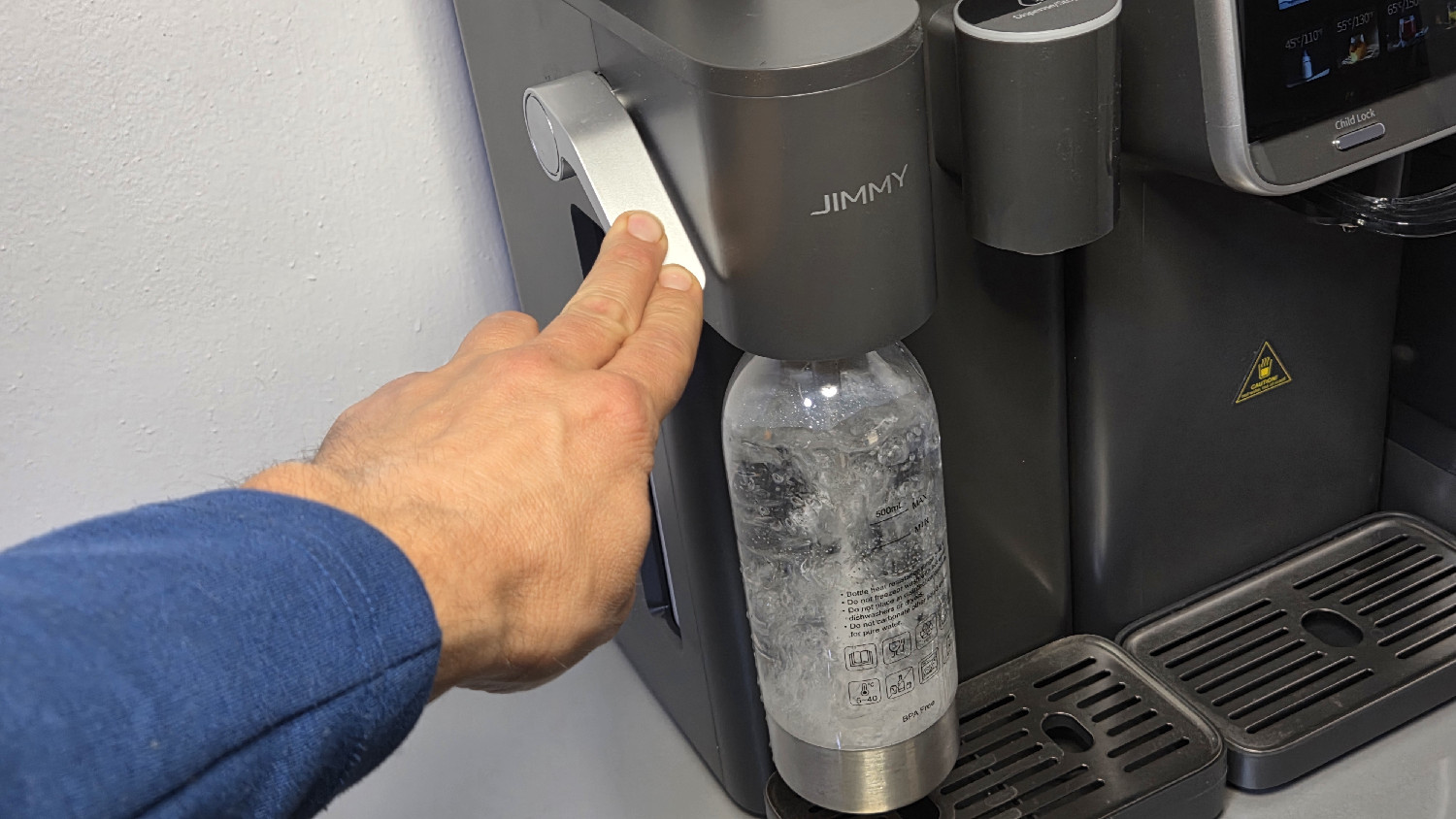
The 500 ml bottles are handy and are well suited to supplying one person at the workplace. For families or longer meals, however, they are too small for me. Larger bottles explicitly approved for the system would be a useful addition.
A defect in the carbonation lever mars the result
During my test, a distinct cracking sound was suddenly heard when operating the lever. After that, it could be moved with virtually no resistance. The carbonation function was no longer usable afterward.
The fault pattern indicated a defect in the actuation mechanism. However, no technical disassembly or conclusive root cause analysis took place. I therefore cannot say for sure which component actually failed. Only that the lever action probably exerted too much force on the connection mechanism.
A single defective test device does not allow any general statement to be made about the durability of the entire product line. For my evaluation, however, the failure is still relevant: a sparkling mechanism that is used regularly must function reliably. Even before that, I would have liked a sturdier design.
I shared my suggestions for improvement with JIMMY. The manufacturer responded openly and said the feedback would be passed on to product development. That is encouraging.
Maintenance and follow-up costs: Around 90 euros annually for filters
Anyone wanting to replace bottled water crates should consider not only the purchase price but also replacement filters, electricity, water, and CO₂. On the M9 Pro, the three filter cartridges can be replaced individually, so the entire filter system does not have to be renewed every time.
Filter | Intended replacement interval | Example price |
|---|---|---|
M2S composite filter | 12 months | €33.99 |
Q2S mineralization filter | 12 months | €33.99 |
RO-2.0S membrane | 24 months | €44.99 |
Price basis: the Zigbuy information available for the article, as of October 2026; no current live price check. Prices may vary. The manufacturer's specifications and conditions of use are decisive for actual filter replacement.
Based on these prices and replacement intervals, the calculated filter costs amount to €90.48 per year. At two liters of drinking water daily, that is around 12 cents per liter for the filters alone. Purchase costs, electricity, tap water including concentrate, and CO₂ are added on top.
A reliable conclusion about total savings compared to bottled water cannot be derived from this alone. For that, factors such as actual consumption, power consumption, and the types of water previously purchased would also need to be taken into account. For me, however, the increase in convenience of “quick, clean water in different forms” is justified in relation to the financial outlay.
Regular cleaning remains necessary
After opening the top cover, the filters are easy to access and can be replaced without tools. Just as important, however, is cleaning the raw water tank, where the concentrate remains.
The sparkling water bottles also require regular care. The included bottles are not intended for high cleaning temperatures or the dishwasher. You should follow the manufacturer's care and usage instructions here.
My advice before buying: First check which functions you really need. For filtered water and convenient hot water dispensing, the M9 Pro is sufficient. If it is only about adding carbonation to tap water, a classic sparkling water maker is the simpler solution.
Conclusion: Less hauling – with compromises on the S9
Can the JIMMY Matrix M9 Pro with S9 replace bottled water crates? In principle, yes. However, you are exchanging the hauling for refilling, cleaning, filter replacement, and the supply of CO₂.
For me personally, the added value was mainly in the home office. The independent water dispenser made reaching for a glass so uncomplicated that I consumed significantly more fluids during the test period. The base station in particular impressed me with easy setup, clear operation, and versatile hot water dispensing.
My verdict on the S9 is more reserved. Chilled sparkling water is a useful extension, but the audible cooling, the small cold water supply, and the 500 ml bottles limit convenience. The failed carbonation lever is the clearest point of criticism in my test.
At an offer price of around €600 for the combination mentioned in the available information, I would carefully weigh which functions will actually be used regularly. For me, the M9 Pro is the more convincing buying option. The S9 can usefully expand the range of functions, but in light of my test experience, I can only recommend it with reservations.
Flexible placement without a fixed water connection, including in the home office.
Water supply lasts several days for 1 person
Ready-to-hand water significantly increased my personal fluid intake.
Super-fast hot water function with several temperature settings.
Clear touch display and individually replaceable filters.
Modular AquaLink system.
Compatible standard CO₂ screw cylinders can be used.
Expansion with an ice cube machine possible
Clearly audible cooling of the S9.
Only 750 ml cold water supply and small 500 ml bottles on the S9.
No freely programmable dispensing quantities or cooling times.
Water dispensing could be faster and height-adjustable.
Carbonation lever failed on the test device.
Ongoing filter costs and regular cleaning effort.
You can buy the water filter set here:
👉 zigbuy.de
Save 10% with discount code: smj9f

